Can the latest CrowdStrike Gartner leadership nod really power the next leg of CRWD’s AI-fueled cybersecurity rally?

Does CrowdStrike Gartner news justify today’s move?
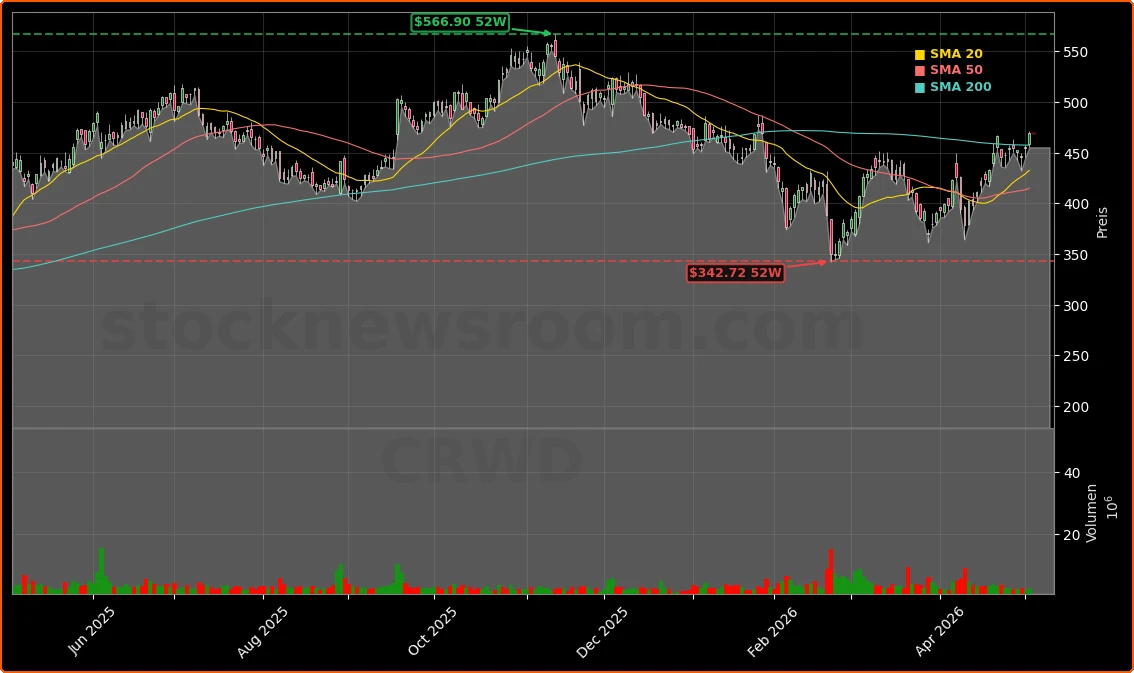
CRWD closed at $469.24 on the NASDAQ, up 2.98% from the previous close of $455.25, before easing slightly to $468.79 in after-hours trading. The move came on the same day the company announced it has been named a Leader in the 2026 Gartner Magic Quadrant for Cyberthreat Intelligence Technologies, where it is positioned furthest right on the “Completeness of Vision” axis among all evaluated vendors. For U.S. investors, this CrowdStrike Gartner recognition reinforces the company’s status as a top-tier security platform at a time when cyber risk is seen as a structural growth driver for tech spending.
The Gartner placement is strategically important because it validates CrowdStrike’s emphasis on operational, AI‑driven intelligence rather than static reporting. As adversaries increasingly weaponize AI to accelerate attack cycles, enterprises are seeking vendors that can detect, reason and respond at comparable machine speed. Being a Leader in this new Magic Quadrant gives CrowdStrike a powerful marketing and sales tool when competing for large enterprise and public-sector contracts in North America and globally.
How is CrowdStrike’s AI threat model different?
CrowdStrike Holdings, Inc. has built its Falcon platform around what it calls “adversary-driven intelligence.” The company tracks more than 280 sophisticated nation-state, eCrime and hacktivist groups, feeding frontline findings into its cloud-native security architecture. Its Threat AI system, described as an agentic threat intelligence layer, is designed to reason across vast streams of threat data, hunt adversaries proactively and trigger automated actions along the kill chain.
Instead of treating threat intelligence as a separate reporting function, Falcon brings detection and response, exposure management and intelligence into a single data fabric. The same telemetry used to flag a potential breach also informs which assets are exposed, which attack paths are most likely and what remediation sequence can close gaps fastest. For enterprises trying to implement Continuous Threat Exposure Management (CTEM), this integrated approach can reduce tool sprawl and operational friction—key selling points against rivals like NVIDIA-powered security stacks and cloud-native suites from Apple and other hyperscalers.
From a Wall Street lens, this architecture helps explain why CRWD is often compared to high‑growth cloud names rather than legacy security vendors. Investors are betting that AI agents embedded deep in security workflows will drive high attach rates across Falcon modules, supporting strong net retention and long-term margin expansion, even as competition intensifies.
Where does CrowdStrike stand versus U.S. rivals?
The CrowdStrike Gartner leadership comes as enterprises are reassessing their security posture amid a steady drumbeat of high-profile breaches. In the U.S. market, CrowdStrike competes directly with a mix of standalone cybersecurity players and platform giants. While this article’s focus is on intelligence technologies, investors inevitably compare CRWD with broader security names and even AI leaders like NVIDIA that are pushing into accelerated cybersecurity analytics.
What distinguishes CrowdStrike is its single lightweight-agent model and its scale of security telemetry—measured in trillions of events per day. That data advantage feeds Threat AI and a team of elite threat hunters, giving the company an opportunity to move faster than hardware-centric or on‑premise-centric peers. For institutional investors benchmarking against the NASDAQ and S&P 500, this advantage is part of the bull case that CrowdStrike can maintain premium growth and justify a valuation above many traditional software peers.
However, the crowded nature of AI‑security also means investors need to monitor whether customers see Falcon as mission‑critical enough to fend off bundled offerings from mega‑caps like Apple or fast‑moving challengers tied into cloud ecosystems. The CrowdStrike Gartner result suggests the company’s intelligence layer remains best‑in‑class for now, but sustaining that edge will require continued heavy investment in AI models and data infrastructure.
What should investors know about insider activity and risk?
Alongside the positive news, regulatory filings show Chief Financial Officer Burt Podbere has registered 1,933 restricted shares for potential sale via a Form 144, with an approximate sale date of May 4, 2026. Such transactions are common for executives managing compensation packages and do not necessarily signal a change in fundamentals, but they can temper sentiment when a stock is trading near historically elevated levels.
Analyst coverage of CRWD has broadly highlighted CrowdStrike’s strong competitive positioning and the importance of its intelligence capabilities, though individual ratings and price targets vary across firms such as Morgan Stanley, Goldman Sachs, Citigroup and RBC Capital Markets. With the stock already discounting substantial future growth, many on Wall Street emphasize execution risk, intensifying competition and macro-sensitive IT budgets as key variables to watch through the rest of 2026.
Related Coverage
“Threat intelligence is no longer a static reporting discipline; it has become an operational capability that must act at machine speed to stop modern adversaries.”— Adam Meyers, Head of Counter Adversary Operations at CrowdStrike
For a deeper dive into how CrowdStrike’s AI stack is evolving, investors can read CrowdStrike AI Integration: Warning Signs for Bulls, which examines the integration of Claude Opus 4.7 into the Falcon platform. That analysis explores whether the company’s AI partnerships truly extend its moat or if competitors are catching up faster than bullish projections assume.