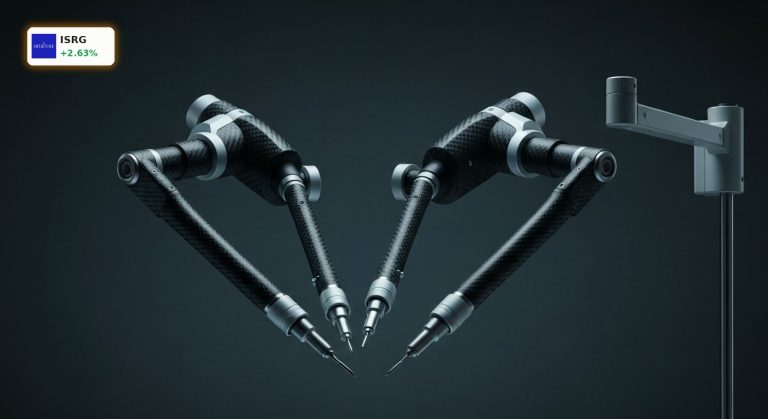

Can the rollout of the next-generation da Vinci 5 system spark a massive long-term rally for Intuitive Surgical?

Why Did the MedTech Giant Experience a Reset?
The sudden drop in the stock price was not triggered by poor current performance. In Q2 2026, Intuitive Surgical delivered its fifth consecutive quarterly beat, posting revenues of $2.89 billion—an 18.54% year-over-year increase—and non-GAAP earnings per share of $2.80, easily outperforming the consensus estimate of $2.50. Despite these strong numbers, the stock plunged over 11% immediately following the announcement. Investors were spooked when management, led by CEO Dave Rosa, adjusted full-year procedure growth guidance downward to 13.5%–15.5%. This deceleration was attributed to temporary headwinds, including shifting Affordable Care Act (ACA) premium dynamics, a decline in bariatric surgeries due to popular GLP-1 weight-loss drugs, and macroeconomic softness in China. Compounded by component tariff pressures, the stock’s forward price-to-earnings multiple compressed from a premium of 95 times earnings down to a much more reasonable 39 times earnings.
Why Does This Intuitive Surgical Analysis Point to a Rebound?
A forward-looking Intuitive Surgical Analysis reveals that the company’s underlying fundamentals remain incredibly strong, primarily driven by the rollout of its next-generation platform. In Q2 2026, the company placed 468 da Vinci surgical systems, up from 395 in the previous year. Crucially, 246 of these were the newly approved da Vinci 5 systems, representing 52% of total placements. The advanced technology of the da Vinci 5 is already showing an 11% increase in hospital utilization rates compared to older models, allowing clinics to perform more procedures efficiently. Furthermore, this Intuitive Surgical Analysis highlights the strength of the company’s “razor-and-blade” business model. With an active global install base of 11,710 systems, upfront machine sales accounted for just 23.6% of total Q2 revenue. The remaining 85% is highly profitable, recurring revenue derived from instruments, accessories, and services, driving non-GAAP gross margins to a stellar 70.0%.
How Do Wall Street Analysts Rate the Stock?
While peer companies like Medtronic and Stryker have experienced much milder declines this year, Wall Street remains overwhelmingly bullish on a recovery for Intuitive Surgical. For instance, investment bank UBS upgraded the stock to Buy, setting a price target of $500, noting that the recent selloff was unjustified given the accelerating long-term penetration of robotic procedures. Meanwhile, Bernstein maintained its Outperform rating with a price target of $685, which implies an impressive 92% upside from current levels. The consensus among major firms is that the current procedure slowdown is merely a temporary roadblock rather than a structural issue, especially as management showed immense confidence by repurchasing $379 million of its own shares at an average price of $439 during the second quarter.
Related Coverage
For more insights into how the company’s technological innovations are shaping its financial future, read our coverage on Intuitive Surgical AI: 18% Revenue Surge Sparks Unexpected Plunge, which details the immediate market reaction to the latest earnings report. Additionally, you can explore how global macroeconomic factors are impacting other major medical technology firms in our report on Philips Earnings: Stock Falls 4.3% as China Woes Offset Tariff Boost to understand the broader industry headwinds.
In conclusion, the temporary headwinds facing the medical robotics leader have created a rare valuation discount for an otherwise dominant industry giant. This Intuitive Surgical Analysis demonstrates that the combination of robust recurring revenue, the rapid adoption of the da Vinci 5, and aggressive share buybacks positions the company for a strong market recovery. For long-term investors, buying the stock at these compressed levels could yield exceptional returns as global procedure volumes normalize.