Can Johnson & Johnson IMAAVY and a $24 billion quarter finally convince investors that JNJ deserves a higher growth multiple?

What does Johnson & Johnson IMAAVY mean for rare disease investors?
Johnson & Johnson IMAAVY (nipocalimab-aahu) achieved a landmark outcome in the Phase 2/3 ENERGY trial for warm autoimmune hemolytic anemia (wAIHA), a rare condition where IgG antibodies destroy red blood cells. Patients receiving the 30 mg/kg dose were nearly three times more likely to achieve durable hemoglobin improvement versus placebo over 24 weeks — meeting a stringent primary endpoint requiring ≥2 g/dL hemoglobin increase, sustained ≥10 g/dL levels across three visits by Week 16, and no rescue therapy. Early benefits emerged by Week 1 (average +1 g/dL), with fatigue improvements and reduced steroid use observed as secondary endpoints. The FDA has granted Priority Review for the supplemental Biologics License Application — a catalyst with high near-term optionality for biotech and immunology-focused portfolios.
How is Johnson & Johnson accelerating its MedTech leadership?
The broader U.S. rollout of the TECNIS PureSee intraocular lens marks a strategic expansion in Johnson & Johnson’s Surgical Vision business. As the first and only FDA-approved extended-depth-of-focus IOL without a contrast sensitivity warning, PureSee addresses both cataract-related vision loss and age-related presbyopia in a single procedure — a critical advantage for the 20% of U.S. adults aged 40+ affected by cataracts. With over 500,000 implants globally and a 97% patient recommendation rate, PureSee strengthens Johnson & Johnson’s position against peers like Alcon (owned by Novartis) and Bausch + Lomb. Surgeons report fewer night-vision symptoms versus monofocal lenses — a key differentiator in patient satisfaction and clinical adoption. This rollout directly supports Johnson & Johnson’s MedTech segment, which grew 7.7% in Q1 2026 and now contributes nearly 40% of total revenue.
Why is Wall Street re-rating Johnson & Johnson’s growth profile?
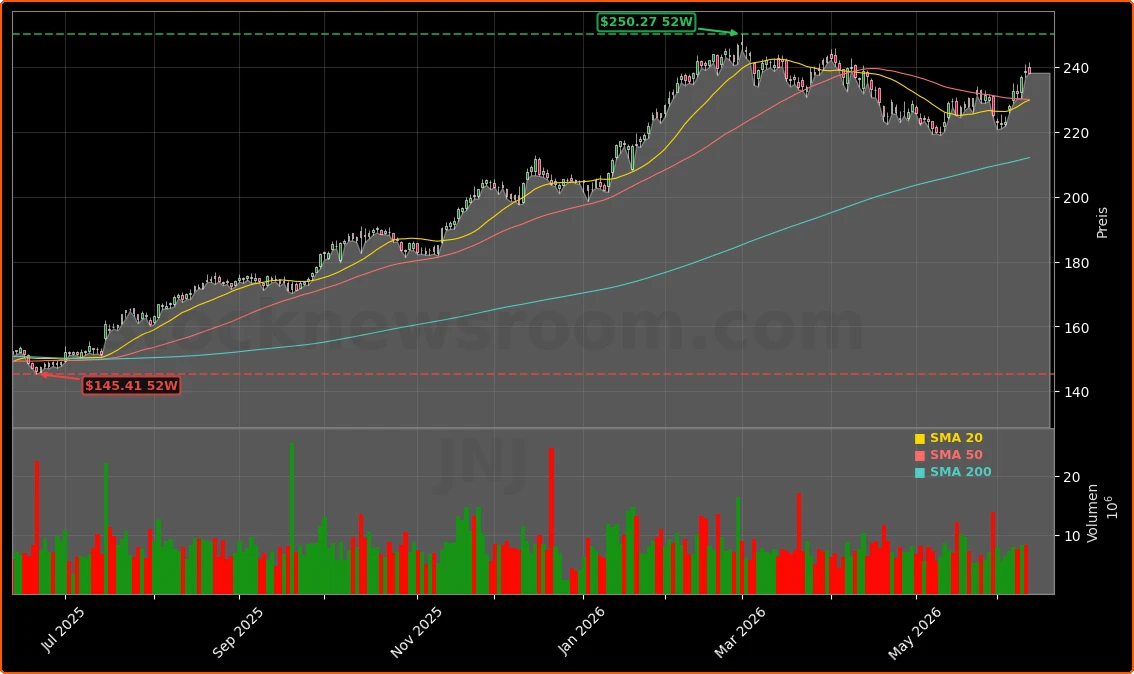
Q1 2026 results shattered legacy narratives: $24.06 billion in revenue (+9.9% YoY), $2.70 adjusted EPS (fourth straight consensus beat), and upgraded full-year guidance to $100.30–$101.30 billion in revenue and $11.45–$11.65 in adjusted EPS. Innovative Medicine surged 11.2%, powered by DARZALEX ($3.96B, +22.5%), TREMFYA ($1.61B, +68.3%), and CARVYKTI ($597M, +62.1%). Even with STELARA’s 59.7% biosimilar-driven decline, the segment grew double digits — proving portfolio resilience. Morgan Stanley recently reiterated its ‘Overweight’ rating, citing ‘unmatched immunology depth’ and ‘pipeline optionality beyond 2027.’ Meanwhile, Citigroup lifted its 12-month price target to $258, citing ‘accelerating IMAAVY adoption and PureSee’s commercial runway.’
How does Johnson & Johnson’s balance sheet support long-term compounding?
Johnson & Johnson’s AAA-rated balance sheet — one of only two in corporate America — and $19.7 billion in 2025 free cash flow provide unmatched financial flexibility. The board raised the quarterly dividend 3.1% to $1.34 per share, extending the company’s record 64-year dividend growth streak. With a 2.24% yield and a 1.59x free cash flow payout ratio, the payout is among the most durable on the S&P 500. That fortress balance sheet absorbed a $330 million Q1 2026 litigation charge without impacting guidance or capital return plans. For income investors, Johnson & Johnson remains a core holding — and for growth investors, its pipeline — anchored by Johnson & Johnson IMAAVY, next-gen oncology assets, and MedTech innovation — delivers tangible near- and long-term catalysts.
What’s next for Johnson & Johnson in Q2 2026?
With IMAAVY’s FDA decision expected by late Q3 2026 and PureSee now scaling across U.S. surgical centers, Johnson & Johnson is entering its strongest execution phase in years. The planned Orthopaedics separation remains on track for late 2026, unlocking further strategic clarity. Meanwhile, Q2 2026 will test the durability of MedTech momentum and the ramp of CARVYKTI in multiple myeloma. RBC Capital Markets recently upgraded Johnson & Johnson to ‘Outperform,’ highlighting ‘the convergence of clinical validation, commercial execution, and valuation discipline.’ As the S&P 500 grapples with macro uncertainty, Johnson & Johnson’s dual-engine model — backed by Johnson & Johnson IMAAVY, PureSee, and fortress cash flow — offers rare stability and upside.
Patients increasingly want vision solutions that align with their lifestyle needs, and the company aims to support that decision-making process.— Erin Powers, President, Surgical Vision, North America, Johnson & Johnson
Related Coverage: For deeper analysis of Johnson & Johnson’s earnings momentum and dividend strength, see Johnson & Johnson Earnings +9.9% Surge With Dividend Hike. Investors tracking AI-driven infrastructure demand should also review Caterpillar AI Strategy +4.4% as AI Power Demand Surges, which highlights how industrial players are adapting to the same technological tailwinds reshaping healthcare delivery.