Will Marvell’s S&P 500 entry unlock fresh institutional demand, or is the stock already priced for perfection?

What Does Marvell S&P 500 Inclusion Mean for Index Funds?
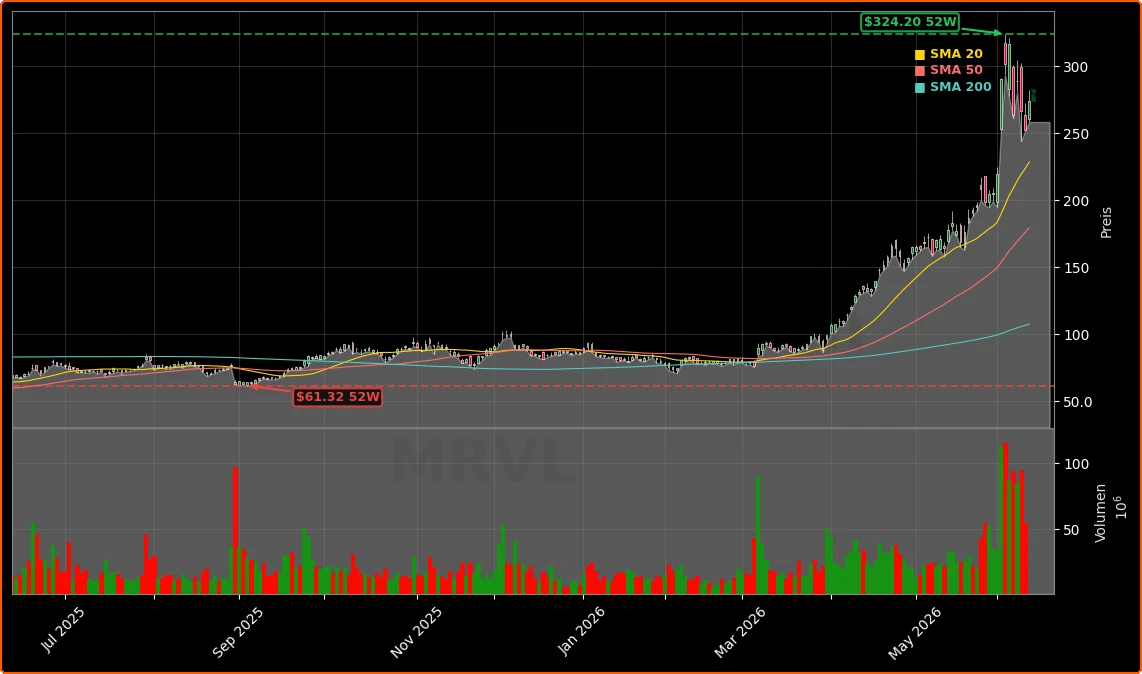
The inclusion of Marvell Technology, Inc. in the S&P 500 — effective before market open on June 22 — mandates automatic buying by all index-tracking funds, including Vanguard, BlackRock, and State Street ETFs. With a current market capitalization of approximately $230 billion, MRVL will represent a meaningful new weight in the index, estimated at 0.08–0.10% by Barchart.com. That translates to roughly $3.2–$4.1 billion in programmatic inflows over the rebalancing window. Unlike smaller-cap additions, Marvell’s liquidity and institutional ownership profile ($274.25 intraday, $282.00 after-hours) suggest minimal slippage — a rare tailwind in today’s volatile semiconductor sector. The move replaces Pool Corp. (POOL) and Campbell’s (CPB), underscoring Wall Street’s pivot toward AI infrastructure over legacy consumer staples.
How Does Marvell Compare to NVIDIA and Broadcom?
While NVIDIA dominates AI compute and Broadcom leads in custom ASICs and networking silicon, Marvell Technology, Inc. occupies a critical niche: optical interconnects and AI-optimized data path IP. Its digital signal processors (DSPs) power NVLink Fusion and are embedded in Microsoft’s Maia AI accelerators and Amazon’s Trainium chips — though recent reports suggest AIchip has gained traction on newer Trainium iterations. Financially, Marvell trades at a forward P/E of 71 — far above NVIDIA’s 31.37 and Broadcom’s 64.15 — but below peers like Advanced Micro Devices Inc (162.82) and Lattice Semiconductor Corp (1020.86). Its 27.57% revenue growth lags the sector average (50.19%), yet its optical interconnect revenue is projected to rise 70% in fiscal 2027, per company guidance.
Why Did Dan Durn Join as New CFO?
Effective June 15, Dan Durn — formerly CFO of Adobe — succeeds Willem Meintjes at Marvell Technology, Inc. Durn brings deep experience in scaling high-growth SaaS and infrastructure businesses, a skillset critical as Marvell shifts from hardware licensing toward recurring IP monetization. His appointment signals management’s intent to tighten capital allocation, improve margin discipline, and strengthen investor communications ahead of S&P 500 integration. Meintjes remains in an advisory role through April 2027, ensuring continuity during a pivotal transition. Citigroup analysts noted the hire ‘de-risks near-term execution’ and upgraded MRVL to ‘Buy’ with a $315 price target, citing ‘improved governance and AI monetization clarity’.
Is Marvell’s Valuation Justified Amid AI Hype?
At $282.00 after-hours, Marvell Technology, Inc. trades at 28.15x sales — 1.49x above the semiconductor industry average — and a 0.21% ROE, well below the sector’s 9.31%. While its debt-to-equity ratio of 0.29 is among the strongest in the group, its gross profit ($1.26 billion) and EBITDA ($660 million) remain modest versus peers like Micron and NVIDIA. RBC Capital Markets maintains a ‘Sector Perform’ rating but warns that ‘sustained 40%+ revenue growth is required to validate current multiples.’ Meanwhile, Seeking Alpha analysts argue the market still underestimates Marvell’s role in disaggregated AI clusters — where optical bandwidth, not just raw compute, defines scalability.
What’s Next After the S&P 500 Inclusion?
Dan Durn brings deep experience in scaling high-growth SaaS and infrastructure businesses, a skillset critical as Marvell shifts from hardware licensing toward recurring IP monetization.— Citigroup analyst team
With Marvell S&P 500 Inclusion locked in, attention shifts to Q2 fiscal 2027 earnings — due August 20, 2026 — where guidance for interconnect revenue growth and Maia/Trainium design-win visibility will be pivotal. The company has reaffirmed its full-year outlook, but investors will scrutinize gross margin expansion and operating leverage as it scales. A successful Q2 could cement MRVL’s status as a core AI infrastructure holding — not just a momentum play. Longer term, its ability to convert optical leadership into recurring IP royalties and secure next-gen NVLink contracts will determine whether it truly becomes the ‘next trillion-dollar company’ — or a high-flying index constituent facing valuation recalibration.