Can Marvell S&P 500 Inclusion turn a strong AI winner into an even bigger institutional favorite?

Why Is Marvell S&P 500 Inclusion a Market Catalyst?
The S&P 500 Inclusion is more than symbolic: it triggers automatic, programmatic buying by index funds tracking the benchmark — estimated to represent over $14 trillion in assets. Marvell Technology, Inc. replaces PoolCorp (POOL) in the index, a move that signals Wall Street’s recognition of its transformation from a legacy storage chipmaker into a core AI infrastructure enabler. With a market capitalization now nearing $230 billion and GAAP profitability achieved, Marvell meets the S&P’s stringent liquidity, profitability, and float requirements. Deutsche Bank, Barclays, and Jefferies have all raised price targets following Marvell’s Q1 FY27 earnings beat — citing accelerating data center revenue and AI-related design wins. This Marvell S&P 500 Inclusion is expected to lift institutional ownership and tighten bid-ask spreads, supporting sustained volume growth.
How Is AI Infrastructure Driving Marvell’s Upside?
Jensen Huang’s recent remarks — calling AI the ‘next global infrastructure, just like the internet’ — directly benefit Marvell Technology, Inc. Its custom XPUs, optical interconnects, and high-speed networking silicon are embedded in AI clusters powering Meta, Microsoft, and Oracle data centers. Unlike broad-based chip plays, Marvell focuses on data movement — the critical bottleneck in large-language model training. That specialization has driven 42% year-over-year revenue growth in its infrastructure business, outpacing peers like Intel and AMD in high-margin custom silicon. While NVIDIA dominates AI compute, Marvell’s role in AI networking and memory acceleration positions it as a structural beneficiary — not a cyclical play. Analysts at Seeking Alpha argue investors still underestimate Marvell’s AI opportunity, particularly as optical I/O adoption accelerates beyond 2026.
What Does Technical Momentum Say About MRVL?
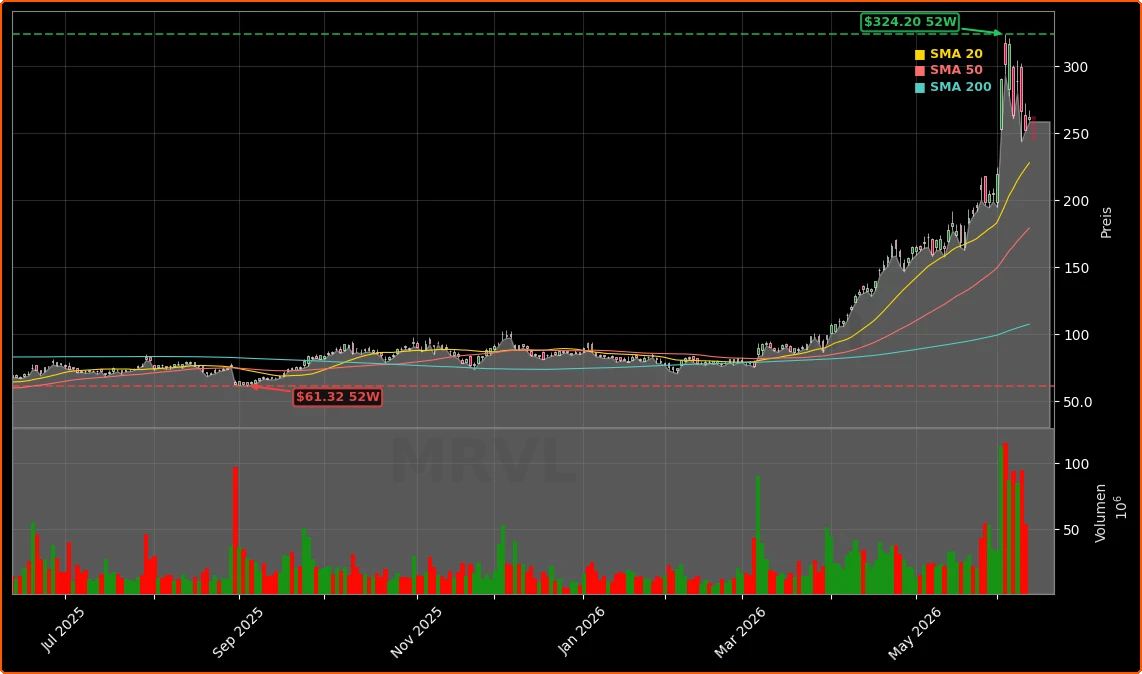
Technically, Marvell Technology, Inc. remains in a powerful uptrend: trading well above its 20-day ($223.67), 50-day, and 200-day ($106.46) moving averages — preserving a golden cross first established in October 2025. The MACD remains above its signal line, and volume has surged on up-days, validating institutional accumulation. While the stock pulled back slightly after hitting $265.95 intraday, support holds near $224.40 — the prior all-time high gap-fill level. Resistance looms at $324.20, the June 52-week high. Importantly, Marvell’s volatility — while elevated — is now anchored by fundamentals, not speculation. Traders monitoring sideways action ahead of a directional move should note that MRVL has consistently outperformed the iShares PHLX SOX Semiconductor Sector Index Fund, which rose nearly 3% in premarket trading Thursday.
How Does Marvell Compare to AI Chip Peers?
Marvell Technology, Inc. trades at a premium to peers — but with justification. Its gross margin of 68.3% in Q1 FY27 surpasses both Micron (52.1%) and Intel (49.7%), reflecting its shift toward higher-value custom silicon. Unlike Navitas Semiconductor (NVTS), which trades at over 30x forward sales despite operating losses, Marvell reported GAAP net income and projects fiscal 2028 revenue to exceed $12 billion. RBC Capital Markets recently upgraded Marvell to ‘Outperform’, citing its ‘unique positioning at the intersection of AI, networking, and optical interconnects’. Meanwhile, Citigroup raised its price target to $295, emphasizing Marvell’s growing share in AI data center interconnects — a $7.2 billion TAM expected to double by 2028.
What’s Next for Marvell Technology, Inc.?
With the S&P 500 Inclusion effective June 22, the next catalyst is Marvell’s Q2 FY27 earnings preview — due in mid-July — where management is expected to reaffirm its AI infrastructure revenue guidance. The company’s ability to scale optical interconnect production and expand design wins with cloud hyperscalers will be key. Institutional inflows from index funds are likely to accelerate in the final week before rebalancing, potentially compressing volatility. For U.S. investors, Marvell S&P 500 Inclusion represents a rare convergence: index-driven liquidity plus structural AI tailwinds — a combination few semiconductor names currently offer.
AI will become global infrastructure just like the internet was infrastructure for the world.— Jensen Huang, CEO of NVIDIA
Related coverage: Marvell S&P 500 Inclusion: -2.7% Warning as Funds Rebalance explores the short-term rebalancing risk and how passive fund flows could create temporary overbought conditions. Meanwhile, Intel Upgrade +5.9% as BofA Turns Bullish on AI Push highlights how Marvell’s momentum is part of a broader AI infrastructure re-rating — with Intel’s recent upgrade underscoring Wall Street’s growing confidence in the entire data center silicon stack.