Can Micron’s massive New York fab push turn today’s construction news into a longer-term AI memory advantage?

Why did Micron New York Fab just become urgent?
The answer lies in timing, scale, and scarcity. Micron Technology, Inc. announced today that Bechtel — the global engineering and construction leader behind dozens of megaprojects — has been selected as the engineering, procurement, and construction (EPC) partner for Phase 1 of its Clay, NY memory manufacturing complex. This Micron New York Fab is projected to become the largest semiconductor facility in the United States, generating 50,000 jobs and $16.7 billion in annual economic output for New York State. Crucially, it’s not a theoretical milestone: construction mobilization begins immediately at White Pine Commerce Park. For U.S. investors, this isn’t just about jobs — it’s about derisking supply chain exposure in a sector where 70% of global DRAM and NAND capacity remains concentrated in Asia. While Apple and Tesla rely on foundry partners, Micron is the only U.S.-based memory manufacturer building its own leading-edge fabs — and the Micron New York Fab is its flagship.
How does Micron compare to NVIDIA and SanDisk in 2026?
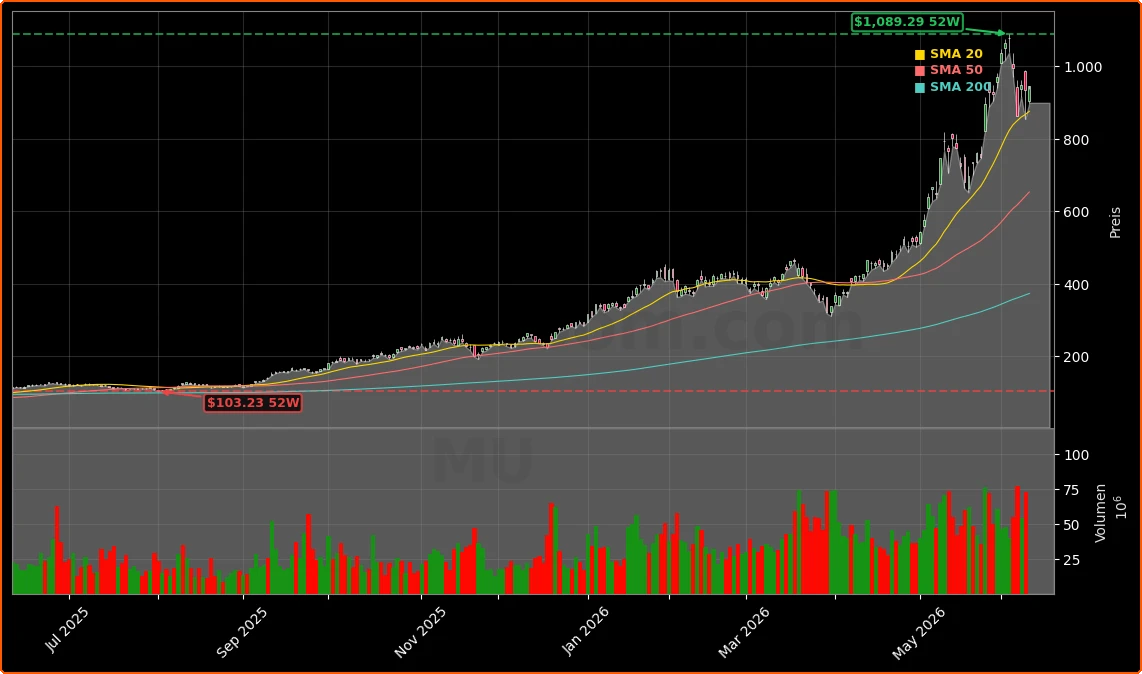
Micron Technology, Inc. is up 228% year-to-date — outpacing NVIDIA’s 12% gain and dwarfing the S&P 500’s 8% rise. SanDisk (SNDK) has surged nearly 600%, but Micron’s dual exposure to both DRAM and high-bandwidth memory (HBM) gives it broader AI infrastructure leverage. Unlike NVIDIA, whose AI chip growth faces increasing scrutiny over monetization and competition, Micron’s earnings power is rooted in structural supply constraints: management confirmed it meets only 50–67% of DRAM demand from key customers. That imbalance has pushed gross margins to 81% in Q3 guidance — up from 74% in Q2 — and driven consensus EPS estimates to $19.43, versus $1.71 a year earlier. Analysts at UBS and Susquehanna have issued $1,625 price targets, while Goldman Sachs recently raised its forecast to $900 — maintaining a Neutral rating — and Wells Fargo lifted its target to $1,220.
Is the chip sector rotation over — or just getting started?
The Philadelphia Semiconductor Index plunged 10% from its recent peak, reflecting broad-based profit-taking after a 700%+ 12-month rally in Micron Technology, Inc. shares. But this isn’t a sector-wide collapse — it’s a recalibration. The Nasdaq Composite remains up 10% YTD, and the S&P 500 is up 8%. What’s shifting is capital allocation: investors are rotating *within* semiconductors — away from over-owned AI logic names and toward memory suppliers with locked-in order books and visible capacity expansion. Micron’s HBM commitments are secured through 2027, and its Micron New York Fab adds a decade-long visibility layer no peer can match. As ClearBridge analyst Dalya Hahnn noted, ‘tight high-bandwidth memory and DRAM supply likely to underpin stronger pricing and earnings through 2027.’ That’s not cyclical — it’s infrastructural.
What’s the Wall Street consensus ahead of June 24?
Our New York project will be home to the most advanced memory manufacturing in the world and will serve as a cornerstone of America’s leadership in the AI era.— Manish Bhatia, Executive Vice President of Global Operations, Micron Technology
Of the 44 analysts covering Micron Technology, Inc., 39 rate it Buy or Strong Buy, with an average price target of $913 — just 3.3% below its current $945.55 intraday quote. TD Cowen recently upgraded to $660 (Buy), DA Davidson initiated at $1,000 (Buy), and Cantor Fitzgerald lifted its target to $1,500. The valuation case remains compelling: Micron trades at just 9.8x forward P/E versus 26x for the Nasdaq Composite. Its five-year PEG ratio of 0.37 signals deep undervaluation relative to earnings growth. With Q3 revenue projected at $33.5 billion and gross margins at 81%, this isn’t just a memory play — it’s a proxy for AI infrastructure buildout velocity. And the Micron New York Fab is the physical manifestation of that velocity.