
Can Micron’s AI memory dominance justify Wall Street’s huge new targets, or is this forecast already pricing in perfection?

Why Are Analysts Raising Targets So Aggressively?
Wells Fargo analyst Aaron Rakers lifted Micron Technology, Inc.’s price target to $1,220 from $550 — a 122% increase — and reaffirmed an ‘Overweight’ rating, citing ‘persistent memory tightness and flawless execution on HBM4 ramp.’ Cantor Fitzgerald’s CJ Muse followed with an even steeper move: $1,500 from $700, calling the new AI-driven memory paradigm ‘non-cyclical and structurally under-supplied.’ Raymond James analyst Melissa Fairbanks added that ‘the market has never seen demand this concentrated, this urgent, or this pre-committed.’ These aren’t isolated upgrades — they reflect a consensus shift across Wall Street, anchored in hard data: Micron’s fiscal Q3 revenue guidance of $33.5 billion implies 260% YoY growth, while earnings per share are projected to surge 1,025% to $18.90. That momentum is fueled by NVIDIA’s Vera Rubin GPU systems — shipping H2 2026 — which will exclusively use Micron’s HBM4 chips.
How Does Micron Compare to Other AI Enablers?
While NVIDIA has dominated headlines, Micron Technology, Inc. is now the critical bottleneck — and the highest-margin link — in the AI hardware stack. Unlike logic chips, memory can’t be easily substituted: HBM4’s 60% capacity and 20% energy efficiency gains over HBM3E give Micron decisive leverage. That’s why Micron’s Cloud Memory unit posted a 66% gross margin — rivaling Apple’s hardware margins and exceeding Broadcom’s 68% EBITDA margin. In contrast, Intel and Advanced Micro Devices (AMD) remain in ramp-up phases for AI accelerators, and Marvell Technology tumbled 17% last week amid execution concerns. Meanwhile, Micron’s $100 billion HBM market forecast for 2028 — up from $35 billion in 2025 — puts it on a steeper growth curve than even the most bullish Tesla energy storage projections.
What’s the Real Risk to the Micron Forecast?
Despite the bullish consensus, two structural headwinds loom. First, rising U.S. Treasury yields — with the 2-year yield now approaching 5% — threaten valuations for high-multiple growth stocks. Technical analyst John Roque of 22V Research warns this could pressure the entire semiconductor sector, especially momentum names like Micron. Second, hyperscaler pushback on AI costs is intensifying: Uber’s COO recently stated its 2026 AI budget was exhausted in four months, while Alphabet CEO Sundar Pichai acknowledged enterprise complaints over rising usage costs. If two or more top-tier hyperscalers — Meta, Microsoft, Amazon — slow capex growth sequentially, Micron’s Micron Forecast could face downward revision. Still, with order books locked through 2027 and no near-term supply relief, the risk remains asymmetrically skewed to the upside.
How Are Investors Positioning Ahead of Earnings?
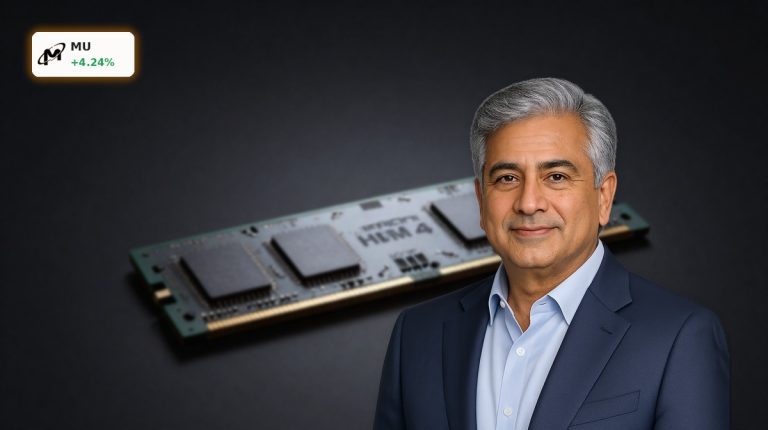
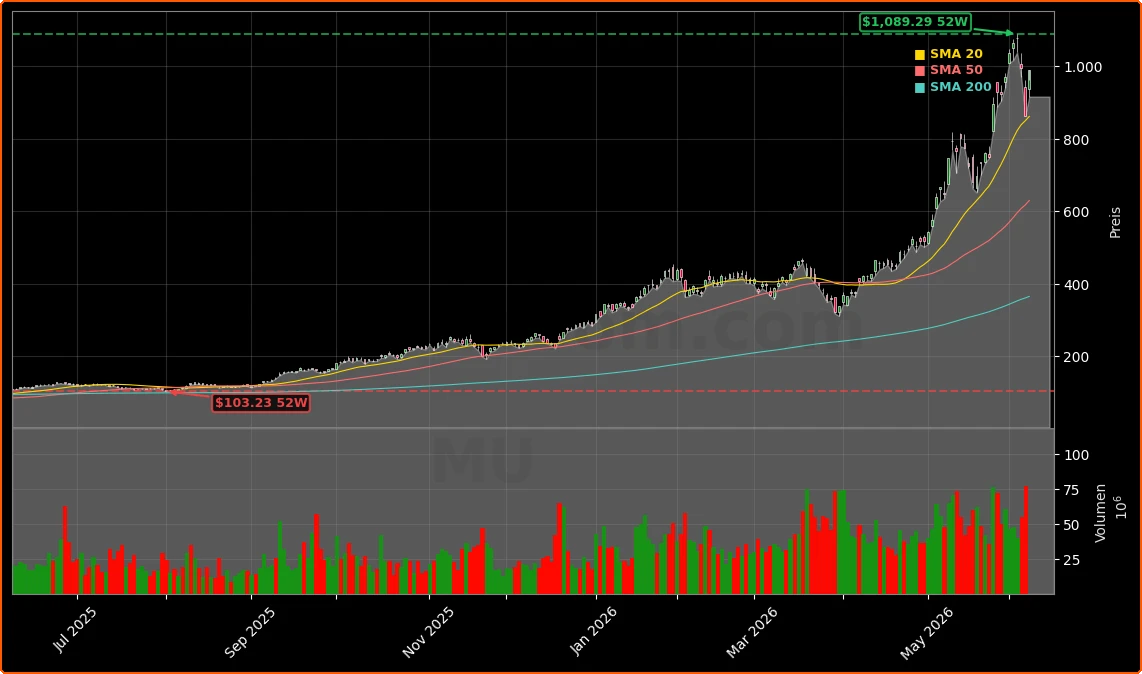
Micron Technology, Inc. was among the top three buys by Schwab clients in May — a signal of retail conviction — and now anchors 4.1% of the AI-focused ARTY ETF, alongside NVIDIA, AMD, and Oracle. Its 4.47% weighting in QQQM makes it the fourth-largest holding behind NVIDIA, Apple, and Microsoft — a clear institutional vote of confidence. Pre-market action today confirms momentum is returning: MU is up 4.24% to $989.53, rebounding from last week’s 13% selloff and Friday’s broader semiconductor weakness. That resilience — even as SK Hynix deepens its ties with NVIDIA — underscores how tightly the market views Micron’s HBM4 certification and production control. With earnings due June 24, the Micron Forecast isn’t just about Q3 results — it’s the litmus test for AI infrastructure durability.
What Does This Mean for the S&P 500 and NASDAQ?
The market has never seen demand this concentrated, this urgent, or this pre-committed.— Melissa Fairbanks, Raymond James
Micron Technology, Inc. is now a core driver of tech sector momentum — and a key divergence signal within the NASDAQ Composite. While NVIDIA has underperformed the SOXX semiconductor index this year, Micron, Intel, and AMD have surged 240%, 211%, and 141% YTD, respectively. That dispersion is set to trigger a mechanical rebalance in SOXX, trimming the winners and reloading NVIDIA — but for now, Micron’s strength is lifting the entire chip group. Its 10x forward P/E ratio (versus the NASDAQ-100’s 35.2 P/E) makes it a relative value play in a high-valuation market. For S&P 500 investors, Micron’s performance is increasingly a proxy for AI capex health — and with 21.3% of the S&P 500’s weight in tech, that linkage matters more than ever.