
Will MercadoLibre’s aggressive expansion in Mexico and a massive technical double-bottom trigger the next major rally for Latin America’s e-commerce giant?

Why is the MercadoLibre Analysis turning bullish?
The sentiment surrounding MercadoLibre (MELI) has shifted dramatically in recent weeks. After experiencing a steep correction that saw the stock drop as much as 36% from its previous peaks, a strong technical bottom has formed. The equity has staged a impressive recovery, narrowing its year-to-date losses to just 22%. Technical analysts point to a classic double-bottom formation, characterized by a brief false breakout to the downside that quickly reversed, trapping short sellers and triggering a rapid short-squeeze rally.
This technical turnaround is backed by solid fundamental developments. Wall Street analysts have begun revising their price targets upward, with several prominent investment firms setting a new target of over $1,900 per share. Currently trading at $1,860.00, representing a modest gain of 0.42% from its previous close of $1,852.22, the stock is rapidly approaching this key psychological threshold. For growth-oriented investors, this MercadoLibre Analysis suggests that the stock is transitioning from a speculative recovery play into a sustained medium-term uptrend.
How is MercadoLibre expanding in Mexico?
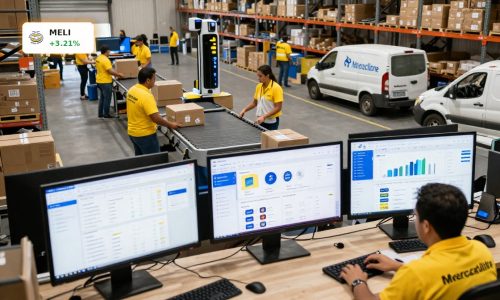
A key driver behind the optimistic MercadoLibre Analysis is the company’s aggressive infrastructure expansion in North America, specifically in Mexico. By investing heavily in new distribution and fulfillment centers across key Mexican states, the company is significantly reducing delivery times and strengthening its competitive moat against global giants like Amazon. Mexico has emerged as one of the fastest-growing e-commerce markets in Latin America, and MercadoLibre’s localized logistics network allows it to capture a dominant share of this volume.
Furthermore, this expansion is not just about physical goods. The integration of its fintech arm, Mercado Pago, within these new hubs is driving financial inclusion in a heavily unbanked region. This dual-engine growth model—combining retail logistics with digital banking—is a primary reason why prominent hedge fund managers, including Michael Burry, have reportedly gone long on the stock. Burry’s interest underscores the deep value that institutional investors see in the company’s underlying cash flows and regional dominance.
Is MercadoLibre the ultimate emerging market pick?
For international investors looking to diversify away from domestic US equities, emerging markets present highly attractive valuations. According to prominent financial experts like Lukas Fröhlich, who specializes in medium-term investments in emerging market equities, MercadoLibre represents a premier vehicle for Latin American growth. The stock’s successful bottoming process indicates that the worst of the regional inflation and currency volatility may already be priced in.
While some investors continue to hold leveraged products, such as the MB8UP8 certificate with a 3.34 leverage factor—which is currently sitting at a 22% loss due to the timing of the initial entry—the underlying equity’s upward trajectory suggests these positions could soon return to profitability. The consensus among institutional researchers is that the company’s operational efficiency will continue to outpace regional economic challenges.
Related Coverage
To fully understand the competitive landscape, read our detailed analysis on the MercadoLibre Forecast +2.6% Surge as Margin Risks Build, which explores how the company is balancing credit losses against Brazil’s fierce price wars. Additionally, for insights into broader global market momentum and how institutional upgrades impact growth stocks, check out the NIO Analyst Upgrade: Goldman Sachs Sparks +3% EV Stock Rally.
Ultimately, this MercadoLibre Analysis demonstrates that the company’s robust logistics network, combined with its rapidly growing fintech ecosystem, makes it a highly resilient player in the global e-commerce sector. As the company continues to optimize its supply chain and expand its financial services, it remains well-positioned to deliver substantial long-term value to shareholders. Wall Street’s growing confidence and rising price targets indicate that the current recovery phase may just be the beginning of a much larger upward move.