Did Netflix kill its biggest merger idea only to make a far bolder bet on its own stock?

Why did Netflix abandon the Netflix Merger?
Netflix walked away from its proposed acquisition of Warner Bros. Discovery in early April 2026 — a move analysts at Morgan Stanley described as “prudent capital discipline in an overvalued media M&A environment.” The deal, initially seen as a bid to accelerate content scale and global distribution, faced mounting regulatory scrutiny and internal concerns about debt integration. With Netflix’s balance sheet carrying just $4.2 billion in long-term debt and $7.8 billion in cash, the board opted to double down on organic leverage rather than strategic acquisition. Jim Cramer confirmed on CNBC’s “Mad Money” that the decision reflected disciplined optionality — not strategic retreat.
How does the $25 billion buyback affect Netflix stock?
Netflix’s expanded $25 billion repurchase authorization is now the largest active program among S&P 500 media stocks — surpassing Disney’s $18 billion and Paramount’s $4 billion. At current prices near $81, the program could retire roughly 308 million shares — or 12% of its current float — over the next 24 months. Unlike dividends, which carry tax immediacy and signaling risk if cut, buybacks offer flexibility: Netflix can pause, accelerate, or redirect funds without market penalty. RBC Capital Markets upgraded Netflix to “Outperform” this week, citing “the most credible capital return story in streaming” and raising its 12-month price target to $92.
What does this mean for S&P 500 investors?
Netflix’s move mirrors a broader S&P 500 trend: companies spent $942.5 billion on buybacks in 2024 — a record — and 2026 is on pace to exceed $1 trillion. For index investors, this matters directly: fewer shares outstanding lift EPS and index weightings without earnings growth. Netflix’s EPS rose 14% year-over-year in Q1 2026 despite flat revenue — a direct result of a 5.3% decline in weighted-average shares outstanding. That EPS boost flows into every major index fund, from Vanguard’s VOO to Fidelity’s FZROX. Citigroup analysts noted that Netflix’s buyback velocity now outpaces Apple’s on a percentage-of-market-cap basis — a rare distinction among mega-caps.
Is Netflix’s buyback sustainable — and what are the risks?
I want to buy Netflix. The biggest headwind is that they went and got involved with trying to buy the Warner Brothers Studio, and everyone thinks, oh, they don’t know what they’re doing. I think they took the optionality that they had.— Jim Cramer, CNBC “Mad Money”
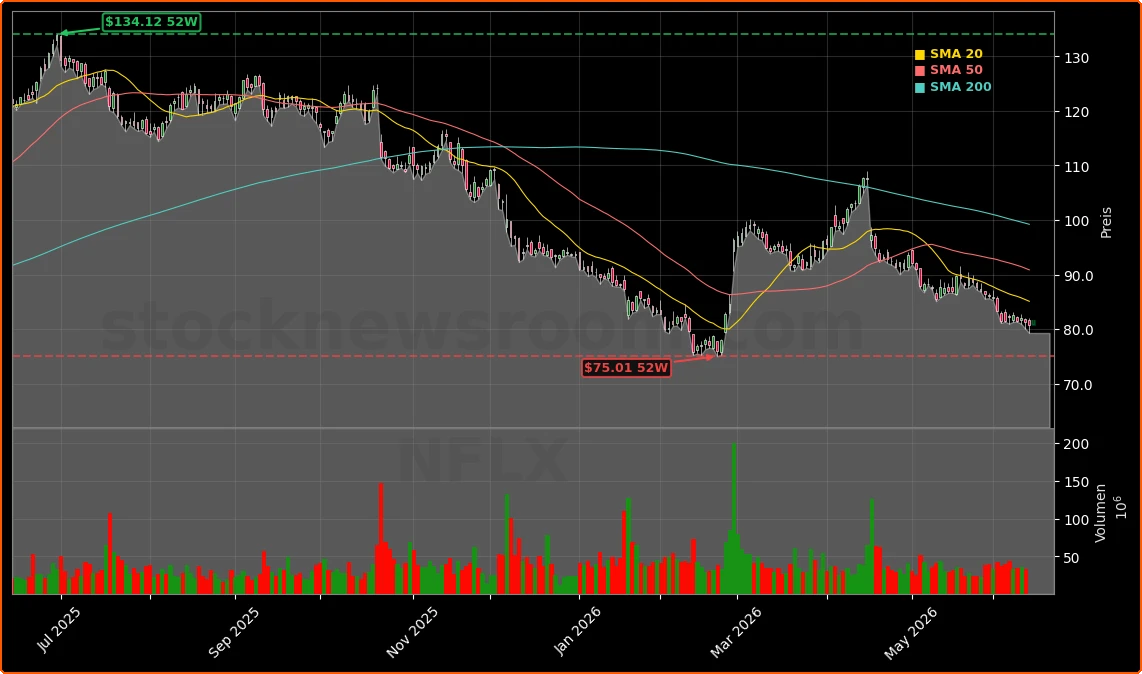
Yes — but with caveats. Netflix funds repurchases entirely from free cash flow, generating $3.1 billion in Q1 2026 — up 38% YoY — and carrying no net debt. Still, critics warn that buybacks often peak near market highs: Netflix’s stock traded near $83 in mid-May before retreating to $80.68 in after-hours trading on June 12. As Bloomberg reported this week, hedge funds have trimmed broad tech exposure ahead of the SpaceX IPO, dragging Netflix lower despite strong fundamentals. Another risk: stock-based compensation issued to employees offsets ~1.2% of annual share retirements — a dynamic investors must track in the 10-Q, not just press releases.