

Can strong Netflix Earnings and a booming ad tier offset legal risks and a rare profit miss enough to win back investors?

How are markets digesting Netflix Earnings?
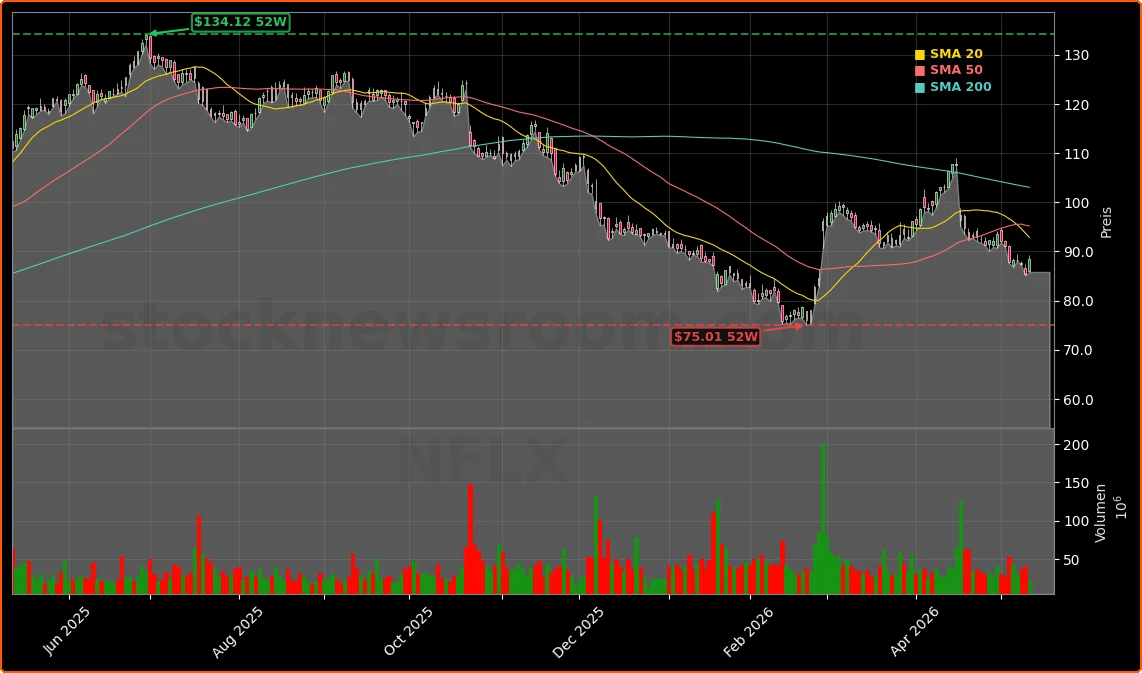
Netflix, Inc. has been volatile since reporting Q1 2026 numbers in mid‑April. The stock spiked to roughly $107 after the release, then slid nearly 20% in the following weeks before stabilizing near the mid‑80s. At about $88.41 on Tuesday, the shares have bounced off technical support in the mid‑80s that some traders see as a short‑term floor, but they remain down sharply from the recent high and about 8% lower year to date, even as the S&P 500 is up around 8% over the same period.
The Q1 Netflix Earnings showed revenue of roughly $12.25 billion, up about 16% year over year, powered by subscriber growth and higher engagement. However, earnings per share of about $1.23 came in below consensus estimates near $1.34, a rare miss for a company that has historically outpaced Wall Street on the bottom line. The report also included a sizable one‑off benefit: a multibillion‑dollar termination fee tied to Netflix walking away from a potential Warner Bros. Discovery transaction, complicating the read‑through on underlying profitability.
That combination – strong top‑line growth, a messy EPS line and a big non‑recurring gain – left many institutional investors cautious. Erste Group, for example, downgraded Netflix from “buy” to “hold” in late April, arguing that after a powerful rebound in March and early April, the share price needed more concrete evidence of sustainable earnings expansion to move higher.
What do Netflix Earnings say about the ad strategy?
If there was a standout in the latest Netflix Earnings, it was the ad‑supported tier. Co‑CEOs Greg Peters and Ted Sarandos highlighted that in markets where advertising is available, the ad plan accounted for more than 60% of new sign‑ups in Q1. Advertiser count rose roughly 70% to more than 4,000 brands, and management reiterated that ad revenue is on track to roughly double again and approach $3 billion in 2026.
Strategically, Netflix is positioning itself less like a traditional media conglomerate and more like a focused software and data platform. The company has exited the Warner Bros. deal, resumed share buybacks with about $1.3 billion repurchased in Q1 and $6.8 billion remaining in authorization, and is investing in tools such as Ben Affleck’s InterPositive GenAI filmmaking tech to streamline production. Live events – from premium boxing matches such as Tyson Fury vs. Anthony Joshua to future sports rights – are being used to expand reach without building a full linear‑style bundle.
Ad industry executives are being pitched an aggressive vision. Netflix’s ad chief Amy Reinhard has been telling brands that the company can now compete with any major video platform globally, pointing to a growing programmatic business, deeper brand integrations and high‑profile sports content such as NFL Christmas Day games and the 2027 Women’s World Cup. For investors, the central earnings question is whether this ad flywheel can keep accelerating without sparking subscriber churn or diluting the premium brand.
How serious is the Texas lawsuit for Netflix?
Just as the dust around Netflix Earnings began to settle, legal risk stepped into the spotlight. Texas Attorney General Ken Paxton has sued Netflix, alleging the company built a “behavioral‑surveillance program” that secretly collects detailed user data – including from children – and then profits from selling that data to third parties. The complaint also targets product features such as autoplay on kids’ profiles, describing them as manipulative “dark patterns” intended to keep viewers hooked.
The lawsuit seeks to force Netflix to delete improperly collected data, halt certain targeted advertising practices without explicit consent and disable autoplay by default on children’s accounts. It also pursues civil penalties under the state’s consumer protection laws. Following the filing, Netflix shares edged lower as traders priced in the possibility of fines, product design changes and broader scrutiny of the company’s growing advertising business.
Privacy enforcement has been ramping up against major tech platforms, and the Texas action places Netflix squarely in that crosshairs. While it is far too early to know the financial impact, the case arrives at a delicate moment: regulators are focusing on how streaming platforms monetize data just as Netflix is trying to convince advertisers that it can use data and targeting to rival the likes of Apple TV+, Amazon Prime Video and legacy players such as Disney+.
How does Netflix stack up against rivals?
Despite the pullback after the latest Netflix Earnings, the company retains a significant scale advantage. Netflix counts around 325 million subscribers worldwide, ahead of Amazon’s roughly 200 million Prime Video customers and far ahead of Disney+, which sits near 131 million. That leadership gives Netflix more data, more global reach and more pricing power, but it also paints a bullseye on its back in an environment where rivals are under pressure to close the gap.
Legacy media competitors, including Disney and Comcast’s NBCUniversal, may lean on price discounts or bundles to win share. Aggressive discounting could constrain how quickly Netflix can raise subscription prices without igniting churn. Meanwhile, tech‑driven competitors like NVIDIA’s AI partners and platform giants such as Tesla’s in‑car entertainment or Apple’s growing services ecosystem are all vying for the same finite pool of consumer attention.
On the cost side, Netflix continues to spend heavily on original programming, from global hits like “Stranger Things,” “Bridgerton” and “Wednesday” to a growing pipeline of gaming‑related projects such as “Devil May Cry,” “Arcane” and other high‑scoring adaptations. While these titles can generate tremendous engagement, they also require billions of dollars of content investment, and generative AI tools have not yet delivered the kind of step‑change cost savings some optimists were hoping for.
Management has guided full‑year 2026 revenue to a range of roughly $50.7 billion to $51.7 billion, with free cash flow near $12.5 billion. If Netflix can hit those targets while scaling ads and controlling content costs, the current valuation could look more attractive relative to the broader NASDAQ. But with the stock still down more than 20% from its 12‑month high, many growth investors are waiting for clearer confirmation in future Netflix Earnings that margins can hold up.
Related Coverage
For a deeper dive into how past results shaped sentiment, readers can review “Netflix Earnings +1.6% Rally: Guidance Shock or Long-Term Buy?”, which analyzes whether earlier guidance signaled an end to hyper‑growth or the setup for the next long‑term opportunity. Together with the current legal and advertising developments, that piece helps frame how the Netflix story has evolved for investors over the last few quarters.
Netflix Earnings now sit at the center of a tug‑of‑war between a fast‑growing ad business, heavy content spending and rising regulatory risk. For U.S. investors, the stock remains a high‑beta play on global streaming and connected‑TV advertising rather than a defensive media holding. The next Netflix Earnings report will be critical in showing whether subscriber growth, ad momentum and free cash flow can all move higher at the same time, keeping the long‑term bull case intact.