Are Netflix Earnings strong enough to justify the latest AI push and leadership shift as the stock suddenly sells off?

Why did Netflix shares drop after strong results?
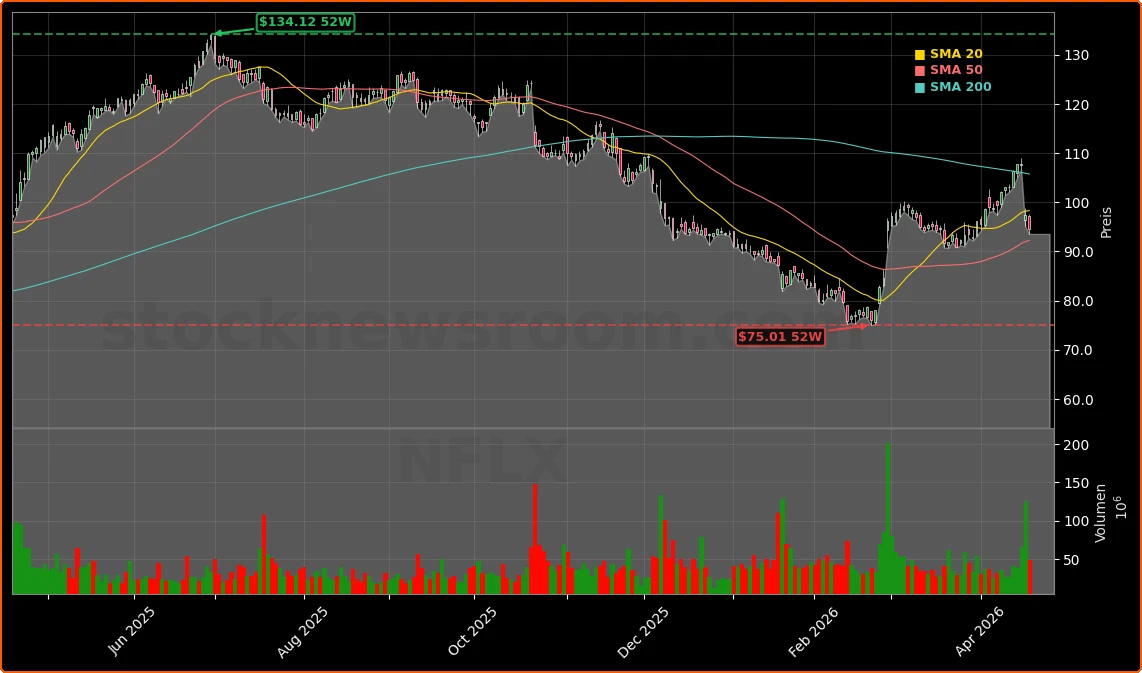
Netflix, Inc. (NFLX) closed at $94.55 on Monday, down 2.84% from the prior $97.30, extending a post‑earnings sell‑off that at one point erased more than 10% in a single session. That weakness stands in stark contrast to a robust Q1 2026 print: revenue rose 16.2% year over year to $12.25 billion, slightly ahead of Wall Street’s expectations around $12.18 billion. Operating income climbed to just under $4 billion, driving a strong 32% operating margin.
Net income nearly doubled, helped by a one‑time $2.8 billion compensation payment tied to Netflix’s decision to walk away from a Warner Bros. Discovery deal. While that windfall supercharged the bottom line, investors largely discounted it as non‑recurring. The bigger concern was a more cautious outlook for the coming quarters, which signaled moderating growth after a multi‑year rebound. With the stock still trading roughly 35% below its split‑adjusted 52‑week high near $134, traders used the Netflix Earnings event as an excuse to lock in gains.
What do these Netflix Earnings say about the business?
The latest Netflix Earnings underscore how the business model is shifting from pure subscriber growth to a more diversified revenue stack. The company now counts over 325 million paid members worldwide, with only about 44% of revenue generated in the US. Management believes the long‑term addressable market remains vast, particularly across Asia‑Pacific, Europe and Latin America, where penetration is far from saturated and local content is gaining traction.
At the same time, Netflix is leaning harder into monetization. Recent price hikes across several regions have pressured churn at the margin, especially on premium tiers, but co‑CEO Greg Peters argues that subscribers still pay the “least per hour” of viewing compared with rival services. The ad‑supported tier is meant to capture more price‑sensitive users; however, revenue per user there trails traditional premium subscriptions for now. Advertising is expected to roughly double this year to about $3 billion, providing a new growth leg that could help offset slower net adds in mature markets and intensifying competition from players like Disney+, Amazon Prime Video and Apple TV+.
How is AI changing the content and cost equation?
On the strategic side, Netflix is preparing for an AI‑heavy future. Co‑CEO Ted Sarandos reiterated that artificial intelligence will be used as a tool to give creators better capabilities while also driving more efficient productions. The company plans to deploy AI across the film and series pipeline, from script and pre‑visualization tools to post‑production and personalization, and is pursuing the acquisition of Interpositive, a specialized film tool provider, to deepen that toolkit.
For investors, the AI push matters because content spending remains the largest line item on the income statement. If AI can reduce production times, optimize budgets and improve hit‑ratio probabilities, Netflix could further expand margins without cutting back on the volume of shows and movies. That would reinforce the company’s competitive edge versus cash‑burning rivals and even against user‑generated content platforms such as YouTube and TikTok, which challenge Netflix for engagement time. Debate is also emerging over whether Netflix should one day separate its curated premium content from a potential user‑generated content area, sometimes floated under concepts like a ‘You Flicks’ segment, to compete more directly in that arena.
Is Reed Hastings’ exit a turning point for Netflix?
Layered onto the Netflix Earnings volatility is a symbolic leadership shift. Co‑founder and long‑time CEO Reed Hastings will not stand for re‑election to the board after 29 years, formally closing an era in which he helped transform the company from a DVD‑by‑mail service into the world’s largest streaming platform with a market cap above $400 billion. Hastings has said he plans to concentrate on philanthropy and other ventures, but his exit has unsettled part of the investor base.
Critics, including political figures, have publicly speculated whether Hastings was “forced” out, adding noise around governance just as the stock is under pressure. Nonetheless, operational control has already shifted to co‑CEOs Sarandos and Peters, and the broader leadership team is widely viewed as deep. Wall Street’s core debate is less about succession and more about strategy: should Netflix double down on curated, premium long‑form content and live events like wrestling, boxing and concerts, or pivot further toward cheaper, more viral formats that mimic the short‑form, ad‑heavy playbooks of competitors?
How is Wall Street reacting to the guidance reset?
Despite the stock drop, analyst sentiment remains broadly constructive. Major houses such as Bernstein and Oppenheimer have reiterated or even strengthened their Buy ratings, pointing to Netflix’s scale advantages, margin expansion and under‑average valuation. At a price/earnings multiple around 27, Netflix trades below its long‑term historical average, a fact many bulls highlight when arguing that the post‑earnings pullback is more sentiment reset than structural break.
Growth investors are also watching notable buyers step in. ARK Invest’s Cathie Wood has resumed accumulating Netflix shares in April following the earnings dip, reinforcing her conviction in the company’s pivot toward higher revenue per user, advertising and live events. Meanwhile, options‑based products like the YieldMax NFLX Option Income Strategy ETF continue to generate income on the name, underscoring Netflix’s importance in derivatives markets. Technically, the stock has lost its 20‑day simple moving average and is testing support zones dating back to December, backed by the 50‑ and 500‑day SMAs. Traders warn that a sustained break below the $90 area could open room for further downside, while a quick rebound above the 200‑day line would improve the medium‑term picture.
Related coverage on Netflix and streaming
For a deeper dive into how this quarter’s Netflix Earnings fit into the broader narrative around slowing growth and valuation, investors can read Netflix Earnings -9.7% Shock as Growth Story Wobbles, which explores whether recent volatility marks a temporary reset or the start of a tougher era for the stock. The article also situates Netflix within the wider streaming ecosystem, offering useful context on how rivals like Disney, Amazon and NVIDIA‑powered AI infrastructure could influence the sector’s next phase.
AI is going to give our artists better tools, not replace them.— Ted Sarandos, Netflix co-CEO
In sum, the latest Netflix Earnings delivered powerful headline numbers but triggered a classic “sell the news” reaction as investors focused on softer guidance, leadership transition and intensifying competition. For US portfolios, Netflix remains a heavyweight NASDAQ growth story whose valuation now looks more reasonable, but whose trajectory will hinge on execution in ads, AI and international expansion. The next few quarters will be critical in showing whether the company can turn its current AI and live‑content offensive into sustained earnings momentum that re‑energizes the stock.