Can Pfizer’s lung cancer setback stay contained to one trial, or is it an early warning for its broader oncology turnaround?

What Does the Pfizer Lung Cancer Trial Mean for Wall Street?
The topline results from Pfizer’s Phase 3 SigVie-002 trial — evaluating sigvotatug vedotin, an integrin beta-6 (IB6)-targeted antibody-drug conjugate (ADC) — confirmed what analysts had quietly braced for: no statistically significant improvement in overall survival (OS) versus docetaxel across the full population of patients with locally advanced or metastatic non-squamous NSCLC. The failure marks a notable setback for Pfizer’s post-Seagen oncology ambitions, especially as the company races to replace aging blockbusters like Ibrance and Vyndaqel ahead of looming patent expirations in 2027–2028. Still, the data weren’t uniformly negative: patients who had received only one prior line of systemic therapy demonstrated stronger OS and progression-free survival (PFS) trends. That subgroup signal — combined with a manageable safety profile — keeps the asset alive for further development, including an ongoing first-line Phase 3 trial with pembrolizumab.
How Does This Compare to Eli Lilly and Novo Nordisk?
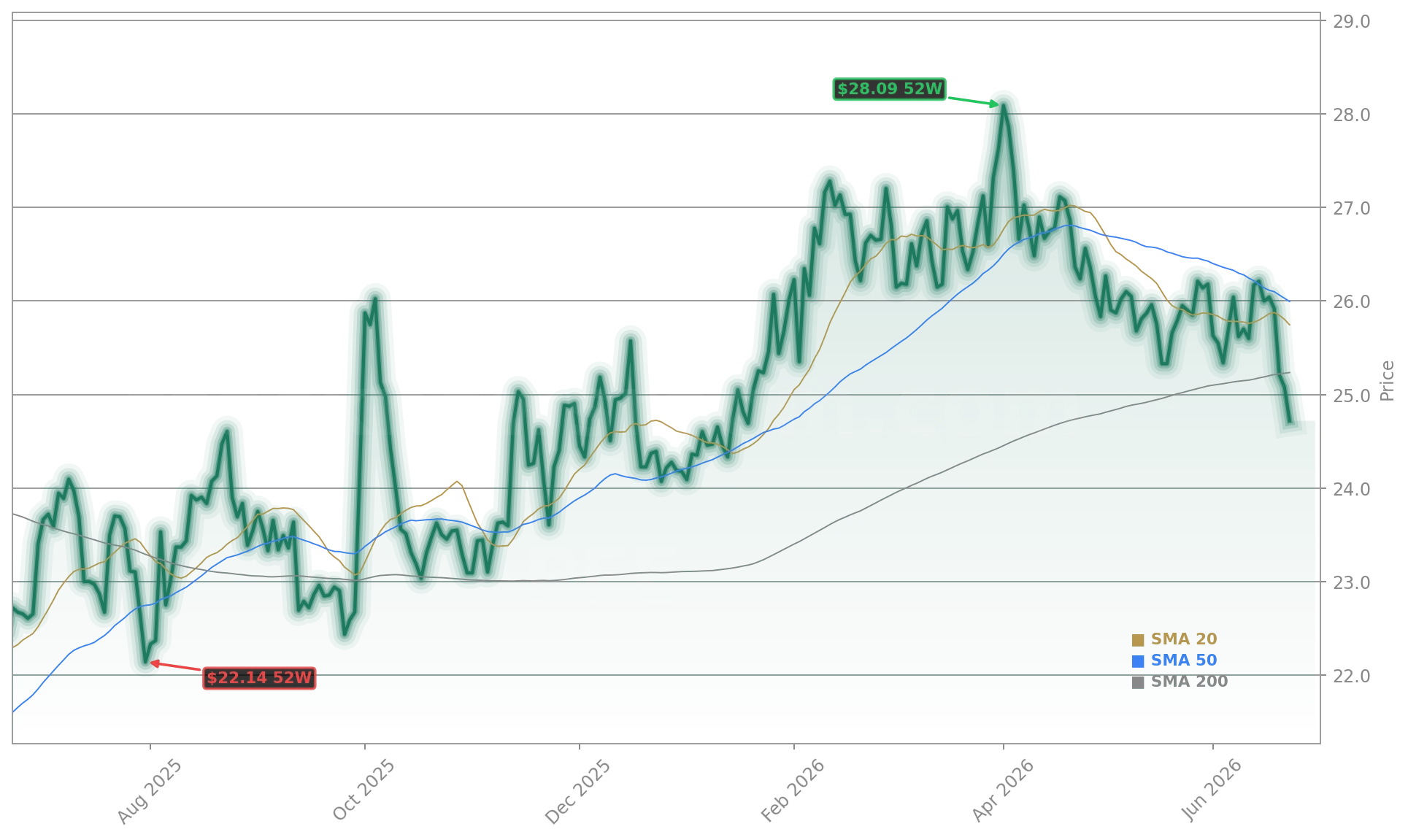
While Pfizer grapples with oncology execution, Eli Lilly (LLY) continues its dominance in obesity therapeutics — Mounjaro and Zepbound sales surged 125% and 80% respectively in Q1 2026. Novo Nordisk (NVO), meanwhile, faces its own headwinds: Q1 FY26 sales declined 4% at constant exchange rates after stripping out a one-time $4.2B accounting reversal, and Wegovy’s U.S. sales fell 14%. Pfizer’s 6.8% yield and $25.21 price offer stark contrast to Lilly’s 0.6% yield and Novo’s 38.97% one-year drop — positioning it as a high-yield, turnaround-oriented alternative for income-focused investors. Yet the Pfizer Lung Cancer Trial failure underscores the risk that pipeline execution must now match strategic ambition.
Is Pfizer’s Dividend Still Safe Amid Pipeline Pressure?
Yes — for now. Pfizer’s $1.72 annual dividend is covered by a 6.3% free cash flow yield, and management reaffirmed full-year 2026 adjusted EPS guidance of $2.80–$3.00, comfortably above the payout. CEO Albert Bourla has prioritized the dividend over buybacks — explicitly canceling share repurchases in 2026 despite $3.3 billion remaining on its authorization. That discipline, paired with the Vyndamax patent settlement extending U.S. exclusivity to June 2031, buys critical runway. Still, the payout ratio remains above 100%, a red flag analysts like JPMorgan’s Chris Schott cite when maintaining a ‘Neutral’ rating with a $30 price target. Jefferies, however, held its ‘Buy’ rating — lowering its target from $35 to $34 — calling the Pfizer Lung Cancer Trial outcome ‘no real surprise’ given early signals from combination studies.
What’s Next for Pfizer’s Oncology and Obesity Strategy?
Patients with previously treated advanced NSCLC are a historically difficult-to-treat population, and there is clearly more work to be done to improve the outcomes for this population.— Jeff Legos, Chief Oncology Officer, Pfizer
Pfizer isn’t retreating — it’s recalibrating. The company is executing on approximately 20 pivotal trials in 2026, with roughly ten focused on obesity assets acquired via the $7 billion Metsera deal. PF-3944, its ultra-long-acting GLP-1, showed 16% weight loss in Phase 2b. Meanwhile, AI-driven R&D is now the centerpiece of its two-year strategic pause on mega-acquisitions — a shift CEO Bourla described as essential to ‘execute on AI transformation without the disruption of a mega merger.’ That pivot, combined with Seagen’s ADC platform and new launches like Padcev (up 39% in Q1), signals a deliberate, multi-year rebuild — one where the Pfizer Lung Cancer Trial is a data point, not a verdict.