
Can Rigetti defend its quantum premium now that a deeper-pocketed rival has crashed the party?

What triggered Rigetti’s 14% intraday plunge?
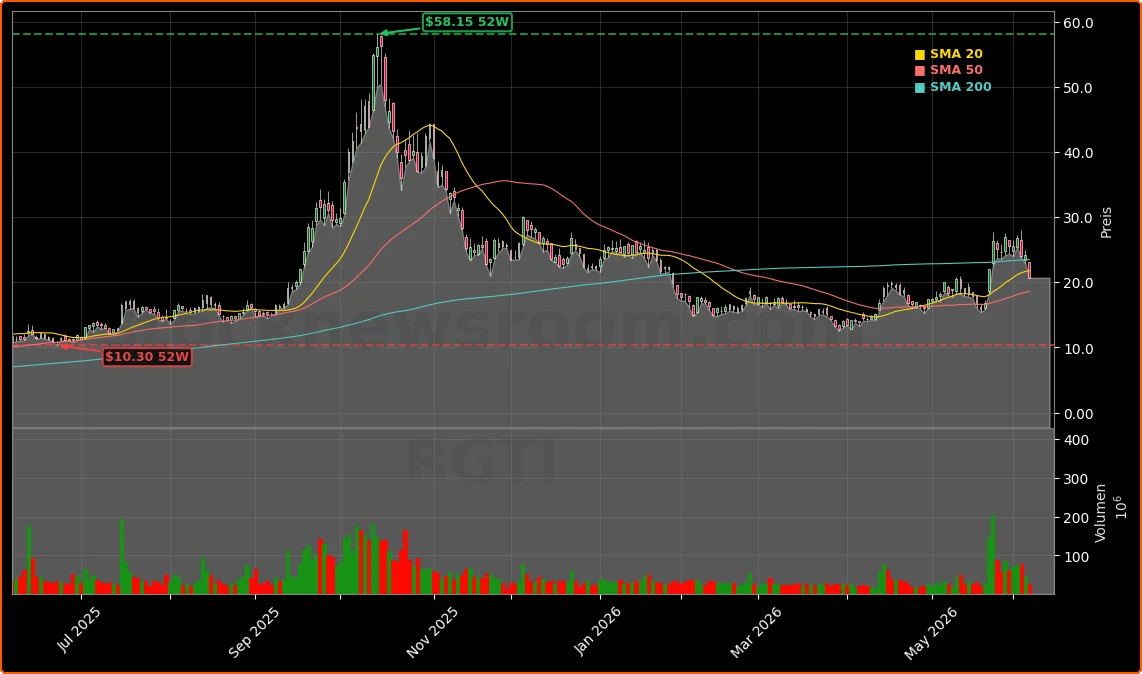
Rigetti Computing, Inc. shed $2.94 per share Friday — its steepest single-day decline since March — amid broad tech weakness and a sector-specific catalyst: Quantinuum’s $1.46 billion Nasdaq debut. The Honeywell-backed quantum startup priced at a $14.3 billion valuation, instantly dwarfing Rigetti’s $8.93 billion market cap and forcing investors to confront a stark reality — Rigetti Competition is now multi-fronted, with IonQ (IONQ), D-Wave (QBTS), and Quantinuum all vying for federal contracts, cloud partnerships, and institutional capital. While no earnings miss or analyst downgrade triggered the move, the sell-off reflects a structural recalibration: Rigetti is no longer the sole quantum proxy in U.S. equity markets.
How does Rigetti Competition reshape the quantum ETF landscape?
The Quantinuum listing directly pressures the QTUM ETF — an equal-weighted quantum theme fund where Rigetti Computing, Inc. previously held outsized influence. In contrast to market-cap-weighted indices like the S&P 500 or NASDAQ Composite, QTUM gives Rigetti, IonQ, and D-Wave identical weight — regardless of revenue scale or cash position. That structure helped QTUM outperform the Mag 7 in early 2026. But with Quantinuum now in the basket, Rigetti’s relative influence shrinks — and its valuation premium faces renewed scrutiny. As one institutional strategist noted, ‘You can’t justify a $9B valuation for a company with $4.4M in quarterly revenue when a direct peer just raised $1.46B at 60% higher enterprise value.’
Is Rigetti Competition hurting fundamentals — or just sentiment?
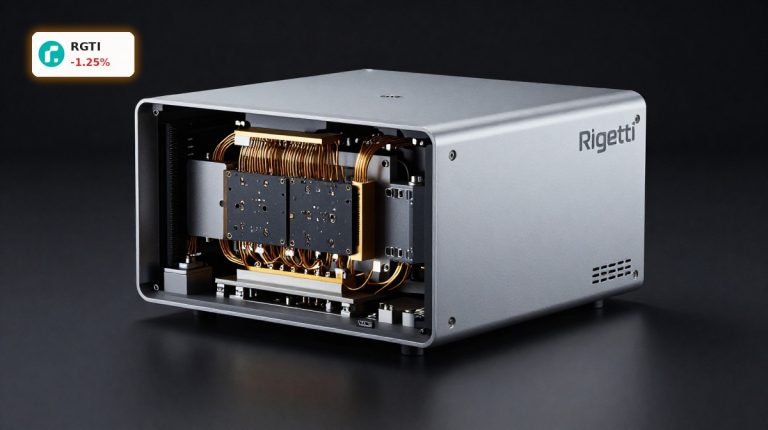
Operational metrics remain strong: Q1 revenue tripled year-over-year to $4.4 million, driven by new U.S. government contracts and delivery of the 108-qubit Cepheus-1-108Q system — now live on Amazon Braket, Microsoft Azure Quantum, and qBraid. Median two-qubit gate fidelity hit 99.8%, validating Rigetti’s superconducting approach. Yet Rigetti Competition isn’t just about hardware specs. It’s about capital efficiency: IonQ burned $151 million in operating cash last quarter; Rigetti’s $33 million GAAP net income included a $54 million non-cash swing in derivative warrant liabilities. The bottom line? Rigetti Computing, Inc. remains pre-profitability — and analysts at Morgan Stanley and RBC Capital Markets continue to emphasize 2030 as the earliest plausible inflection point for positive EBITDA.
Who’s buying — and who’s selling — amid Rigetti Competition?
While CEO Subodh Kulkarni sold 61,000 shares in late May and CTO David Rivas offloaded warrants, institutional activity tells a different story. Intech Investment Management LLC increased its Rigetti Computing, Inc. stake by 66.3% in Q4, and Eurizon Capital SGR S.p.A. acquired 222,893 new shares — a $4.94 million position. Meanwhile, S&P Global Market Intelligence analysts maintain a $29.18 average price target, reflecting confidence in the $100 million CHIPS Act letter of intent with the U.S. Department of Commerce. That agreement — which grants the government a minority equity stake — is a direct response to Rigetti Competition: it locks in non-dilutive R&D capital while signaling federal endorsement against rivals like IonQ and D-Wave.
How does Rigetti Competition affect U.S. quantum leadership?
Cepheus-1-108Q is one of the most powerful generally available gate-based quantum computers in the world.— Subodh Kulkarni, CEO of Rigetti Computing, Inc.
With NVIDIA dominating AI acceleration and Apple and Tesla driving real-world hardware adoption, quantum remains a high-stakes, long-horizon bet. Rigetti Competition isn’t just about market share — it’s about U.S. technological sovereignty. The $100 million CHIPS Act commitment, paired with access to a broader $2 billion federal quantum grant pool, positions Rigetti Computing, Inc. as a critical node in national infrastructure — not just a speculative stock. Yet valuation discipline is tightening: Rigetti trades at 2,030x forward revenue — versus 1,250x for IonQ and 980x for D-Wave. That gap is the core tension in Rigetti Competition today: leadership in gate fidelity versus leadership in capital discipline.