
Can Salesforce’s new AI reporting overhaul and explosive Agentforce growth finally convince investors it is a true AI platform, not legacy SaaS?

How is Salesforce reshaping its AI reporting?
The new Salesforce AI Reporting framework centers on two pillars: Agentforce Apps, and Data 360, Platform & Other. Agentforce Apps bundles the company’s AI-infused cloud offerings across sales, service, marketing, and commerce, where autonomous, goal-driven agents are increasingly embedded into workflows. The Data 360, Platform & Other bucket groups together the company’s data layer, flex credits, and acquired integration and analytics tools such as Informatica, MuleSoft, and Tableau.
To maintain comparability, Salesforce is recasting disaggregated revenue for fiscal 2025 and 2026 under this structure ahead of fiscal 2027, which started with the April quarter. Management argues that the architecture now better reflects how customers buy and deploy AI agents across the stack, from core CRM to back-office automation. Investors have been pressing for more transparency on AI monetization, and this Salesforce AI Reporting shift is designed to answer that demand without flooding the market with dozens of micro-metrics.
The company also highlighted ongoing traction in Agentforce. Annual recurring revenue for Agentforce products jumped 169% in the January quarter, climbing to $800 million from $540 million the prior quarter, as more customers move from pilot projects into broader deployments.
What does the new structure mean for investors?
The reclassification is a double-edged sword for shareholders. On one hand, clearer Salesforce AI Reporting should make it easier to track the health of its most strategic growth vectors: autonomous agents and the underlying data and platform layer. The focus on Agentforce Apps directly addresses Wall Street’s question of how much of Salesforce’s multibillion-dollar cloud franchise is truly AI-driven rather than just AI-branded.
On the other hand, some analysts caution that broader buckets could obscure weakness or strength in individual clouds. Evercore ISI’s Kirk Materne noted that while aligning metrics to the pervasive role of Agentforce “makes sense,” investors may worry about losing the ability to pinpoint performance in narrower products. That tension comes at a sensitive time: Salesforce’s core subscription businesses have slowed amid shifting enterprise IT budgets and heightened competition from AI-native rivals and hyperscalers.
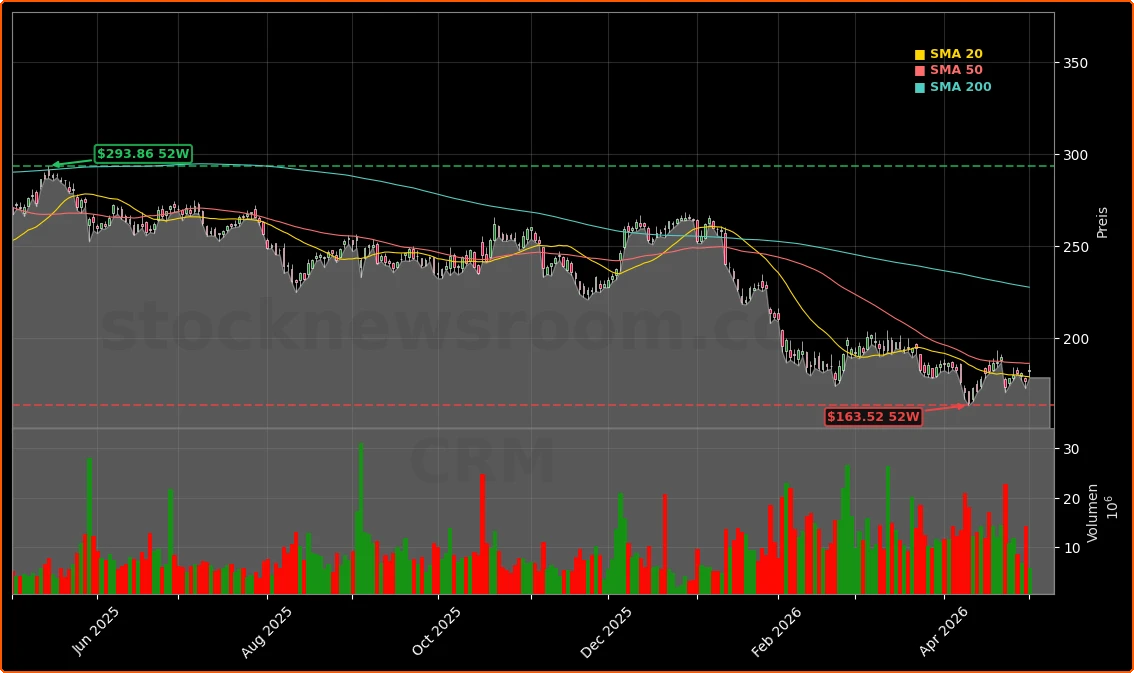
Despite the stock’s rally today to about $182.66, Salesforce remains well below its 52‑week high and has shed roughly 30% in 2026 amid a broader pullback in software. The S&P 500’s AI leaders, including NVIDIA and Apple, have held up far better, fueling debate over whether traditional SaaS vendors can reinvent themselves as true AI platforms or risk ceding ground to newer players.
How do Agentforce and Data 360 fit into the AI race?
Salesforce is positioning Agentforce as a foundation for autonomous agents that span front- and back-office tasks, from sales outreach to service case resolution and e-commerce operations. Recent launches like Agentforce Operations target back-office automation, promising to cut process cycle times and manual data entry by coordinating agents across supply chain, onboarding, and compliance workflows. These capabilities are built on the company’s Data 360 platform, which stitches together structured and unstructured enterprise data and connects into external systems via MuleSoft, Tableau, and Informatica.
That end-to-end approach is central to Salesforce’s pitch against workflow and AI platforms from Apple ecosystem partners, ServiceNow, and Microsoft. While ServiceNow is leaning on a rich partner network to drive its own AI-native workflows, Salesforce argues that its decades of CRM data, combined with its broad cloud footprint, give it a differentiated edge in building agentic enterprises. For U.S. investors, the key question is whether this architecture translates into durable consumption-based AI revenue that can offset any slowdown in traditional subscription growth.
At the same time, governance and ownership dynamics are in focus. Large institutions such as Vanguard now control sizable stakes in Salesforce, and activist voices continue to scrutinize capital allocation, profitability, and the long-term AI roadmap. With the company transitioning parts of its AI business to usage-based pricing, investors will scrutinize the new Salesforce AI Reporting categories to judge whether AI agents are truly driving incremental spend or simply cannibalizing existing licenses.
What’s the market reaction and competitive backdrop?
Today’s bounce in the stock follows a volatile stretch marked by drawdowns on concerns over AI disruption to legacy SaaS models and legal skirmishes in the collaboration space. Even after today’s roughly 3.5% gain, Salesforce’s technical profile remains mixed, with relatively weak composite and accumulation ratings reflecting heavy institutional selling in recent months. Still, long-term performance has been impressive: a $1,000 investment two decades ago would now be worth over $21,000, underscoring the company’s history of compounding returns for patient shareholders.
Wall Street’s view is divided. Some firms have trimmed price targets as growth decelerates and fiscal 2027 guidance underwhelmed, even after folding in the Informatica acquisition. Others maintain bullish ratings, arguing that Agentforce and Data 360 could reaccelerate revenue in late 2026 as AI projects move from experimentation to production. Across the broader market, software names are under pressure as investors weigh whether models from OpenAI, Anthropic, and big tech platforms will compress the value of traditional enterprise apps.
Against this backdrop, Salesforce AI Reporting becomes more than an accounting change: it is a signaling device. By elevating Agentforce to a primary reporting line, management is effectively telling Wall Street that AI agents, not just cloud subscriptions, will define the next growth chapter. How quickly revenue in those buckets scales relative to core CRM will likely influence whether the stock can close the gap to high-flying AI beneficiaries like NVIDIA and Tesla.
Related Coverage
For a deeper look at how the company’s broader AI roadmap fits into this shift, readers can explore Salesforce AI Strategy +1.8% Rally Warning for Investors, which examines whether the revamped platform can turn a bruised cloud giant into a sustainable AI leader just as Wall Street’s sentiment begins to thaw.
In summary, the revamped Salesforce AI Reporting structure elevates Agentforce and Data 360 as the clearest lenses into the company’s AI ambitions and early monetization. For investors, tracking growth in these two segments will be critical to judging whether Salesforce can transition from a maturing SaaS incumbent to a true agentic enterprise platform. The next few quarters of disclosures will show if this reporting pivot is matched by accelerating AI-driven revenue and renewed stock momentum.