
Can Solana Perpetuals turn tokenized stock momentum into real value for SOL, or is the market still pricing in the wrong story?

What Do Solana Perpetuals Actually Mean for Investors?
Unlike Ethereum-based perpetuals that rely on Layer 2s or centralized venues, Solana Perpetuals are emerging through a hybrid model: Phantom’s newly hired team—ex-Hyperliquid developers—has built a front-end interface that routes orders to Hyperliquid’s matching engine, which settles in USDC and uses Solana for wallet authentication and fund transfers. This isn’t Solana-native infrastructure, but it’s a distribution channel with over 12 million monthly active users. Crucially, it’s the first major wallet on Solana to offer leveraged exposure to tokenized equities like Apple, Tesla, and NVIDIA—a development that directly competes with Robinhood’s newly announced blockchain initiative. While Solana’s current value-capture mechanism remains weak—transaction fees don’t automatically accrue to SOL stakers—the growth of on-chain derivatives could pressure validators and ecosystem funds to propose fee-sharing upgrades ahead of the Q4 2026 governance vote.
Why Is Tokenized Stock Volume So Critical?
Solana handled $5.8 billion in tokenized asset spot volume in Q2 2026—up 62% quarter-over-quarter and eclipsing Ethereum’s $5.1 billion in the same period. That surge wasn’t driven by retail speculation alone: Visa’s USDC settlement rollout on Solana and Shinhan Card’s stablecoin pilot in South Korea have institutionalized infrastructure for compliant equity tokenization. As of July 6, $566 million in tokenized stocks sat on Solana, just behind Ethereum’s $642 million—but Solana’s throughput (65,000 TPS) and sub-$0.00025 average fee give it a decisive edge for high-frequency perp settlement. If Solana Perpetuals migrate from Hyperliquid-dependent wrappers to native AMMs like Drift or Zeta in late Q3, the chain could capture up to 35% of the $12.4 billion global tokenized equity derivatives market by year-end, according to Morgan Stanley’s latest digital assets framework.
Is SOL’s Price Action Contradicting the Fundamentals?
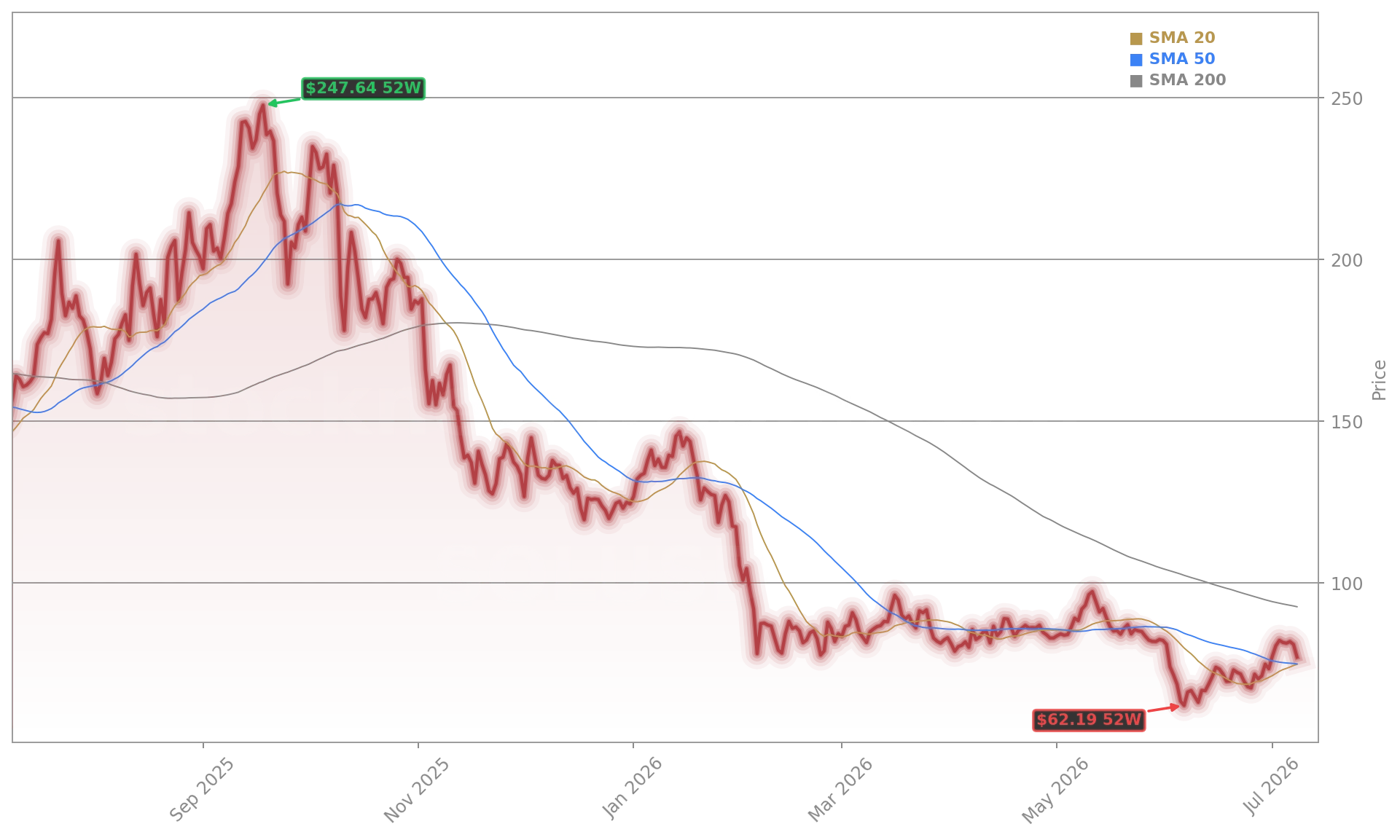
Not necessarily. SOL fell 4.47% to $77.29 on Wednesday, erasing its entire July rally after geopolitical tensions spiked volatility across crypto markets. Yet this pullback aligns with broader NASDAQ weakness—where tech stocks dropped 1.3%—and reflects rotation rather than rejection. Notably, SOL remains up 41% year-to-date, outpacing both Bitcoin (+28%) and Ethereum (+33%). RBC Capital Markets reiterated its ‘Outperform’ rating on Solana this week, citing ‘structural advantages in latency-sensitive tokenized finance use cases’ and raising its 12-month price target from $85 to $92. The firm emphasized that Solana Perpetuals adoption—especially if paired with pending MEV-resistant validator upgrades—could drive a 20% increase in average daily transaction fees by Q4.
How Does This Compare to Ethereum and Competing Chains?
Ethereum remains the leader in total value locked (TVL) for tokenized equities, but its high gas fees and slower settlement hinder perpetuals liquidity. Meanwhile, Base and Arbitrum are pushing perp integrations—but lack Solana’s wallet-native UX and institutional tokenization rails. Solana’s edge isn’t just technical: it’s strategic. While Ethereum’s ecosystem remains fragmented across L2s, Solana’s single-chain architecture allows for atomic composability between tokenized stocks, perpetuals, and DePIN incentives—creating a flywheel for capital efficiency. Bloomberg Intelligence recently noted that Solana’s ‘tokenized asset velocity’ (trades per $1M of on-chain equity value) is 3.2x Ethereum’s, a metric increasingly cited by hedge funds evaluating cross-chain alpha.
Solana Perpetuals represent the most credible path to sustainable fee revenue for the chain—because they tie derivatives volume directly to tokenized real-world assets, not just meme coins.— RBC Capital Markets analyst, July 2026
Solana Perpetuals are no longer a speculative headline—they’re the catalyst for Solana’s next phase of institutional adoption. For U.S. investors holding SOL or allocating to blockchain infrastructure, the Phantom-Hyperliquid integration is a near-term catalyst; native perp venues launching in Q3 could be the inflection point. The next quarterly earnings cycle will reveal whether validator revenue growth and fee burn acceleration justify a re-rating—and whether Solana Perpetuals finally convert promise into profit.