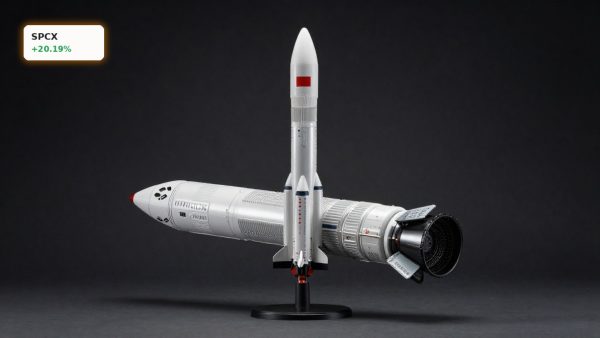
Can the SpaceX IPO justify a $2.1 trillion valuation, or is Wall Street already pricing in perfection?

What Does $2.1 Trillion Mean for the S&P 500?
The SpaceX IPO instantly made it the sixth-largest public company in the U.S. — larger than Broadcom, Tesla, and Meta, and now firmly in the trillion-dollar club alongside Apple and Microsoft. With a market cap exceeding $2.1 trillion, its potential inclusion in the S&P 500 (expected in December) will force massive passive inflows. The S&P 500 closed Friday at 7,431.46 — up 0.50% — with analysts at Morgan Stanley noting that SpaceX’s debut provided critical risk-on momentum amid broader geopolitical relief. Its weighting alone could exceed 0.8% at launch, rivaling major tech constituents and pressuring valuations across satellite, infrastructure, and AI-adjacent sectors.
How Did SpaceX IPO Compare to Tech Giants?
Unlike traditional tech debuts, the SpaceX IPO fused aerospace, global broadband, and AI infrastructure into one equity story — a structure no existing NASDAQ 100 member replicates. While NVIDIA powers AI hardware, SpaceX is building the data pipelines, compute nodes, and orbital backbone. Its $18.7 billion in 2025 revenue stands far below Amazon’s $700 billion — yet its $2.1 trillion valuation implies a 112x forward sales multiple. CFRA initiated coverage with a ‘sell’ rating and $115 price target — a 29% downside from Friday’s close — citing ‘extremely ambitious growth strategy and significant capital intensity.’ Morningstar values the company at just $63 per share, calling it ‘overvalued.’ In contrast, New Street Research issued a $165 target, affirming bullish sentiment among growth-focused firms.
SpaceX IPO: Who’s Buying — and Who’s Selling?
ARK Invest purchased over 3.29 million shares — worth more than $500 million — on IPO day, primarily through the ARK Innovation ETF. To fund the position, Cathie Wood’s firm sold $325 million across 13 holdings, including Advanced Micro Devices and Roku. This signals a decisive institutional pivot from crypto and legacy semiconductors toward integrated space-AI infrastructure. Meanwhile, retail demand was unprecedented: 20% of shares were allocated to individual investors — triple the typical 5–10% — with platforms like Robinhood and Fidelity reporting oversubscription. Still, liquidity remains tight: only ~7% of shares are freely tradable, meaning early price action is heavily influenced by index rebalancing and ETF flows rather than organic supply-demand dynamics.
What’s Next for the Magnificent Seven?
The SpaceX IPO didn’t just add a new name — it fractured the MAG7. With SpaceX now larger than Tesla and Meta, Wall Street is rapidly adopting new acronyms: ‘MANGOS’ (Meta, Anthropic, NVIDIA, Google, OpenAI, SpaceX) and ‘Magna Atoms’ (adding OpenAI and Anthropic). Analysts at JPMorgan estimate $1.5 trillion in equity issuance from IPOs and secondaries over the next two years — with OpenAI and Anthropic expected to follow SpaceX to the NASDAQ. This reshuffling pressures valuation discipline across high-multiple tech: shares of satellite infrastructure firms and AI chipmakers rallied Friday, while legacy telecom and hardware names saw muted gains. The message is clear — investors now price convergence, not silos.
SpaceX IPO: Is the Volatility Just Beginning?
The reason anyone gets insanely rich is almost always because of the stock market.— Mark Cuban
History offers caution. University of Florida research shows the average first-day IPO pop since 1990 is 21.6% — nearly identical to SpaceX’s 19.2% gain. But over the next three months, 8 of the 10 largest U.S. IPOs since 1999 posted declines — averaging a 13% pullback. With SpaceX’s first lockup expiration looming in late July, ~7% of shares — worth over $140 billion — could flood the market. That coincides with Q2 earnings — where investors will scrutinize Starlink’s $4.4 billion operating income versus $12 billion in AI-related capex. If Starlink growth slows or Starship delays persist, the $2.1 trillion valuation could face sharp recalibration. Still, the momentum is undeniable: pre-market trading Monday showed a 6% gain, and Nasdaq 100 inclusion is expected in two weeks.