Can Apple Siri AI turn privacy-first innovation into a winning iPhone upgrade cycle before rising memory costs eat into margins?

How Is Apple Siri AI Changing the iPhone Experience?
Apple Siri AI represents the most consequential evolution of the assistant since its 2011 debut. Unlike prior iterations, the new Siri AI runs natively on-device — leveraging Apple’s Neural Engine and 12GB DRAM requirement for advanced features like real-time screen understanding, memory-aware conversations, and on-device image generation. These capabilities debut in iOS 27 this fall and will anchor the iPhone 18 lineup. Crucially, Apple Siri AI avoids cloud dependency — a strategic differentiator versus Meta AI, Google Gemini, and Microsoft Copilot, all of which rely heavily on remote inference. That privacy-first architecture strengthens Apple’s ecosystem moat but demands more silicon, more memory, and tighter hardware-software integration.
Why Are Memory Costs Squeezing Apple’s Margins?
DRAM prices surged 80%–90% in Q1 2026 alone, driven by hyperscaler demand for AI infrastructure — a trend benefiting Micron Technology but pressuring hardware OEMs. Apple’s Q2 2026 gross margin declined slightly due to “seasonal loss of leverage and higher memory costs,” per CFO Parekh. With Tim Cook explicitly warning that memory costs will drive “an increasing impact” beyond June, Apple faces a structural challenge: its most compelling AI features require hardware configurations (e.g., 12GB DRAM) that exceed current base-model specs (iPhone 17 starts at 8GB). To maintain its ~39% product gross margin, Apple may raise prices on premium tiers or accelerate memory standardization — a decision with implications for ASP growth and unit volume.
How Does Apple Siri AI Compare to Rivals on Wall Street?
While NVIDIA powers AI inference in data centers and PCs, and Tesla pushes real-time edge AI in vehicles, Apple Siri AI targets the most intimate interface: personal devices. Unlike Alphabet’s Gemini or Meta’s Llama-based assistants — both cloud-optimized — Apple Siri AI prioritizes latency, privacy, and continuity across iPhone, Mac, and Vision Pro. That distinction resonates with institutional investors: Apple remains the second-largest holding in the NASDAQ-100 ETF (QQQM) at 7.24%, trailing only NVIDIA. Yet analysts remain divided. RBC Capital Markets recently downgraded Apple to “Sector Perform,” citing “unclear near-term AI monetization,” while Citigroup maintains a “Buy” rating with a $335 price target, arguing Apple Siri AI will “unlock $2.1B in annual services upside by 2028” via deeper app integration and AI-driven subscriptions.
What’s the Broader Market Impact for the S&P 500?
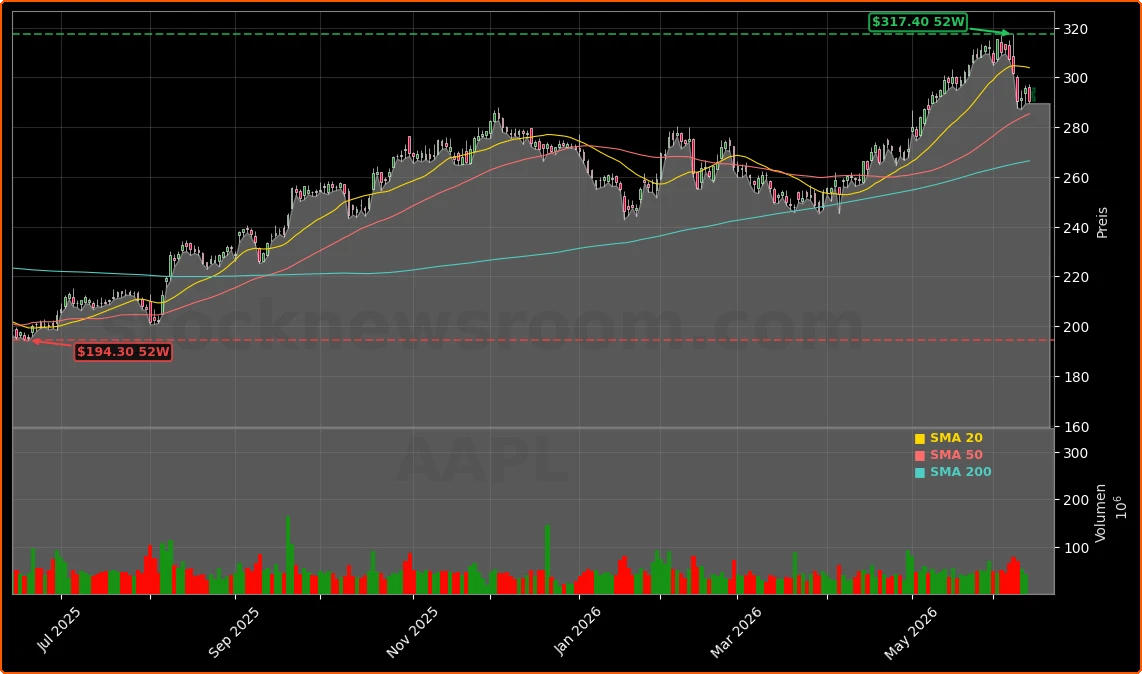
Apple’s 6.44% weight in the Vanguard S&P 500 ETF and 6.96% in the SPDR S&P 500 ETF makes it a linchpin for index performance — especially as tech dominates 35.7% of the benchmark. The recent 2% pullback coincided with the SpaceX IPO and broader Nasdaq weakness, but Apple’s after-hours rebound (+1.85%) signals underlying demand. Jim Cramer reinforced this on Mad Money, calling Apple “the leader, maybe the leader” of the mega-cap cohort — especially as peers like Microsoft and NVIDIA face regulatory scrutiny and valuation compression. With Apple Siri AI now live in developer betas and slated for mass rollout this fall, the stock’s ability to decouple from short-term tech rotation will be critical for S&P 500 stability.
And while we do not give color beyond June, I can tell you that beyond the June quarter, we believe memory costs will drive an increasing impact on our business, and we will continue to evaluate this.— Tim Cook, Apple CEO
Related Coverage: Apple’s AI strategy has drawn skepticism from Wall Street despite its $180B cash pile — Apple Siri AI Warning: $180B Cash but No Clear AI Catalyst explores whether ecosystem strength can translate into revenue. Meanwhile, Amazon Graviton 5 +2.4% Surge Powers AWS AI Ambitions highlights how rival cloud providers are betting on custom silicon to accelerate AI infrastructure spend — a trend that indirectly validates Apple’s on-device AI bet.