
Is Super Micro Computer AI Infrastructure now a contrarian buy after a sharp sell-off and a surprise rebound in margins?

Is Super Micro Computer AI Infrastructure mispriced after the drop?
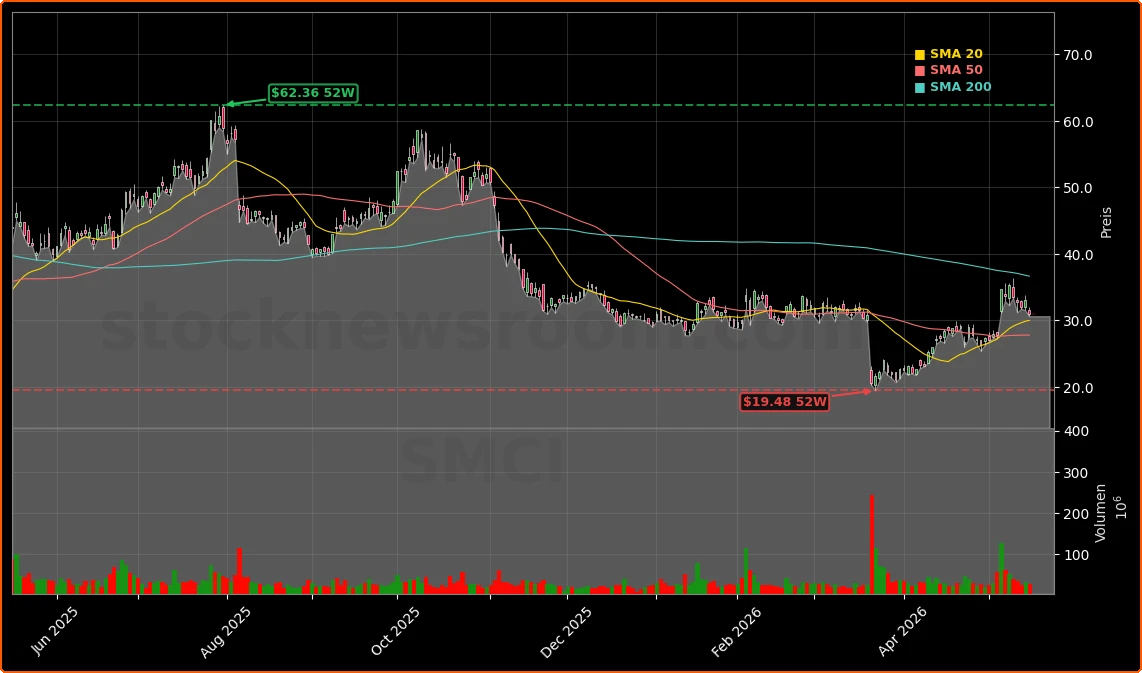
SMCI has endured a punishing 12 months, falling about 26% year over year and now trading roughly 41% below its 52‑week high of $62.36, even after a recent rebound. At $31.04, the shares sit well above the 52‑week low near $19.48 but have given back much of their early‑year strength. A proprietary model from 24/7 Wall St. pegs fair value at $39.34, implying about 27% upside from the latest after‑hours quote and supporting a BUY stance with a 90% confidence score.
The core of that bullish view: margins in the Super Micro Computer AI Infrastructure business are recovering faster than the stock price suggests. In fiscal Q3 2026, revenue of $10.24 billion missed the roughly $12.45 billion Wall Street consensus, but non‑GAAP EPS of $0.84 beat expectations by more than 30%. Net income surged to $483 million, up over 300% year on year, while GAAP gross margin rebounded to 9.9% from just 6.3% in the prior quarter. That margin reset sparked a sharp one‑day rally from about $28 to more than $33 as traders refocused on profitability rather than just top‑line disappointment.
How strong is Super Micro Computer’s AI demand pipeline?
CEO Charles Liang has emphasized that the company’s backlog is at a fresh record high, with AI GPU‑related systems now contributing more than 80% of total revenue. That puts Super Micro Computer, Inc. squarely in the slipstream of hyperscale buyers building out clusters around high‑end accelerators from NVIDIA and others. Management is targeting $12 billion in Q4 revenue and as much as $40 billion for the full fiscal year if supply chains and GPU allocations cooperate.
Beyond raw volume, mix is shifting in favor of higher‑margin designs, especially in Direct Connect Building Block Solutions (DCBBS). Liang highlighted that DCBBS profit margins are often above 20%, and he expects this segment to account for at least 20% of company‑wide net income within two years. Management software bookings exceeded $46 million in the latest quarter, adding another recurring and higher‑margin layer atop the Super Micro Computer AI Infrastructure stack. If double‑digit gross margins hold and SMCI ships early on systems built around the Vera Rubin NVL72 architecture, the stock could re‑rate toward optimistic 12‑month scenarios above $48, close to the top end of current independent projections.
What risks are investors still betting against?
Despite the fundamental momentum, SMCI is not a low‑risk story. The company burned about $6.6 billion in operating cash during Q3, while total debt climbed to $8.8 billion and cash balances fell roughly 49% year over year to $1.29 billion. Management attributes much of the cash outflow to a $10 billion reduction in accounts payable alongside inventory build rather than ongoing operating losses, and CFO David Weigand has stated that he does not expect prior earnings to be restated. Even so, results remain preliminary and unaudited, pending a Board‑level review of export‑control compliance.
Another concentration risk: a single large customer currently represents about 27% of revenue, leaving SMCI exposed to any shift in ordering or compliance posture from that buyer. In a bear‑case scenario, some models see downside toward $30.13, only modestly below current trading levels, suggesting a less favorable near‑term skew between risk and reward if the Board investigation drags on or margins slip.
How does Super Micro compare with other AI hardware plays?
On Wall Street, SMCI is increasingly bracketed with other AI infrastructure and server names rather than the mega‑cap chip designers. Dell Technologies has posted outsized gains as investors bet on its AI and enterprise server exposure, while competitors such as Hewlett Packard Enterprise and Super Micro continue to battle for share in high‑density racks designed for accelerator clusters. For investors who already own dominant chip suppliers like NVIDIA or ecosystem leaders such as Apple and Tesla, SMCI offers a more specialized, potentially higher‑beta way to play the data‑center hardware and Super Micro Computer AI Infrastructure build‑out.
Analyst targets vary widely, but many large banks still frame SMCI as a high‑volatility AI cyclical rather than a stable compounder, so position sizing and risk management are critical for diversified US portfolios. Execution on margins and cash flow in coming quarters will likely matter more for the stock than headline AI server growth alone.
Can nuclear microreactors reshape Super Micro Computer AI Infrastructure?
One of the most intriguing strategic moves is SMCI’s non‑binding Memorandum of Understanding with NANO Nuclear Energy to explore powering next‑generation AI data centers with on‑site nuclear energy. The partnership aims to integrate NANO’s KRONOS MMR microreactors directly with Super Micro’s AI server racks, cooling solutions and lifecycle services, effectively bundling compute and dedicated baseload power in a single package. With AI data centers facing mounting electricity constraints, a self‑powered, grid‑independent design could appeal to hyperscale cloud operators and edge‑compute providers searching for reliable, 24/7 energy.
If the collaboration progresses, the companies plan to co‑develop and market fully integrated systems to cloud, enterprise and edge customers. For SMCI, the potential upside is differentiation: pairing high‑density servers with on‑site nuclear power could push the Super Micro Computer AI Infrastructure story beyond hardware into a vertically integrated platform that addresses both compute and energy security. The concept is still early, but it underscores how urgently the AI ecosystem is seeking new answers to the power bottleneck.
Related Coverage
Investors looking for a deeper dive into how SMCI’s recent quarter reset sentiment can review Super Micro Earnings Q3: Margin Surge Sparks AI Server Re‑Rating, which breaks down the margin recovery, export‑control overhang and what they could mean for future AI server valuation on Wall Street.
Overall, SMCI remains a volatile but central player in the Super Micro Computer AI Infrastructure wave, with recovering margins, record AI backlogs and a bold nuclear‑powered data‑center experiment offset by cash‑flow strain and governance questions. For US investors with higher risk tolerance, the current pullback may offer a tactical entry into a differentiated AI hardware and infrastructure name, provided they can stomach headline and regulatory volatility. The next few quarters of execution on revenue guidance, margins and the nuclear partnership will likely determine whether today’s discounted multiple becomes a stepping stone or a value trap in the broader AI cycle.