Is AbbVie’s $10.9 billion Apogee deal a bold immunology masterstroke, or an expensive bet on future growth?

Why Did AbbVie Inc. Pay a 49% Premium?
AbbVie Inc. is paying $135.11 per share — a 49% premium to Apogee Therapeutics’ Thursday, June 18 close of $90.38 — to acquire the clinical-stage biotech. That price implies a total equity value of $10.9 billion, with net transaction value estimated at $10.1 billion after accounting for Apogee’s cash and marketable securities. Unlike past bolt-ons, this AbbVie Acquisition targets a pre-revenue asset with compelling Phase 2 data: zumilokibart achieved significant skin clearance in two-thirds of atopic dermatitis patients at 16 weeks, with maintenance dosing supported as infrequently as twice yearly. For investors, the premium reflects not just clinical promise but strategic optionality — including APG273, a dual IL-13/TSLP inhibitor in development for asthma. As RBC Capital Markets analyst Trung Huynh noted, zumilokibart is ‘worth more with AbbVie,’ where it gains immediate access to a 2,500-person U.S. immunology salesforce, payer leverage, and launch infrastructure.
How Does This Strengthen AbbVie Inc.’s Immunology Crown?
AbbVie Inc.’s immunology segment — anchored by Skyrizi and Rinvoq — generated $7.3 billion in Q1 2026, nearly half of total revenue. But growth faces new headwinds: Johnson & Johnson’s oral eczema drug Icotyde threatens injection-based adherence, while Dupixent’s biweekly dosing remains the standard of care. The AbbVie Acquisition directly counters both. Zumilokibart’s quarterly or semiannual dosing offers a clear convenience advantage over Dupixent, and its IL-13 targeting aligns with AbbVie’s deep mechanistic expertise — not a departure, but a precision upgrade. BMO Capital Markets analysts recently highlighted zumilokibart’s potential for ‘slightly superior efficacy’ in itch and skin clearance versus Sanofi and Regeneron’s blockbuster. Importantly, the deal accelerates AbbVie Inc.’s entry into respiratory disease — a $28 billion market where no current AbbVie asset holds U.S. approval. This positions the company to compete with AstraZeneca’s Tezspire and Sanofi’s Fasenra in severe asthma.
What’s the Impact on AbbVie Inc. and the S&P 500 Health Sector?
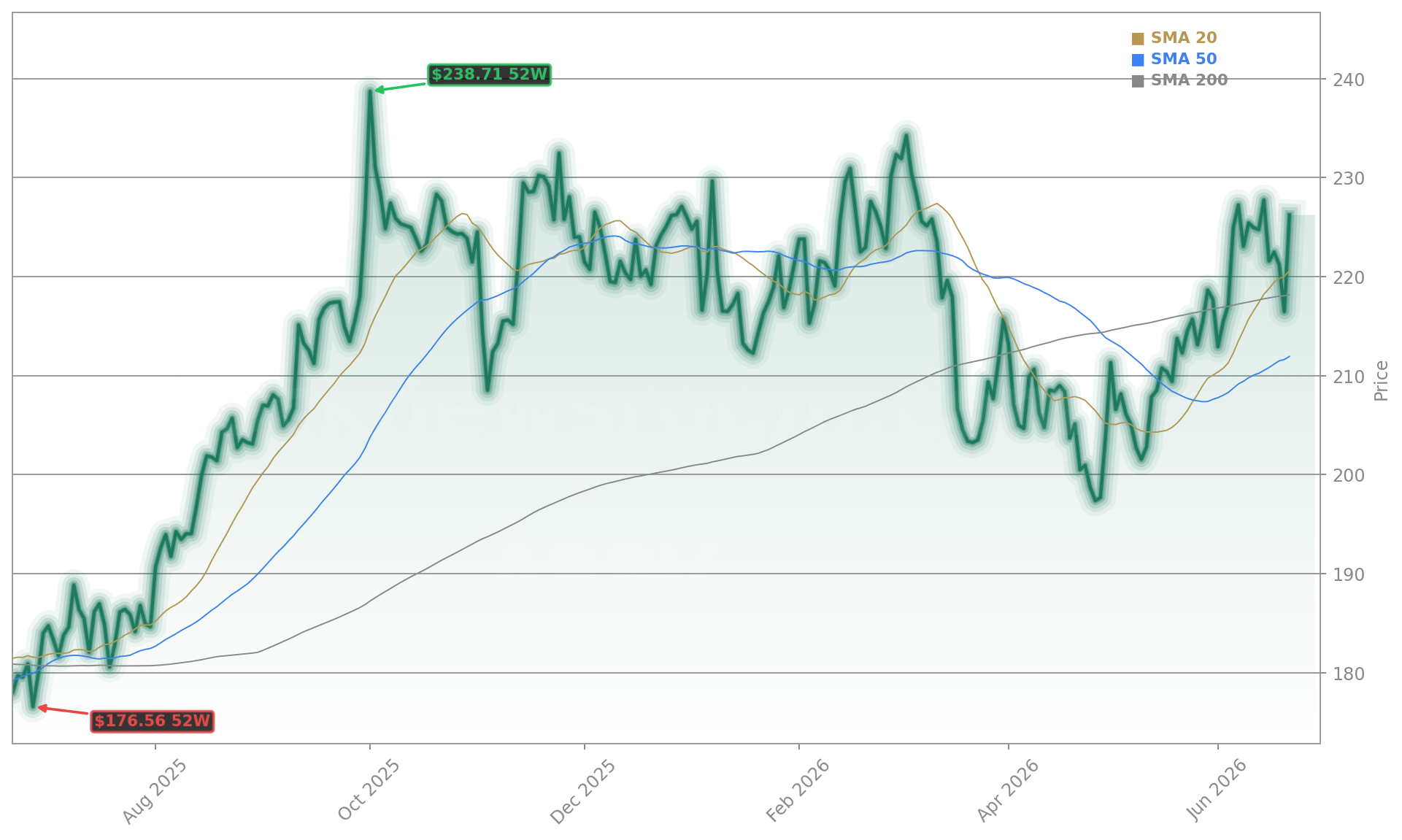
AbbVie Inc. shares surged 4.49% to $226.22 intraday on Monday — its strongest single-day gain since October 2025 — as Wall Street interpreted the AbbVie Acquisition as a decisive response to investor concerns about growth beyond Skyrizi and Rinvoq. The move also lifts sentiment across the S&P 500 health care sector, which has lagged the broader index YTD amid policy uncertainty. With Eli Lilly (LLY), Johnson & Johnson (JNJ), and AbbVie Inc. comprising over 35% of the XLV ETF, AbbVie’s proactive capital deployment bolsters confidence in the sector’s innovation engine. Citigroup analysts called the premium ‘justified’ given the scarcity of high-quality, late-stage immunology assets and Apogee’s $1.3 billion financing partnership with Blackstone Life Sciences earlier this year. Notably, the deal is expected to be accretive to AbbVie Inc.’s adjusted diluted EPS beginning in 2032 — a timeline that aligns with anticipated peak sales for zumilokibart and APG273.
AbbVie Acquisition: A Strategic Signal to Competitors?
The acquisition of Apogee further builds on our existing leadership, strengthening our ability to deliver innovative medicines to patients who need better options while also creating significant long-term value for shareholders.— Robert A. Michael, Chairman and CEO, AbbVie Inc.
The $10.9 billion price tag sends a clear message to peers: AbbVie Inc. is doubling down on core competencies, not diversifying away. While NVIDIA and Tesla dominate AI and EV headlines, biopharma’s real-time innovation race is heating up — and AbbVie Inc. is leading the charge in immunology. The acquisition follows Sanofi’s $9.1 billion Blueprint Medicines buyout and precedes expected moves from Johnson & Johnson, which was reportedly in talks with Protagonist Therapeutics earlier this year. Unlike those deals, AbbVie Inc. acquired Apogee Therapeutics without waiting for Phase 3 data — a vote of confidence in its engineering platform and clinical execution. Moody’s Ratings acknowledged the ‘clinical execution risk’ but affirmed the strategic fit. For U.S. investors, this AbbVie Acquisition reinforces a broader theme: durable growth in health care comes not from chasing AI hype, but from owning leaders with proven commercial scale, deep pipelines, and disciplined M&A — exactly what AbbVie Inc. demonstrated Monday.