Are AbbVie Earnings and a surprise Bank of America upgrade signaling a new phase in the pharma giant’s post-Humira transition?

How are AbbVie Earnings reshaping market sentiment?
AbbVie Inc. (ABBV) has seen a notable shift in investor sentiment since reporting Q1 2026 results, which highlighted both headline noise and solid underlying momentum. Revenue for the quarter reached roughly $15 billion, topping consensus expectations of about $14.72 billion and marking approximately 12.4% year-over-year growth. Adjusted EPS landed at $2.65, a minor miss of $0.02 versus estimates, pressured by a sizeable $744 million in in-process R&D (IPR&D) charges that shaved roughly $0.41 per share from earnings.
Despite the EPS miss, management responded with increased confidence, raising full-year adjusted EPS guidance to a range of $14.08 to $14.28. The market reacted positively at the time, with shares closing more than 3% higher after the print. Against that backdrop, AbbVie Earnings are being framed less as a disappointment and more as evidence that the company’s transition away from Humira dependence is gaining traction.
Why did Bank of America turn bullish on AbbVie?
Helping fuel the latest move in ABBV, Bank of America upgraded AbbVie from Neutral to Buy and lifted its price target to $234 from $226. The bank argues that fears about competitive pressure in AbbVie’s key immunology segment are overdone, particularly around the fast-growing psoriasis and inflammatory disease drug Skyrizi. Analysts at Bank of America see forward indicators for Skyrizi as strong, while new entrants in the category appear more category-expanding than purely cannibalistic.
Bank of America’s call aligns with a broadly constructive Wall Street stance. One detailed price-modeling framework pegs a fair value near $229.32, implying double-digit upside from a reference price around $204. At the same time, the broader analyst consensus clusters even higher, with an average target near $249 and more than 20 Buy ratings and no Sells reported. For U.S. investors benchmarking against the S&P 500, AbbVie’s combination of growth, dividend income, and defensive healthcare exposure makes it a frequent core holding alongside mega caps like Apple and NVIDIA.
What drove the latest AbbVie Earnings mix?
The heart of the bullish AbbVie Earnings narrative is the performance of the company’s next-generation immunology and neuroscience franchises. Skyrizi revenue jumped about 30.9% year over year to roughly $4.48 billion, while Rinvoq advanced around 23.3% to about $2.12 billion. AbbVie’s migraine portfolio added further momentum, with Qulipta sales up roughly 53.6% and Ubrelvy rising about 41.4%.
These gains helped offset steep declines in legacy products. Humira, long AbbVie’s flagship blockbuster, saw sales fall about 38.6% year over year to $688 million amid biosimilar competition. Oncology drug Imbruvica slipped around 24.7%. GAAP net income dropped nearly 46%, driven largely by higher R&D and a roughly 32.9% tax rate, as well as the IPR&D and contingent consideration charges. Nevertheless, many portfolio managers on Wall Street see these hits as the cost of aggressively investing for the next decade of growth rather than a sign of core deterioration.
How attractive is AbbVie versus other pharma names?
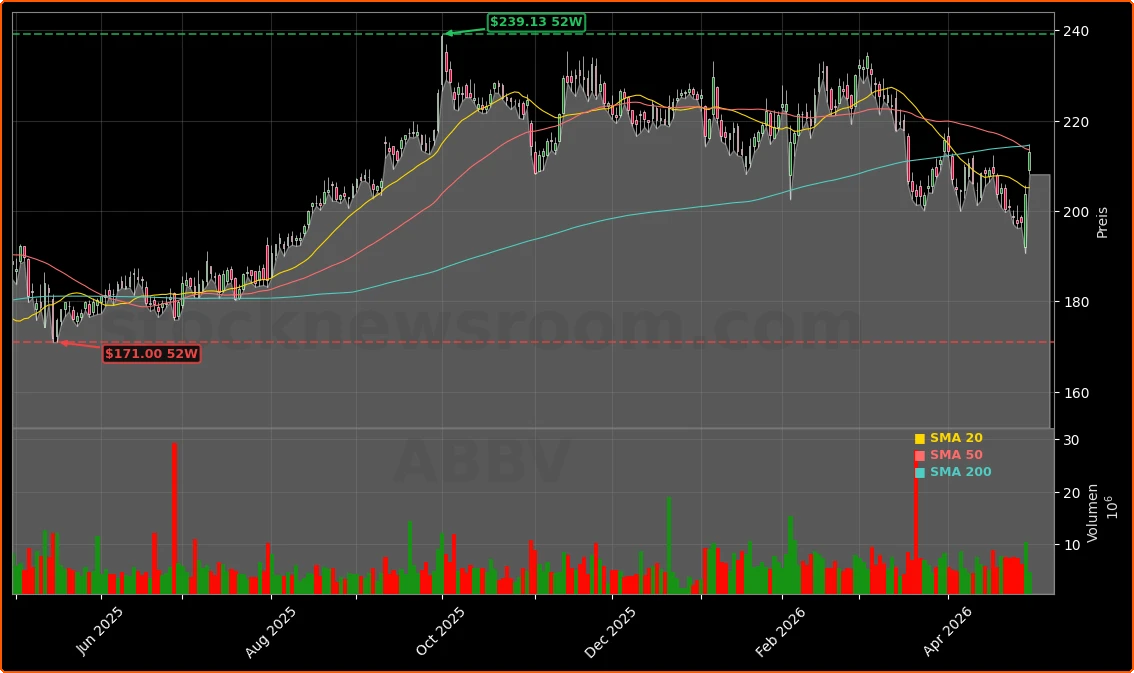
With ABBV recently trading near $213.03, the stock sits below its 52-week peak of roughly $239 but well above earlier-year lows, following a decline of just over 9% year to date before the recent rebound. On valuation, AbbVie’s forward multiple has compressed back to what many analysts consider a reasonable level for a large-cap pharma with visible mid-teens earnings power and an above-market dividend yield. The risk/reward is often compared favorably to peers in the S&P 500 healthcare space, particularly for investors seeking income and defensiveness in contrast to high-beta names like Tesla.
Pipeline optionality adds to AbbVie’s appeal. Obesity candidate ABBV-295 has shown clinically meaningful weight reduction in early data, positioning AbbVie to participate in one of the industry’s largest long-term growth themes. In oncology, Elahere has delivered an objective response rate above 60% in platinum-sensitive ovarian cancer, underlining AbbVie’s ambitions to strengthen its cancer portfolio. On the risk side, investors are watching for any additional regulatory setbacks after the FDA issued a Complete Response Letter for the neuromodulator trenibotulinumtoxinE tied to manufacturing issues.
What should investors watch after recent AbbVie Earnings?
For the next few quarters, the key questions around AbbVie Earnings will center on whether Skyrizi and Rinvoq can maintain 20%+ growth off already large revenue bases, how quickly Humira erosion stabilizes, and whether the obesity and oncology pipelines keep delivering positive readouts. Scenario analyses place a bull-case price target above $250, implying more than 20% total return potential from levels around $203–$213, while bear-case assumptions cluster just above $200, suggesting a relatively balanced downside if growth were to slow or new manufacturing issues emerged.
For U.S. retail investors and institutional allocators alike, ABBV remains a key healthcare position that can complement high-growth NASDAQ names such as NVIDIA and stable consumer tech leaders like Apple. The stock’s role in dividend strategies is especially notable, as AbbVie continues to invest heavily in R&D while supporting shareholder returns.
Related Coverage
Investors looking to dig deeper into AbbVie’s immunology story may want to read the detailed analysis of its dermatology portfolio in AbbVie Dermatology Data Boom at AAD 2026 Shocks Investors. That piece explores how new clinical data from psoriasis and eczema trials could reinforce Skyrizi’s trajectory and broaden AbbVie’s reach in inflammatory skin diseases, providing additional context to the current AbbVie Earnings debate.
In summary, AbbVie Earnings underscore a company successfully pivoting from Humira dependence toward a diversified, growth-oriented portfolio anchored by Skyrizi, Rinvoq, and a promising pipeline. The Bank of America upgrade and a constructive Wall Street consensus highlight that many analysts see more upside than downside from current levels. For long-term investors, the next set of AbbVie Earnings will be crucial in confirming that this momentum can translate into sustained EPS growth and continued stock outperformance versus the broader S&P 500.