Are GE HealthCare Earnings flashing a temporary warning sign or the start of a deeper rerating for this medtech heavyweight?

How weak were GE HealthCare Earnings?
GE HealthCare Technologies Inc. (GEHC) delivered a mixed Q1 2026 report that broke its multi-quarter beat streak and immediately hit sentiment. Revenue came in at $5.13 billion, up about 7.4% year over year and ahead of consensus near $5.03 billion, underscoring that demand for imaging and diagnostics equipment remains solid. The problem was profitability. Adjusted EPS of $0.99 fell short of Wall Street expectations around $1.05–$1.07, a miss of roughly 6%, while adjusted EBIT margin compressed by about 150 basis points to 13.5%.
Management blamed two primary factors for the disappointing GE HealthCare Earnings. First, a supplier issue in the Pharmaceutical Diagnostics (PDx) unit temporarily weighed on margins, though CEO Peter Arduini emphasized that this disruption has been resolved. Second, the company is dealing with a broad inflation shock, calling out significant cost pressure in memory chips, oil, and freight. Those inputs are especially relevant for a hardware-heavy portfolio that competes with large-cap medtech peers like Apple’s health-focused wearables and monitoring ecosystem at the software and data layer.
Why did guidance and the stock drop so hard?
The real hit to the bull case came not from the backward-looking GE HealthCare Earnings line, but from the forward guidance reset. Management cut its full-year 2026 adjusted EPS range to $4.80–$5.00, down from $4.95–$5.15 previously, and trimmed free cash flow guidance to roughly $1.6 billion from $1.7 billion. Adjusted EBIT margin is now expected at 15.4%–15.7%, lower than prior targets as cost headwinds prove more persistent.
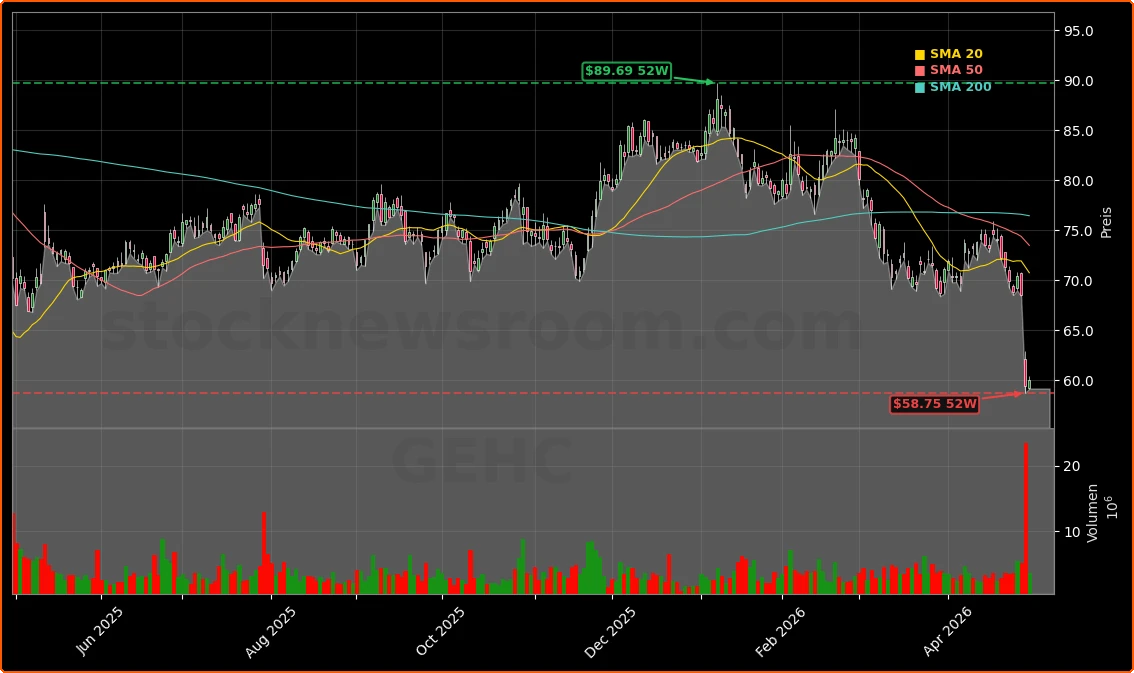
Wall Street reacted swiftly. GEHC shares plunged about 13.2% on Wednesday, closing at $59.49 and breaking to a new 52-week low within a range of $58.75 to $89.77. That single-day move stands in stark contrast to an average post-earnings reaction of roughly −0.5% over the last four quarters. The selloff also comes against a backdrop where the S&P 500 is up around 4% year to date, highlighting the stock-specific nature of the disappointment.
Within the portfolio, the Patient Care Solutions (PCS) segment was the clear soft spot. Revenue there fell 6.5%, and segment EBIT tumbled nearly 80% to just $10 million, fueling concerns that inflation and tariffs could structurally damage one of GEHC’s key franchises. Management is exploring options to improve PCS profitability, including potential portfolio actions and pricing moves, but investors will want to see tangible progress by the next set of GE HealthCare Earnings.
What does the Goldman Sachs downgrade signal?
Adding pressure, Goldman Sachs cut its rating on GEHC to Neutral from Buy and lowered its price target to $65 from $81 in the wake of the Q1 report. Goldman argues that macro exposure, including tariffs and logistics costs, is likely to overshadow positives such as the company’s product pipeline and execution on recent launches. The more cautious stance from a major Wall Street bank comes even though the new target still implies modest upside from current levels.
Other firms are more constructive. Mizuho reduced its target to $80 from $90 but kept an Outperform rating, citing macro risks yet viewing the stock as undervalued at a forward P/E of roughly 14x the revised EPS midpoint. Across the Street, 19 analysts cover GEHC, with the majority still in the Buy or Strong Buy camp and a consensus target near $90, implying more than 50% potential upside if margins stabilize.
That divergence makes the next GE HealthCare Earnings release a critical catalyst. Bulls point to reaffirmed 3%–4% organic revenue growth, a record backlog of around $21.8 billion and momentum in high-growth units like Pharmaceutical Diagnostics, which grew over 20% on new products such as Flyrcado. They also highlight recent innovation wins, including photon-counting CT and next-generation MRI platforms, plus the $2.3 billion Intelerad acquisition that deepens GEHC’s cloud-based imaging software stack in competition with enterprise platforms from NVIDIA and others in AI-enabled diagnostics.
What’s the risk-reward now for U.S. investors?
From a portfolio perspective, GEHC now trades near $60.02, roughly 27% below where it started the year and far below its 52-week high. For U.S. investors who once grouped GEHC with resilient healthcare names and cash-rich innovators like Tesla or Apple, the stock’s profile has shifted toward a classic value-versus-value-trap debate.
The bull camp sees GE HealthCare Earnings as temporarily depressed by cyclical cost shocks rather than structural demand erosion. If management can offset more than half of the inflation impact via pricing and internal efficiencies, as guided, 2026 may represent a margin trough. In that scenario, conversion of the large backlog, integration of Intelerad and continued hospital capex on CT and MRI refresh cycles could drive steady EPS growth into 2027 and gradually close the gap to consensus targets.
The bear case centers on the risk that tariffs, supply-chain friction and PCS weakness prove sticky. Net income already declined about 31% year over year, and another guidance cut would likely reinforce fears that GEHC is sliding into a lower-margin equilibrium. In that downside scenario, the stock’s compressed multiple might reflect genuine structural challenges, not an opportunity.
At this point, GE HealthCare Earnings have become one of the more closely watched data points in U.S. medtech. For investors comfortable with near-term volatility, the combination of a reset bar, supportive long-term demographics and a rich innovation pipeline may justify monitoring the name ahead of the next quarterly report, when management will have a chance to show that Q1 was a setback, not a trend.