Is Alibaba AI Cloud’s rapid growth enough to justify a painful earnings-driven sell-off in one of China’s tech champions?

How did Alibaba’s earnings hit the stock?
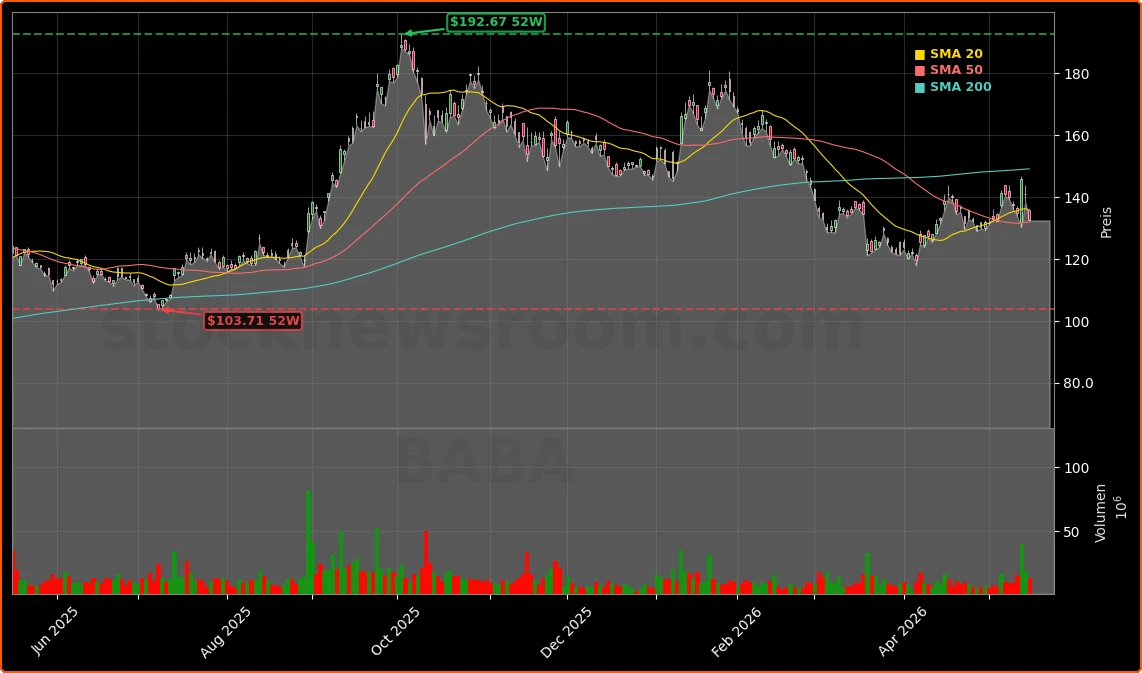
The latest fiscal Q4 2026 report landed with a thud for equity markets. While full-year revenue reached a hefty $148.40 billion and net income totaled $14.81 billion (EPS $3.89), the quarter itself was dominated by investment in AI infrastructure. Q4 showed earnings per share of just $0.09, an operating loss of $123 million and negative free cash flow of $2.51 billion on $3.90 billion of capital expenditures. That margin compression drove today’s nearly 6% slide and keeps Alibaba trading at only about 0.333 times sales, a discount versus many U.S. megacap tech peers in the S&P 500.
Valuation metrics underscore the disconnect. The company currently sits on total assets of $276.83 billion, shareholders’ equity of $153.80 billion and cash and equivalents of $19.07 billion, yet trades at a forward P/E of roughly 21 and a trailing P/E near 25. For comparison, high-multiple AI beneficiaries like NVIDIA command far richer earnings and sales multiples, while Alibaba is being valued closer to a mature e‑commerce player despite its accelerating AI push.
Is Alibaba AI Cloud finally at scale?
The growth engine behind the current investment cycle is the rebranded Cloud Intelligence Group, effectively the Alibaba AI Cloud business. Fiscal Q4 2026 revenue from this segment came in at $6.035 billion, up an impressive 38% year over year. AI-related products delivered an 11th consecutive quarter of triple-digit growth and now represent about 30% of external cloud revenue, signaling that AI workloads are no longer a niche inside the portfolio.
Management argues that years of heavy R&D are now converting into real demand. CEO Eddie Wu said Alibaba’s “full-stack AI investments have progressed from incubation to commercialization at scale,” highlighting the Qwen large language model, in-house T-Head Zhenwu PPU accelerators with more than 100,000 units deployed, and a Qwen consumer app that has surpassed 300 million monthly active users. For investors comparing Alibaba AI Cloud to U.S. hyperscalers, these metrics position the company as a genuine contender in generative AI infrastructure rather than a follower.
What does Nvidia H200 access change?
A key new variable for Alibaba AI Cloud is hardware supply. The U.S. government has approved the sale of NVIDIA’s advanced H200 AI chips to around ten Chinese tech players, including Alibaba, JD.com, ByteDance and Lenovo. These accelerators had been blocked under prior export controls, limiting Chinese access to frontier training hardware and forcing more reliance on domestic chips.
Access to H200 GPUs should boost Alibaba’s ability to run cutting-edge training and inference workloads for Qwen and enterprise clients, at least in the near term. At the same time, Chinese tech giants such as Tencent and Alibaba have signaled they expect greater production of local chips and heavier use of in-house technology this year, which could gradually reduce dependence on U.S. silicon. For NVIDIA and memory suppliers like Micron, that mix of H200 demand today and rising Chinese self-sufficiency tomorrow is a double-edged sword.
How strong is Alibaba beyond the cloud story?
Outside Alibaba AI Cloud, the broader ecosystem continues to scale. Taobao Instant Commerce revenue grew 57% year over year to $2.898 billion, reflecting resilient Chinese consumer demand for fast delivery formats. The premium 88VIP membership base climbed past 62 million subscribers, reinforcing Alibaba’s ability to monetize loyalty and drive repeat engagement across retail and services.
Despite the current investment-heavy phase, Alibaba is returning capital to shareholders. The board declared an annual cash dividend of $0.13125 per ordinary share, or $1.05 per ADS, amounting to roughly $2.5 billion, with a June 11, 2026 record date and a July 6, 2026 payment. The company also repurchased 73 million ordinary shares for about $1.046 billion over the fiscal year and issued $3.2 billion in convertible notes plus HK$12 billion in exchangeable bonds to fund cloud and international expansion. That combination of buybacks, dividends and fresh funding suggests management is balancing shareholder returns with long-term AI build‑out.
How are Wall Street analysts framing Alibaba?
On Wall Street, sentiment remains more constructive than the stock price implies. The company is covered by a broad analyst base, with 8 strong buy, 31 buy, 2 hold and 1 strong sell recommendations and an average target price of $188.98. U.S. banks including Citigroup, Goldman Sachs and Morgan Stanley have highlighted the disconnect between Alibaba’s scale and its discounted multiples versus U.S. tech peers on the NASDAQ and within the S&P 500, particularly given the momentum in Alibaba AI Cloud.
For American investors, the key debate is whether the current margin reset represents a temporary valley before AI-driven earnings power kicks in, or a longer period of structurally lower profitability. While prior regulatory and geopolitical shocks punished Alibaba’s valuation, easing U.S. chip restrictions and clear progress in commercializing Qwen and related services offer a more tangible growth roadmap than many early-stage AI names.
Related Coverage
For a deeper dive into how the latest quarter’s 84% profit decline intersects with the rapid expansion of Alibaba AI Cloud, readers can explore “Alibaba Earnings Shock: Profit -84% While AI Cloud Booms”. That analysis breaks down segment-level trends, margin dynamics and what the current investment cycle could mean for Alibaba’s long-term AI leadership versus U.S. and Chinese competitors.
Alibaba’s full-stack AI investments have progressed from incubation to commercialization at scale.— Eddie Wu, CEO of Alibaba
In summary, Alibaba Group Holding Limited is trading lower today because near-term earnings are being sacrificed to fund the build-out of Alibaba AI Cloud, Qwen and next-generation infrastructure. For investors willing to look beyond quarterly noise, the combination of strong cloud growth, expanding AI workloads and renewed access to high-end chips positions Alibaba as a diversified AI platform at a valuation far below U.S. mega-cap peers like Apple or Tesla. The next few quarters will show whether this aggressive spending can translate into sustained profit growth, but for long-term portfolios seeking discounted exposure to global AI, Alibaba’s current reset could prove to be an opportunity rather than a warning sign.