Can the Alibaba Chip Smuggling headlines derail the group’s fragile AI-driven recovery just as investors turn bullish again?

How is Alibaba trading after the chip headlines?
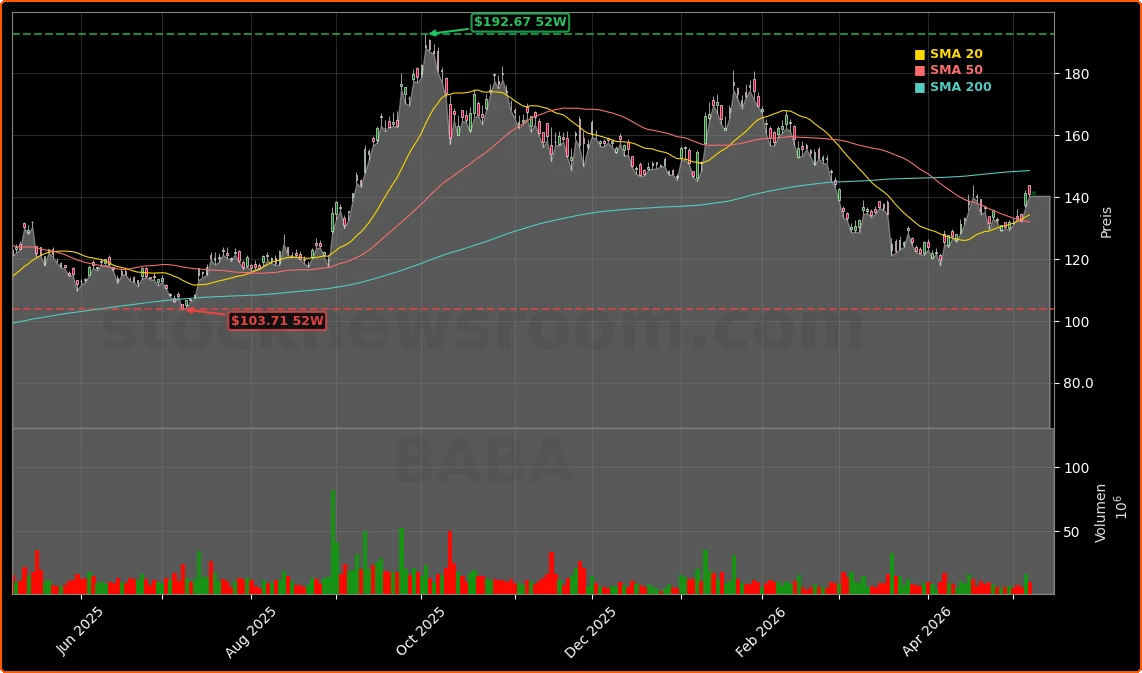
Alibaba Group Holding Limited ADRs closed Thursday at $141.03 and were quoted around $141.80 in early pre-market trading on Friday, up about 0.6% as of 3:40 a.m. ET. The stock has staged a notable rebound, including a roughly 7% surge earlier this week that still leaves it more than a quarter below its 52-week high, underscoring how far sentiment had previously fallen.
Hong Kong-listed shares also jumped about 5% this week, signaling that the latest controversy around the alleged Alibaba Chip Smuggling route via Thailand has not yet derailed the recovery narrative. On Wall Street, the move comes against a backdrop of firm major indices, with the Nasdaq and S&P 500 supported by ongoing enthusiasm for AI beneficiaries such as NVIDIA and other mega-cap tech names.
Options markets are bracing for more volatility into Alibaba’s upcoming earnings, with recent estimates implying a potential move of nearly 6% on the day of the report. For U.S. investors, that means the chip story is landing at a time when positioning is already sensitive around May 13 earnings.
What do we know about the Alibaba Chip Smuggling case?
U.S. prosecutors this year laid out an alleged scheme involving Super Micro Computer servers embedded with advanced Nvidia AI chips, diverted through a Southeast Asian intermediary to skirt export controls into China. People familiar with the matter identified the unnamed intermediary as Bangkok-based OBON Corp., a company involved in Thailand’s national AI push, and said that Alibaba was among several Chinese end customers for the hardware.
Critically for investors, Alibaba has publicly stated that it has no business relationship with Super Micro, OBON or any of the third-party brokers cited in the U.S. indictment, and that all chips used by the company are obtained legally and in full compliance with applicable regulations. That response is central to how the Alibaba Chip Smuggling narrative is being assessed on Wall Street: regulators are scrutinizing the broader flow of AI semiconductors into China, but there is no direct allegation that Alibaba itself violated U.S. export rules.
Still, the episode highlights the growing geopolitical and regulatory risk around access to cutting-edge AI hardware. Any tightening of export controls, or secondary sanctions that touch large Chinese cloud providers, could affect the pace and cost of Alibaba’s AI infrastructure build-out, even if the company remains in technical compliance.
How does this affect Alibaba’s AI and cloud story?
The timing is awkward. Analysts and institutional investors have been shifting their focus back to Alibaba’s AI and cloud strategy just as the Alibaba Chip Smuggling discussion resurfaces. The group’s cloud arm and international digital commerce division have rolled out AI tools such as Accio Work, which now serves more than 230,000 businesses globally, positioning Alibaba as a key infrastructure and software player in the AI economy.
Research from CLSA recently trimmed its U.S. price target for Alibaba from $200 to $190 but kept an “Outperform” rating, emphasizing robust expected growth in cloud, quick commerce, and customer management revenue. CLSA projects strong top-line momentum—around RMB 241.1 billion in Q4 FY26 revenue—but warns that near-term margins could remain under pressure due to heavy investment in new growth initiatives.
That mirrors a broader market view: Simply Wall St’s valuation work suggests the ADRs trade at a discount to intrinsic value, despite a price-to-earnings ratio above the broader retail sector. Large institutions such as Jennison Associates, Capital World Investors and Coatue Management have recently increased positions, signaling that some long-term capital is willing to look past headline risk and bet on the AI and cloud pivot.
How does Alibaba compare to U.S. tech peers?
From a U.S. portfolio perspective, Alibaba sits at the crossroads of three dominant themes: Chinese consumer internet, AI infrastructure, and regulatory risk. Unlike Apple or Tesla, whose China exposure is largely on the demand and manufacturing side, Alibaba is at the center of China’s domestic AI stack—more comparable to how Microsoft or Amazon Web Services function in the U.S. ecosystem, though with a very different regulatory backdrop.
Exchange-traded funds highlight that distinction. The Schwab Emerging Markets Equity ETF, for example, has nearly 3% of assets in Alibaba and larger weightings in Taiwan Semiconductor and Tencent, giving U.S. investors indirect exposure to the company’s AI ambitions along with other Asia tech heavyweights. That makes the ripple effects of the Alibaba Chip Smuggling headlines relevant not just to direct BABA holders, but to anyone owning broad EM funds.
At the same time, core profitability is being squeezed by China’s weak consumption backdrop and rising competition in domestic AI services, especially following high-profile model launches from challengers like DeepSeek. Whether AI monetization and cloud growth can offset pressure in legacy e-commerce and quick commerce businesses remains the key strategic question for Wall Street.
Related Coverage
Investors looking for a deeper dive into Alibaba’s AI thesis may want to examine how its cloud and automation strategy has driven recent share price gains. An in-depth discussion of the company’s world-model ambitions, cloud pivot and market reaction is available in this analysis of Alibaba’s AI strategy and +4.8% stock surge, which explores whether the latest rally can turn into a more durable rerating.
In conclusion, the unfolding Alibaba Chip Smuggling story adds another layer of regulatory uncertainty just as Alibaba’s share price and AI narrative regain traction. For U.S. investors, the stock remains a leveraged play on China’s consumer and AI cycles, but also on Washington–Beijing tech tensions. The next earnings report and any further U.S. enforcement actions will determine whether today’s concerns fade or evolve into a more lasting risk factor.