Can the Alibaba AI Strategy turn Qwen and cloud into a $100 billion engine while regulators and chip limits close in?

How is Alibaba trading before earnings?
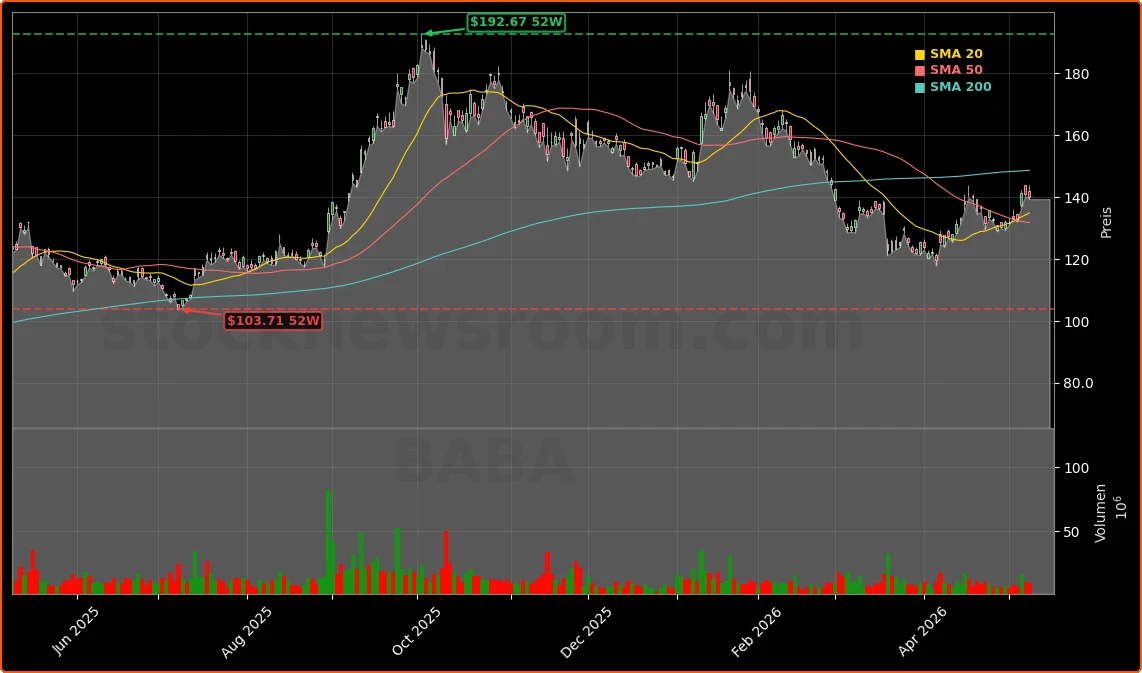
Alibaba Group Holding Limited (BABA) last changed hands at $140.06, down 0.7% from the prior close of $141.03, with after-hours indications near $140.00 as of late Thursday in New York (ET). The ADR remains well below its 52‑week high of $192.67 and above the 52‑week low of $103.71, leaving room for upside if the Alibaba AI Strategy delivers on growth expectations. Options pricing implies roughly a 6% move around the May 13 earnings release, a reminder that Wall Street expects volatility as cloud and AI spending ramps.
In Europe, the stock recently traded around EUR 119, up about 11% over the past month but still down roughly 10% year-to-date. The mixed performance mirrors broader China tech sentiment, even as the NASDAQ and S&P 500 sit closer to their highs, led by U.S. AI beneficiaries such as NVIDIA, Apple and Tesla.
What is changing in Alibaba AI Strategy?
The latest phase of the Alibaba AI Strategy focuses on turning Qwen, its in-house large language model and flagship assistant, into a gateway for everyday services. Qwen is being integrated directly into Taobao and Tmall so users can shop via conversation rather than keyword searches. Shoppers will be able to describe items in natural language through text or voice, while Qwen handles product discovery, comparisons and checkout steps in the background.
This push toward “conversational shopping” echoes what U.S. investors have seen from Apple’s Siri upgrades, Alphabet’s Gemini experiments and Tesla’s work on AI‑assisted interfaces, but with a uniquely commerce‑centric angle. Earlier this year, Alibaba also began embedding Qwen more broadly across food delivery, travel booking and entertainment services, aiming to create a single AI layer over its mature platform rather than separate point solutions.
On the enterprise side, Alibaba is expanding its Accio Work AI suite into B2B commerce through Accio Launchpad, designed to help businesses design and procure branded merchandise. Together, these initiatives show the Alibaba AI Strategy targeting both consumer engagement and enterprise workflow automation, key pillars if the company is to hit management’s ambitious goal of more than $100 billion in annual cloud and AI revenue within five years.
Do chip-smuggling probes threaten Alibaba’s plans?
The bullish narrative around Alibaba AI Strategy is being tested by fresh U.S. law‑enforcement scrutiny. Prosecutors in the United States have charged a Bangkok-based company, OBON Corp., with orchestrating a scheme to move servers containing advanced NVIDIA H200 and B300 chips into China via Super Micro Computer hardware, allegedly in violation of export controls. Court documents identify Alibaba as a potential end customer for some of this hardware.
Alibaba has strongly denied any involvement, saying it maintains no business relationships with the named intermediaries and does not deploy sanctioned hardware in its data centers. For U.S. investors, the key questions are whether regulators ultimately link Alibaba to illicit procurement and whether any finding could trigger secondary sanctions or tighter restrictions on non‑U.S. suppliers.
Even absent direct penalties, the episode underscores how dependent the Alibaba AI Strategy is on access to high-end accelerators at a time when Washington is tightening controls. Management will likely face pointed questions on the earnings call about how it plans to secure compliant compute capacity, including through domestic chip alternatives and localized cloud nodes that respect U.S. export rules.
How much will AI and cloud spending hit margins?
Alibaba is not alone in facing near-term profitability pressure from heavy AI investment. Bloomberg has highlighted that both Tencent and Alibaba are seeing growth slow even as AI spending doubles, with valuation now hinging more on future AI monetization than on current earnings. For Alibaba, the capex ramp is especially aggressive: the company plans to invest roughly 3.8 trillion yuan over the next three years in new data centers and infrastructure.
Brokerage houses remain broadly constructive but cautious on earnings. CLSA recently cut its price target for Alibaba from $200 to $190 while maintaining an “Outperform” rating, citing expectations for strong cloud, quick‑commerce and marketing revenue but warning that near‑term profits will be “significantly subdued” by investment. Simply Wall St’s valuation work suggests fair value near $184 per share, implying the stock still trades at a notable discount despite the recent rebound.
For U.S. investors, the trade-off resembles debates around other AI heavyweights: should they prioritize near‑term margin expansion or accept lower profitability now to capture a larger share of the long‑run AI stack? The Alibaba AI Strategy clearly leans toward the latter, positioning the group as a digital infrastructure provider rather than just an e‑commerce platform.
How are markets pricing the AI and legal risks?
Despite the ongoing investigations, Alibaba shares have rallied in recent weeks and outperformed on several sessions when AI-related names led gains on Wall Street. MarketWatch data show the ADR surged nearly 7% in one strong session, even as it remains over 25% below its 52‑week high, leaving room for re‑rating if cloud growth and Qwen monetization accelerate.
At the same time, Hong Kong trading has been choppy, with modest pullbacks following rallies, indicating that regional investors are still digesting the balance between opportunity and risk. Institutional flows are mixed as well: some U.S. asset managers such as Truist Financial have trimmed positions, while others, including Asian-focused funds like RD Finance, have built new stakes, betting that current concerns are already reflected in the share price.
With Tencent set to report its own earnings and global peers like Microsoft and NVIDIA continuing to post robust AI‑driven results, Alibaba’s upcoming quarter will be closely watched as a test of whether China’s platforms can translate AI hype into sustainable revenue growth without triggering additional regulatory blowback.
Related Coverage
Investors looking for a deeper dive into the legal overhang and hardware bottlenecks can read Alibaba Chip Smuggling Warning Puts AI Cloud Plans Under Scrutiny, which explores how export-control risks intersect with the company’s cloud roadmap. That analysis complements today’s focus on the broader Alibaba AI Strategy by zooming in on how chip supply constraints could affect data center build‑outs and Qwen’s performance over the next few years.
In summary, Alibaba AI Strategy is evolving into a full‑stack play that spans conversational shopping, enterprise tools and massive cloud infrastructure, even as it faces scrutiny over how it sources advanced chips. For U.S. investors, the stock now represents a high‑beta way to gain exposure to China’s AI build‑out at a valuation that still lags many NASDAQ peers. The next earnings print and management’s commentary on compliance and capex will be crucial in determining whether this renewed AI push translates into a sustained rerating on Wall Street.