Is Alibaba AI Infrastructure being squeezed by China’s data center boom, or is Wall Street misreading a strategic advantage?

What Does $295 Billion in AI Infrastructure Mean for Alibaba?
China’s announced 2 trillion yuan ($295 billion) five-year investment in AI-optimized data centers is the largest sovereign cloud infrastructure commitment since the U.S. CHIPS and Science Act. Unlike broad-based stimulus, this program targets AI compute density, energy-efficient cooling, and domestic chip interconnects—directly overlapping with Alibaba’s core infrastructure roadmap. The move triggered a 3.25% intraday drop in Alibaba Group Holding Limited shares, as investors priced in potential pricing pressure on cloud services. Yet the rebound in after-hours trading signals growing recognition that Alibaba AI Infrastructure isn’t being displaced—it’s being repositioned. Citigroup analysts emphasize that public infrastructure will serve state-owned enterprises and SMEs, while Alibaba retains its premium enterprise segment—where margins exceed 35% and custom AI model deployment drives sticky revenue.
How Does Alibaba AI Infrastructure Compare to U.S. Hyperscalers?
Unlike Meta or Microsoft, Alibaba does not rely on massive U.S.-based AI chip imports for its most advanced training clusters—its self-developed Yitian 710 CPUs and Pingtouge AI chips now power over 40% of its inference workloads. That vertical integration reduces exposure to U.S. export controls and accelerates time-to-market for generative AI tools like Qwen 3 and Token Foundry’s new multimodal foundation models. While NVIDIA’s Blackwell architecture dominates global AI training, Alibaba’s infrastructure stack is increasingly optimized for inference at scale—mirroring the shift underway at Amazon Web Services and Google Cloud. This divergence makes Alibaba AI Infrastructure a unique hedge in portfolios increasingly concentrated in U.S. chip and software names.
Is the Pentagon Blacklist a Structural Headwind or a Catalyst?
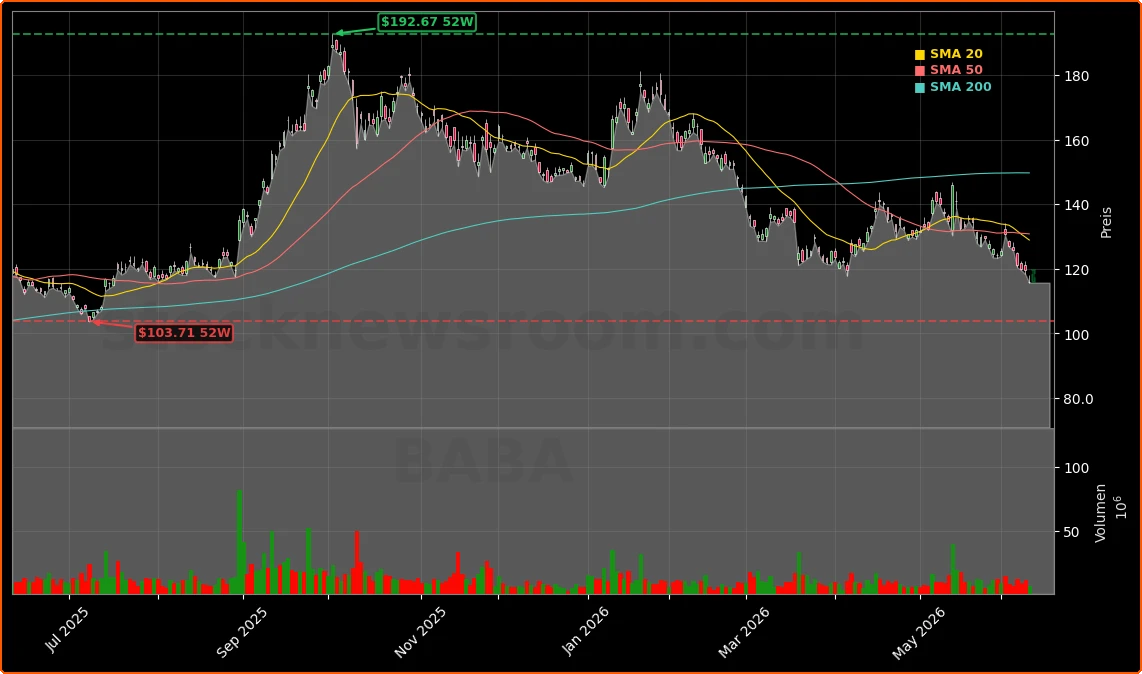
Alibaba Group Holding Limited’s inclusion on the U.S. Defense Department’s Section 1260H list—alongside Baidu and BYD—bars Pentagon contracts and third-party procurement starting in 2027. But institutional flows tell a different story: O Shaughnessy Asset Management increased its stake by 5.9% in Q4 2026, while Northwestern Mutual Wealth Management and Capital World Investors expanded positions significantly. Meanwhile, Brandes Investment Partners reduced its holding by only 2.7%, and the company’s $1.05 annual dividend—payable July 13—remains intact. Analysts at Citigroup maintain a ‘Buy’ rating with a $188.76 price target, citing Alibaba’s AI infrastructure advantage in domestic AI adoption velocity, not just cost arbitrage.
Can Token Foundry Unlock New Valuation Levers?
We view these market concerns as premature. We believe this government investment should not be seen as a ‘zero-sum game’ for private hyperscalers like BABA, Tencent and Baidu.— Citigroup analysts
Alibaba’s newly formed Token Foundry unit—led directly by CEO Eddie Wu Yongming—consolidates AI model development, open-source tooling, and enterprise AI deployment under one P&L. The move signals a decisive shift from ‘cloud-as-infrastructure’ to ‘AI-as-product’. Early deployments with Chinese financial institutions and logistics firms show 30% faster model fine-tuning cycles versus public cloud alternatives. That agility matters: in a fragmented global AI stack, Alibaba AI Infrastructure now serves as both a training ground and commercialization engine—similar to how Amazon’s AWS incubated Alexa before spinning out its AI services. With Token Foundry’s first enterprise SaaS contracts expected in Q3, this infrastructure layer becomes monetizable—not just defensible.