Are Arm Holdings Earnings and its AI data center push enough to justify a soaring, highly valued chip architecture giant?

How did Arm Holdings Earnings surprise Wall Street?
For its most recent reported quarter, Arm Holdings plc posted revenue of $1.49 billion, topping expectations of roughly $1.47 billion. Adjusted earnings came in at $0.60 per share, also ahead of consensus estimates near $0.58. The latest Arm Holdings Earnings thus marked the company’s third straight year of more than 20% annual revenue growth, underscoring how quickly the business is pivoting from a smartphone‑centric licensing model toward AI‑heavy workloads in data centers.
The mix of revenue is shifting in a way many growth investors like to see. Licensing and other revenue surged 29% year over year to $819 million, beating expectations of around $774 million, as cloud and chip customers rushed to secure next‑generation CPU designs. Royalty revenue, which is typically more tied to unit shipments in smartphones and other devices, grew a slower but still solid 11% to $617 million–$671 million, modestly below some estimates but enough to keep total top‑line growth elevated. Margins stayed robust, with a gross margin near 98% and an adjusted operating margin around 49%, reflecting the high‑value nature of Arm’s intellectual property.
Why is AI data center demand so important for Arm?
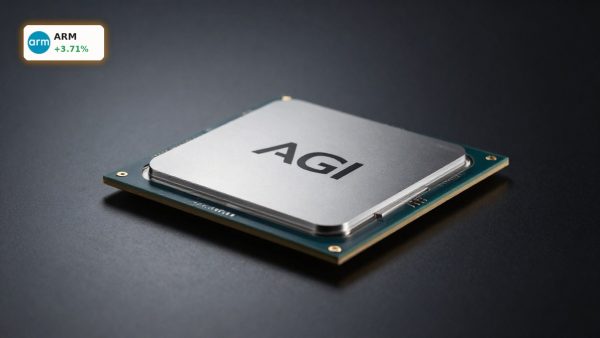
The key bullish narrative coming out of the latest Arm Holdings Earnings is the acceleration in AI and data center demand. Management highlighted that its new Arm AGI CPU platform for data centers saw demand come in at roughly double initial expectations. As hyperscalers and cloud providers expand AI infrastructure, Arm believes these AGI CPUs could generate more than $2 billion in additional revenue over the next few years, potentially by 2027/28.
Data center‑related revenue has already almost doubled year over year, turning what used to be a niche segment into a major growth engine. This positions ARM in the same strategic conversation as NVIDIA, AMD and traditional CPU vendors, but with a different monetization model built around architecture and licensing rather than manufacturing. The shift also helps justify the stock’s premium valuation, with Benzinga’s momentum rankings putting Arm in the 92nd percentile for momentum but only the 2nd percentile for value, a combination that clearly signals growth‑stock status rather than a value play.
The AI angle is not limited to the cloud. Partners like Samsung are integrating Arm‑based designs into next‑generation Exynos mobile processors, and AI optimization firms are tailoring their software to Arm‑compatible NPUs in both mobile and data center environments. These ecosystem moves deepen the company’s moat and support the case that AI‑driven workloads will be a multi‑year tailwind beyond a single upgrade cycle.
What is the outlook and where are the risks?
Looking ahead, Arm guided for current‑quarter revenue of around $1.29 billion, slightly ahead of consensus near $1.25 billion. Adjusted EPS is expected between $0.36 and $0.44, bracketing prior estimates around $0.37. That outlook keeps the growth story intact but was not the blowout some momentum traders had hoped for, helping explain the sharp swings in the share price between the U.S. close and subsequent off‑session trading.
The main risk flagged alongside the upbeat Arm Holdings Earnings commentary is the slowdown in the smartphone market, still a key royalty driver given that Arm designs power virtually every modern handset. Management noted that the weakness is most pronounced in the lower‑end segment, which should limit the financial hit, but it remains a drag on near‑term royalty growth. Higher device prices tied to memory chip shortages and cautious consumers have slowed upgrades worldwide, offset in part by stronger demand for high‑end, AI‑capable phones where Arm can capture more value per device.
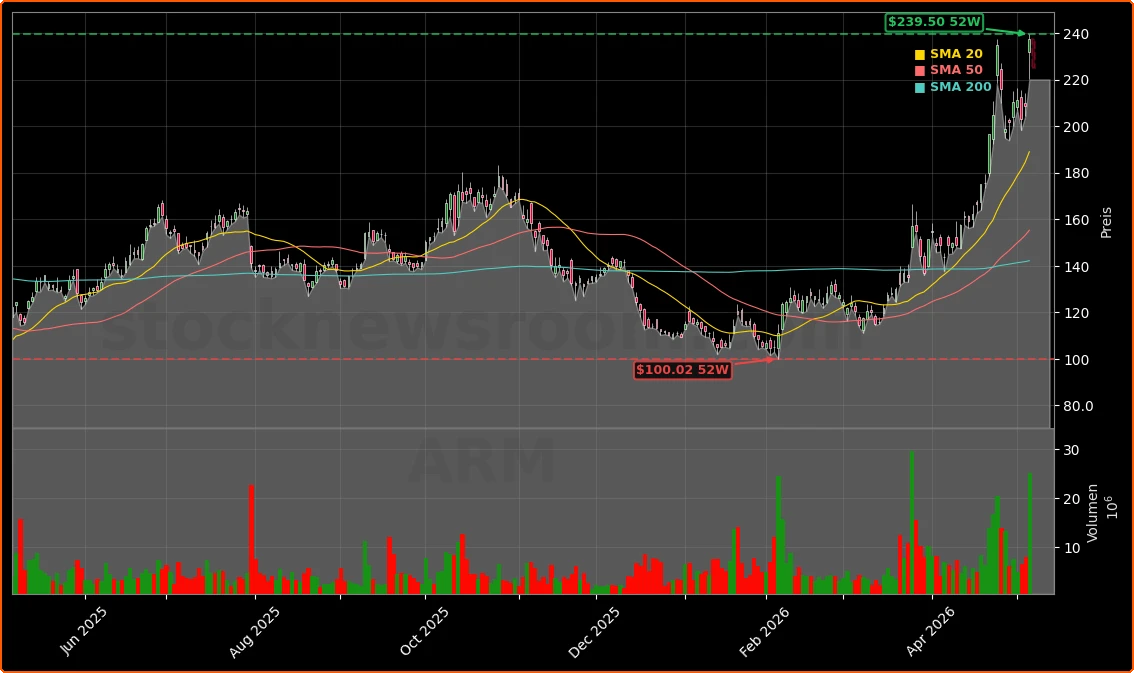
The stock’s reaction illustrates how sensitive AI winners have become to even minor outlook disappointments. After an initial surge of roughly 25% in late U.S. trading on the results, Arm shares reversed and traded down as much as 8% off those highs once investors focused on the smartphone commentary and the still‑lofty valuation. The shares are up more than 90% year to date and have traded in a 52‑week range of $100.02 to $239.50, putting Wednesday’s $239.50 intraday high right at the top of that band.
How does Arm stack up against U.S. chip leaders?
For American investors comparing Arm with other AI beneficiaries, the distinction lies in business models. ARM earns primarily through up‑front license fees and ongoing royalties when chips based on its designs ship in volume. By contrast, NVIDIA and AMD collect revenue directly from selling GPUs and accelerators, while CPU incumbents like Intel compete with their own x86 architectures. That means Arm’s earnings leverage comes less from factory utilization and more from design wins and ecosystem adoption.
From a portfolio standpoint, Arm sits somewhere between a high‑growth IP licensor and a leveraged bet on AI infrastructure. Its ties to major platform companies, including long‑time partner Apple and automotive and edge‑computing players like Tesla, give it diversified exposure beyond just smartphones and cloud servers. However, the rich valuation and recent volatility suggest many positives are already priced in. Investors will be watching how quickly AGI CPU revenue ramps and whether smartphone royalties stabilize to determine if the multiple can be sustained.
Related Coverage: For a deeper dive into how the latest Arm Holdings Earnings fit into the broader AI trade, readers can explore the analysis “Arm Earnings +12.2% Surge: Is the AI Boom Just Starting?” on StockNewsroom. That piece examines whether Arm’s rapid share price gains reflect a durable AI opportunity or an overheating market, and discusses how the stock compares to other high‑momentum chip names.
In summary, the latest Arm Holdings Earnings confirm that AI and data center demand are transforming Arm from a smartphone‑centric licensor into a broader infrastructure play. The combination of rising licensing revenue, strong margins and an expanded AGI CPU roadmap keeps the long‑term narrative attractive, even as smartphone headwinds and an elevated valuation introduce volatility. The next few quarters will show whether AI‑driven growth can consistently outpace cyclicality in handsets and justify ARM’s new place among the market’s top AI beneficiaries.