Are AT&T Earnings strong enough to justify the latest deals and segment overhaul as the stock suddenly slides again?

How are markets reacting to AT&T Earnings momentum?
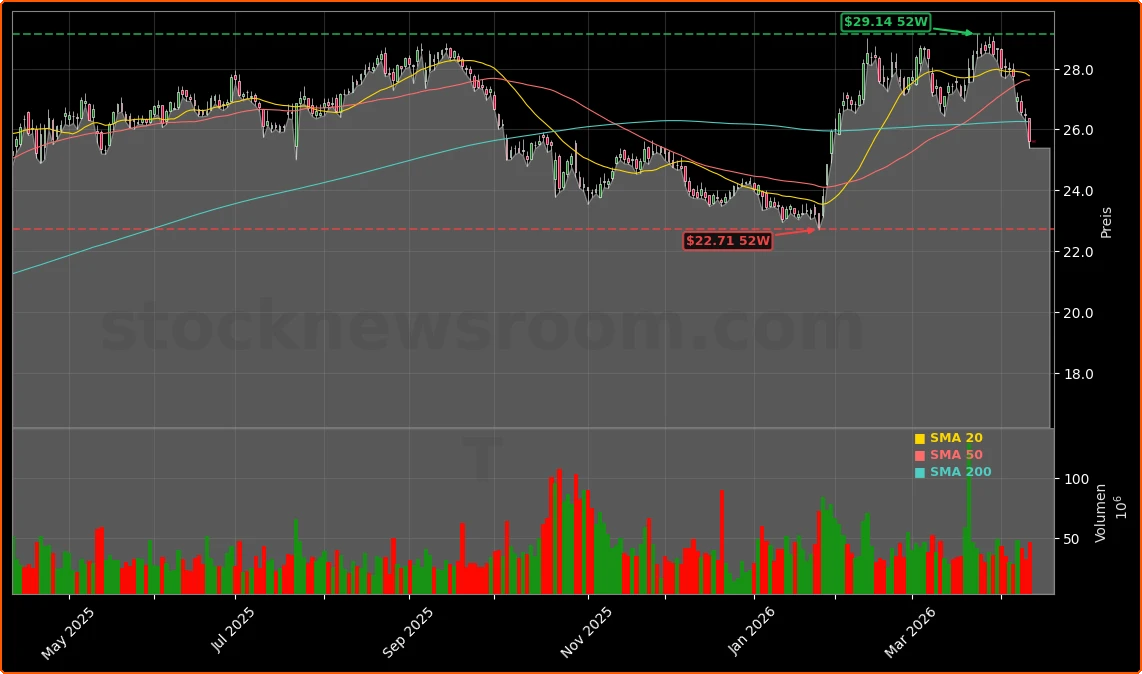
AT&T Inc. (T) shares trade around $25.61, down about 3% on the day and roughly 8% below recent highs near $29, despite solid AT&T Earnings momentum. The stock is also marginally lower in after-hours trading at $25.59, leaving it close to a widely watched support zone between $25 and $26 that many technical traders view as an important line in the sand. Even after the recent pullback, the stock remains positive year to date, but the reversal highlights growing caution as the company enters a structurally more complex phase.
Wall Street’s full-year 2026 framework still looks constructive. Adjusted EPS for 2025 reached $2.12, up 8.7% from $1.95 in 2024, and management has signaled a path to $2.25–$2.35 in 2026 on low single-digit revenue growth from roughly $125.6 billion. The key question for the next AT&T Earnings cycles is whether that trajectory holds as competition intensifies and integration costs from recent deals show up in the numbers.
Institutional flows have been mixed but broadly supportive. Sumitomo Mitsui Trust Group sharply increased its position to more than 19.6 million shares, while firms such as the State of Alaska Department of Revenue and Robeco trimmed exposure modestly. Other investors, including Tectonic Advisors and Retirement Guys Formula, materially added to their holdings, underscoring the stock’s appeal as a high-yield defensive play in telecom.
What did the last AT&T Earnings report show?
The most recent AT&T Earnings release for Q4 2025 exceeded expectations on both the top and bottom line. Adjusted EPS came in at $0.52, roughly 11% above the $0.47 consensus, while revenue reached $33.47 billion, beating estimates of about $32.84 billion and growing 3.6% year over year. Those results capped a year of improving profitability, driven by fiber growth and cost discipline.
Operationally, AT&T continues to lean into fiber as its primary growth engine. Fiber connections climbed 11.5% year over year to 10.4 million, with 42% of fiber households also subscribing to AT&T wireless, highlighting cross-sell potential. However, postpaid phone churn ticked up 13 basis points to 0.98% in Q4, signaling that competitive pressure from U.S. rivals such as Verizon and T-Mobile is not easing.
From a branding perspective, AT&T has also remained visible, rolling out new TV spots alongside large consumer advertisers like The Home Depot and Dr. Squatch. While marketing alone will not drive AT&T Earnings, maintaining brand relevance matters as the company seeks to deepen customer relationships across mobile, broadband and bundled offerings.
How will the new AT&T Earnings segments work?
Beginning with Q1 2026, AT&T will report under three segments: Advanced Connectivity, Legacy and Latin America. Advanced Connectivity will house core growth assets such as 5G mobility, fiber broadband and enterprise connectivity solutions. The Legacy segment will capture declining businesses, including older wireline and non-core services, where revenue is expected to fall by more than 20% year over year. Latin America remains comparatively small but provides optionality in emerging markets.
For investors tracking future AT&T Earnings, the main swing factor is whether Advanced Connectivity can deliver sustained service revenue growth of 5% or more to offset rapid Legacy erosion. If that balance holds, the company’s EPS and free cash flow guidance for 2026 looks achievable even as it invests heavily in network upgrades.
Those investments are substantial. AT&T plans roughly $250 billion of cumulative capex to position its network for the AI era, including denser 5G, cloud-aligned transport and expanded fiber. While such spending should bolster long-term competitiveness against peers and enable growth areas like edge computing and AI-driven enterprise services, it also risks pressuring margins and limiting near-term flexibility on buybacks or large dividend hikes.
How important are the Lumen and EchoStar deals?
The recently closed Lumen Mass Markets fiber acquisition and EchoStar spectrum license deal are central to the next phase of AT&T Earnings. Management has described both as modestly dilutive in the first years, with accretion expected from 2028 onward as synergies and additional revenue streams kick in. The Lumen transaction deepens AT&T’s fiber footprint in key markets, while EchoStar’s airwaves expand spectrum depth that can support higher data usage and improved 5G performance.
On Wall Street, analysts still generally classify the stock as a “Moderate Buy” with an average price target around the low-$30s, suggesting double-digit upside from current levels. While specific banks like Goldman Sachs, Citigroup or Morgan Stanley are not singled out in recent filings, the consensus tone is that AT&T remains a core income holding with measured growth potential rather than a high-octane AI play like NVIDIA.
Relative to U.S. peers, Verizon is similarly viewed as a defensive, dividend-focused telecom, while T-Mobile is often seen as the growth leader in 5G, particularly in postpaid and fixed wireless access. However, AT&T’s combination of fiber growth, 5G expansion and cross-selling across consumer and enterprise could still deliver attractive total returns if management executes on integration and cost targets.
For diversified portfolios that already hold mega-cap tech names such as Apple or high-beta EV stocks like Tesla, AT&T can serve as a ballast, offering a robust dividend and exposure to essential connectivity infrastructure.
In the end, AT&T Earnings remain the key catalyst. Recent beats, rising EPS and a clear segmentation strategy all support the bull case, but investors will want to watch churn, Legacy revenue declines and capex efficiency closely. The next quarterly report on April 22 at 8:30 AM ET will show whether the company can turn its ambitious network investments and recent acquisitions into durable cash generation. For long-term, income-oriented investors, AT&T still looks like a credible candidate to hold alongside growth names in a balanced U.S. equity portfolio.