
Can Bitcoin shake off MicroStrategy-driven selling fears before July’s institutional catalysts finally change the market narrative?

Why is MicroStrategy driving Bitcoin volatility?
MicroStrategy’s repeated announcements about potential Bitcoin sales to fund corporate obligations have become a recurring overhang on Bitcoin (BTC/USD). With over 250,000 BTC held on its balance sheet — representing more than 1.2% of the total supply — any hint of liquidation triggers immediate downside pressure. The company recently confirmed it may sell portions of its holdings to stabilize debt covenants under its Digital Credit Capital Framework, a move analysts at RBC Capital Markets describe as ‘structurally bearish for near-term sentiment.’ This isn’t theoretical: MicroStrategy’s stock has swung over 15% intraday on similar news in Q2 2026, reinforcing how tightly its equity and BTCUSD correlate. For U.S. portfolios holding both MicroStrategy and broad tech ETFs, this linkage amplifies risk — especially as the NASDAQ remains sensitive to crypto-related volatility.
Is July 2026 the inflection point for Bitcoin Market Analysis?
Historical seasonality suggests yes — and Wall Street is taking notice. July has delivered positive returns for Bitcoin in 7 of the last 9 years, and this year’s setup is unusually potent. The Clarity Act — now advancing through Senate committee — would establish clear federal regulatory guardrails for digital assets, a long-awaited catalyst for pension funds and sovereign wealth funds. Bloomberg reports that at least three U.S. state treasuries are evaluating Bitcoin allocations this quarter, while stablecoin transaction volume on U.S.-licensed rails surged 42% in June. This institutional momentum contrasts sharply with retail fatigue: Bitcoin ETF outflows totaled $1.3 billion in June, per Bloomberg data. Still, Goldman Sachs maintains its $75,000 year-end price target, citing ‘accelerating treasury adoption and declining mining difficulty as key inflection signals.’
How does Bitcoin compare to tech peers like NVIDIA and Tesla?
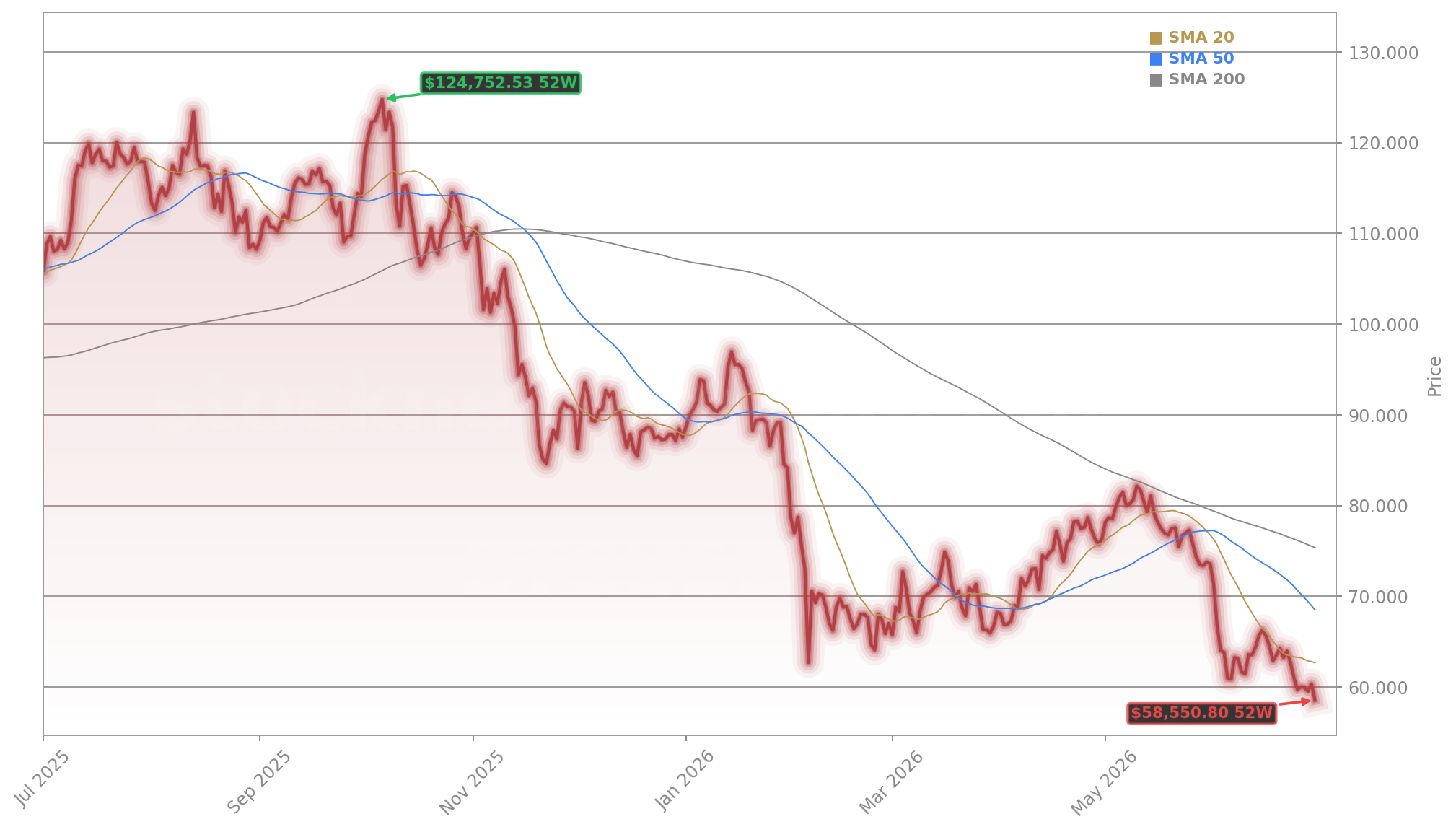
Bitcoin’s 2026 performance diverges sharply from the NASDAQ’s 18% YTD gain — led by AI stocks like NVIDIA, which rose 34% this quarter on strong data-center demand. Tesla, meanwhile, gained 12% amid renewed EV demand and AI software monetization. By comparison, BTCUSD is down 56% from its October 2025 high, underperforming both the S&P 500 and the tech-heavy NASDAQ. Yet correlations remain strong: when Bitcoin drops more than 3% in a day, the ARK Innovation ETF (ARKK) averages a 1.8% decline — a pattern Citigroup attributes to ‘shared risk-on investor positioning.’ This suggests Bitcoin Market Analysis must now account for broader tech liquidity flows, not just crypto-specific drivers.
What’s driving the inverse Bitcoin fund surge?
The BITI ETF — designed to deliver inverse daily returns of Bitcoin — rose 2.55% yesterday, its strongest single-day gain since March. This isn’t isolated: BITI is up 14% in June, outperforming the S&P 500 by over 1,100 basis points. The move signals growing institutional hedging activity — particularly among hedge funds reducing crypto exposure ahead of Q3 earnings season. According to AP, over $4.2 billion in Bitcoin-related options expired out-of-the-money last week, the highest weekly volume since Q4 2025. That volatility underscores how far Bitcoin has fallen from its ‘digital gold’ narrative — now competing with tangible inflation hedges like gold and real estate, as noted in recent Fed commentary.
Can stablecoin adoption offset selling pressure?
Yes — but slowly. U.S. dollar-pegged stablecoin supply grew by $21 billion in Q2 2026, per data from Chainalysis, with 68% of that growth tied to U.S.-regulated issuers like Circle and Paxos. That growth underpins real-world utility: PayPal’s stablecoin payments now process over $850 million weekly, and Walmart’s pilot with JPMorgan’s JPM Coin is expanding to 12 states. These micro-catalysts — highlighted by Coinbase CEO John D’Agostino — suggest structural demand is building beneath the price noise. Yet as Joe Kernan of Fidelity Digital Assets notes, ‘utility doesn’t move price until liquidity meets conviction — and right now, conviction is being tested.’
Utility doesn’t move price until liquidity meets conviction — and right now, conviction is being tested.— Joe Kernan, Fidelity Digital Assets
Related Coverage: Is the latest Bitcoin Plunge talk just noise, or is BTC quietly preparing for a much bigger move? Bitcoin Plunge Warning: Is BTC Setting Up Its Next Big Move?. Meanwhile, Coinbase Migration -2.3% as ARK Buy Meets Revenue Hype shows how regulatory clarity is reshaping exchange valuations — a key input for Bitcoin Market Analysis. These developments reinforce that Bitcoin’s next leg up won’t be driven by hype, but by infrastructure maturity and institutional onboarding.