
Is Bitcoin Regulation becoming the real market catalyst for BTC as exchanges, Wall Street, and lawmakers all pull in different directions?

Why is CME suing the CFTC?
CME Group filed legal action against the Commodity Futures Trading Commission this week over its approval of perpetual crypto swaps — a move CME argues violates the Dodd-Frank Act by misclassifying swaps as futures. CEO Terrence Duffy contends these instruments are legally swaps, subject to stricter capital and margin rules. The lawsuit signals deepening institutional resistance to regulatory shortcuts in crypto derivatives. For U.S. investors, this isn’t just legal theater: it threatens to delay or fragment standardized crypto risk exposure on regulated exchanges. If CME prevails, competing venues like CBOE and Nasdaq may be forced to restructure offerings — adding volatility to BTCUSD’s correlation with S&P 500 financials and NVIDIA-driven AI infrastructure plays.
What does Fidelity’s stablecoin fund mean for Wall Street?
Fidelity Investments launched the Fidelity Reserves Digital Fund — its first on-chain stablecoin reserve vehicle — joining BlackRock, Goldman Sachs, J.P. Morgan, and BNY Mellon in institutionalizing stablecoin infrastructure. Unlike retail-focused stablecoins, this fund tokenizes U.S. Treasury-backed reserves on Solana, enabling real-time settlement and yield accrual for pension funds and corporate treasuries. Moody’s recent integration of credit ratings directly onto Solana’s Alpha Ledger further lowers adoption barriers. This institutionalization is accelerating faster than expected: STRC — the digital credit instrument backed by Bitcoin collateral — hit a $24 billion annualized run rate in May, per internal data. That’s now absorbing more than 2–3x the monthly Bitcoin supply from mining — a structural shift that strengthens BTCUSD’s role as a yield-generating reserve asset, not just a speculative token.
How serious is Bitcoin Regulation for EU market access?
Bitcoin Regulation just became existential for global exchanges. Binance is expected to lose its MiCA authorization in Greece — a decision that would automatically revoke its EU-wide operating license under the regulation’s reciprocity clause. With 75% of pre-MiCA crypto firms projected to exit the bloc by June 30, the regulatory bar has risen sharply. Meanwhile, Coinbase, Kraken, and Bitstamp secured full licenses — positioning them as primary gateways for U.S. investors accessing European crypto liquidity. This divergence matters: U.S. ETF holders rely on EU market depth for arbitrage and hedging. A Binance exit could widen BTCUSD bid-ask spreads during European hours and increase reliance on NYSE- and NASDAQ-listed crypto custody providers like MicroStrategy and Nasdaq’s own digital asset division.
Is Illinois’ crypto tax a warning sign for U.S. states?
Illinois became the first U.S. state to approve a transaction-based crypto tax — a 0.2% levy on all on-chain transfers, including self-wallet moves — effective January 1, 2027. Critics, including tax attorney Adam Lynch, call it unprecedented: no other asset class faces taxation on internal transfers. The law risks displacing high-frequency trading firms like Jump Crypto and Binomial — both headquartered in Chicago — threatening Illinois’ status as a crypto liquidity hub. For U.S. portfolios, this signals growing regulatory fragmentation: while federal Bitcoin Regulation debates stall in Congress, states are moving unilaterally. That increases compliance costs for ETFs, hedge funds, and RIAs managing multi-state client portfolios — especially those holding BTCUSD alongside Tesla and Apple equity exposure.
What’s next for Bitcoin Regulation and price action?
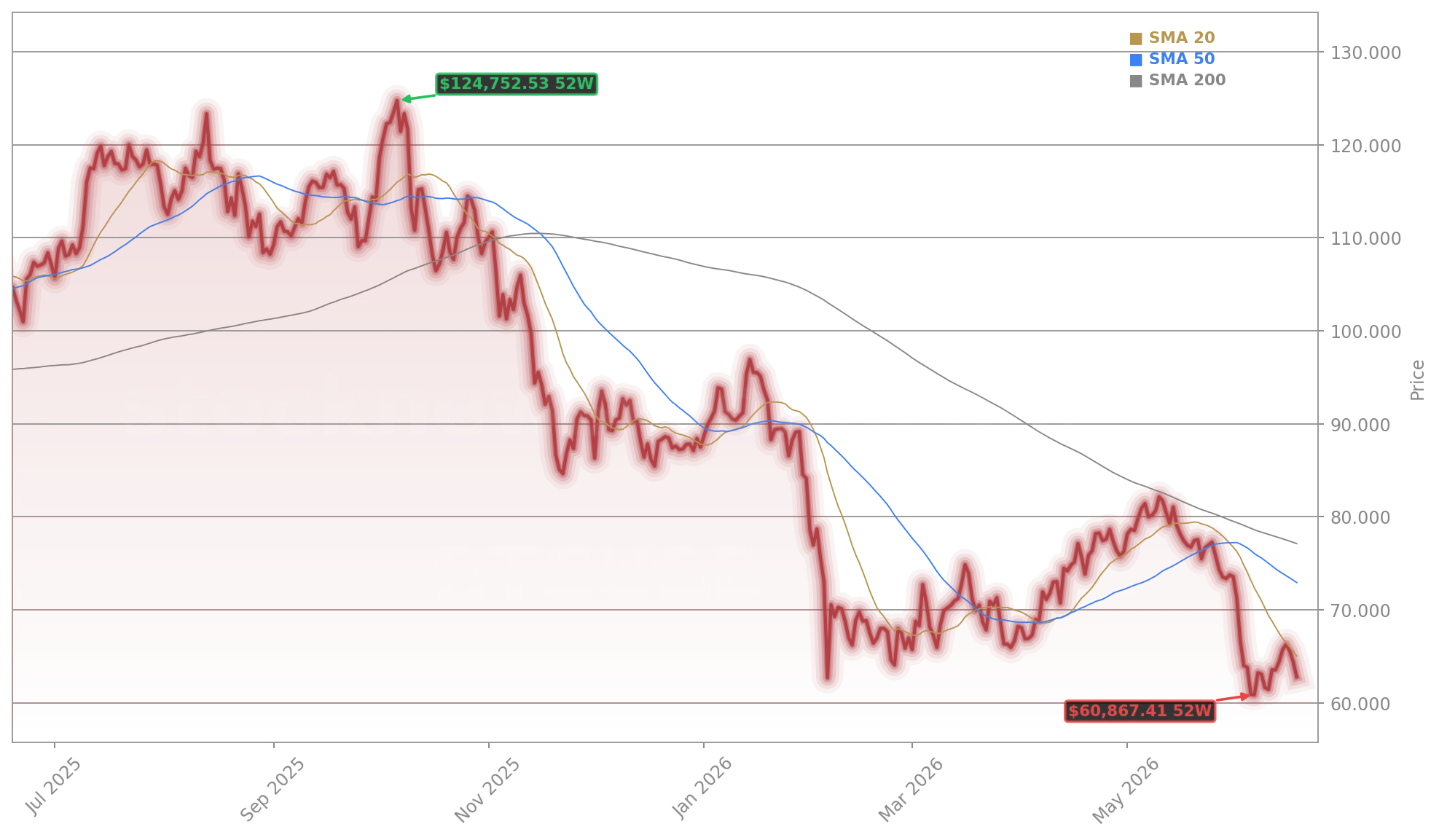
Bitcoin (BTC/USD) traded at $62,986.46 Thursday night — down 0.14% — consolidating within its $61,000–$66,000 range amid dollar strength and geopolitical uncertainty. Technicals show a bearish flag pattern, but fundamentals are strengthening: the Clarity Act holds bipartisan Senate support, SEC Chair Paul Atkins has unwound 100 enforcement actions, and OCC/FDIC pro-crypto guidance has cleared the path for Schwab and Morgan Stanley to offer Bitcoin-backed credit. Citigroup analysts recently reaffirmed their $75,000 BTCUSD year-end target, citing ‘regulatory tailwinds outweighing macro headwinds.’ With STRC’s growth accelerating and institutional reserve adoption deepening, Bitcoin Regulation is no longer just about risk containment — it’s becoming the primary driver of structural demand.
Related coverage: Is Bitcoin quietly building for a breakout, or is global tightening about to pull the floor from under the trade? — Rick Rieder of BlackRock says it’s going higher. Can MicroStrategy STRC still function as a stable funding tool, or is it becoming the biggest threat to MSTR’s Bitcoin play? — analysts cite a break-even level that must hold to sustain the current strategy.
Citigroup analysts recently reaffirmed their $75,000 BTCUSD year-end target, citing ‘regulatory tailwinds outweighing macro headwinds.’— Citigroup
Bitcoin Regulation defines the next phase of digital asset maturity. For U.S. investors, it means shifting from volatility speculation to infrastructure exposure — with regulated custody, tokenized Treasuries, and on-chain credit now integral to portfolio construction. The next major catalyst will be the Senate’s vote on the Clarity Act — expected before summer recess. For long-term holders and institutional allocators, this is the moment to reassess allocation weightings, not retreat.