Can BP contain the fallout from its chairman’s abrupt exit before investors start pricing in a deeper governance discount?

Why does BP Chairman Ouster matter?
The board said it unanimously removed Chairman Albert Manifold as chairman and director with immediate effect after identifying governance oversight and conduct issues it considered unacceptable. Senior independent director Amanda Blanc said the board had been surprised and disappointed by the matters that came to light, even while acknowledging Manifold’s role in sharpening the pace of BP’s transformation. Ian Tyler was appointed interim chairman, giving the group an immediate stopgap as it tries to contain another leadership disruption.
For investors, the BP Chairman Ouster lands at a sensitive time. BP is already balancing capital returns, transition spending, and upstream discipline while navigating volatile commodity markets. A sudden board-level shake-up can raise questions about oversight, succession planning, and the credibility of strategic execution. That helps explain why the stock sold off even as crude prices found support from renewed Middle East tensions.
How is BP trading against peers?
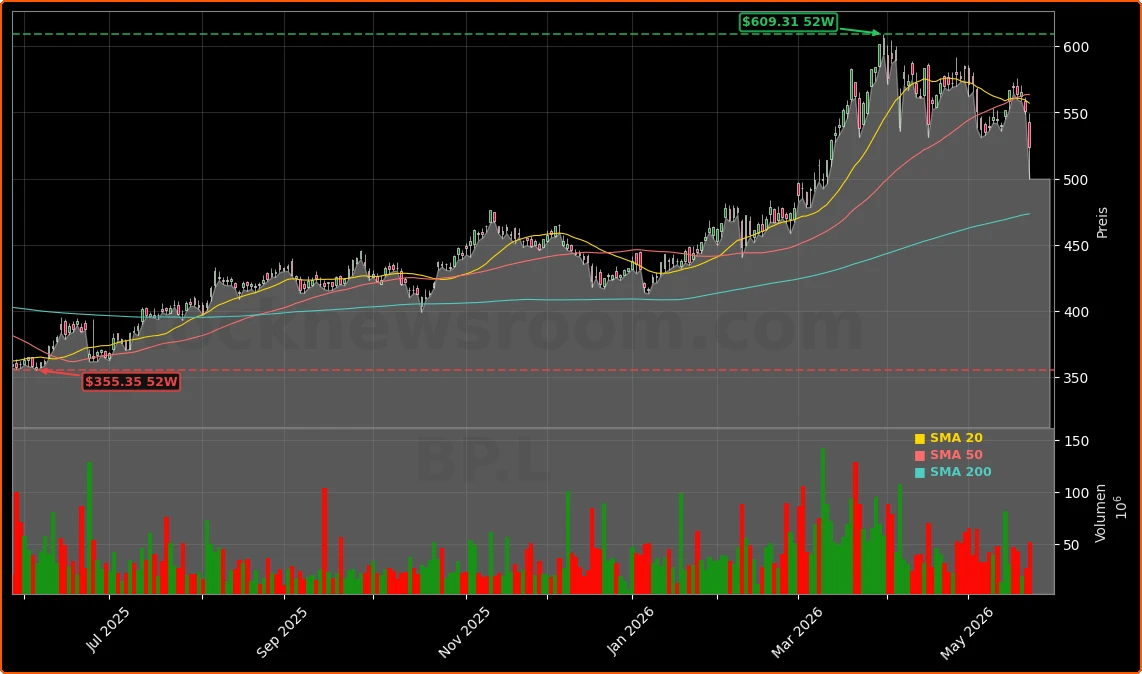
At $523.70, BP.L was down 4.95% intraday, a much steeper move than the modest declines recently seen across parts of the energy complex. Earlier market action had already shown BP lagging the rise in oil, and Tuesday’s governance shock amplified that underperformance. For US investors comparing international energy exposure, the move stands out against names such as Exxon Mobil and Chevron, where board stability has generally been less of an immediate concern.
The setup is especially notable because oil prices had been supported by geopolitical tensions in the Middle East. Normally, that backdrop would provide at least partial support for integrated majors. Instead, the BP Chairman Ouster became the dominant driver, suggesting stock-specific governance risk is currently outweighing commodity tailwinds. That divergence matters for portfolio managers deciding whether to treat BP as a pure oil-price trade or as a company facing a higher execution discount.
Can BP reassure Wall Street quickly?
BP said little publicly beyond the rationale for the dismissal, leaving investors without detailed facts on the underlying issues. The lack of specifics may keep uncertainty elevated in the near term. At the same time, the company reaffirmed its commitment to the strategy under CEO Meg O’Neill, signaling that the board wants to separate the chairman change from day-to-day operating direction.
That reassurance is important because BP has already cycled through multiple top leadership changes in recent years. Another abrupt shift risks reviving the view that governance turbulence could distract from execution at a moment when global energy companies are being judged on capital discipline, shareholder payouts, and realistic transition plans. On Wall Street, that can translate into a lower valuation multiple until confidence is restored.
Analyst calls will now matter more. Investors typically look to firms such as Citigroup, RBC Capital Markets, Goldman Sachs, and Morgan Stanley for updates after a governance event of this scale, particularly on whether price targets or ratings change because of elevated governance risk rather than commodity assumptions alone.
What should BP investors watch next?
The next step is whether BP can move quickly from interim leadership to a permanent chair without prolonging uncertainty. Investors will also watch whether any further board commentary clarifies the governance concerns behind the BP Chairman Ouster. Until then, the market is likely to focus on reputational fallout, board cohesion, and whether management can keep operations and cash-return priorities insulated from the controversy.
Albert has helped bring a welcome focus and pace to bp’s transformation. However, the board has been surprised and disappointed to learn of governance oversight and conduct issues it deems unacceptable and has taken decisive action.— Amanda Blanc
For US-based investors, BP remains relevant as a major global energy holding and a read-through for sector sentiment alongside Shell, Exxon Mobil, and Chevron. But Tuesday showed that company-specific governance events can overwhelm even a supportive oil tape. The BP Chairman Ouster has turned leadership credibility into the key near-term variable, and the next board update could determine whether the stock stabilizes or continues to trade at a steeper discount to peers.