Is Coinbase’s new stablecoin credit fund the moment when traditional private credit finally jumps onto public blockchains for real?

Is Coinbase turning credit markets onchain?
Coinbase Global, Inc. is expanding beyond its core exchange business with the launch of the Coinbase Stablecoin Credit Fund, formally called the Coinbase Stablecoin Credit Strategy (CUSHY). The vehicle is designed for qualified and institutional investors looking for yield in stablecoin-related lending and private credit, while still operating within a familiar fund structure. Shares can be held in traditional book‑entry form or as tokenized units issued on multiple blockchains.
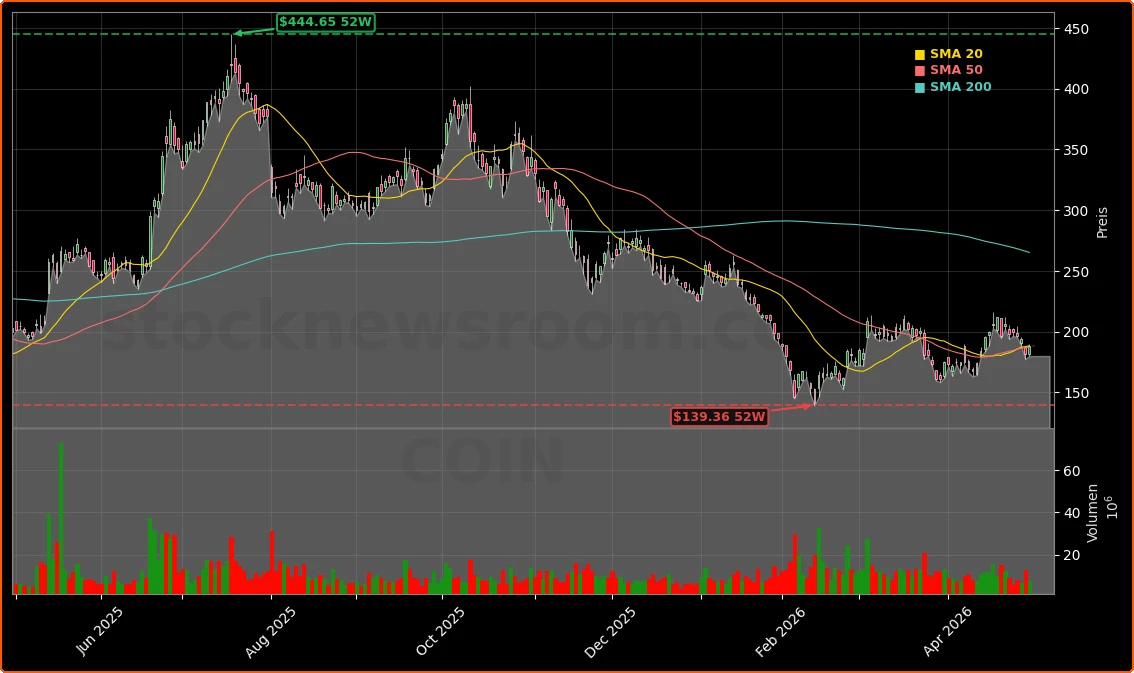
On Thursday, Coinbase (COIN) traded at $187.77, up 3.32% from the previous close of $182.09, with a slight uptick to $187.96 in after‑hours action. The stock remains sensitive to regulatory headlines and crypto market volatility, but Wall Street increasingly values Coinbase as a broad infrastructure and services play, not only as a proxy for bitcoin. Moving credit strategies onchain via the Coinbase Stablecoin Credit Fund is another step in that direction.
CUSHY targets returns from lending activity tied to digital assets and private credit while emphasizing underwriting standards, diversification, liquidity management and credit quality. The fund’s architecture seeks to blend the 24/7 settlement and transparency of crypto networks with the oversight expectations institutional allocators demand.
How does Coinbase’s CUSHY structure work?
The Coinbase Stablecoin Credit Fund uses tokenization firm Superstate’s FundOS platform as its onchain backbone. Instead of creating bespoke smart contracts for each product, Coinbase Asset Management can issue and manage a tokenized share class of CUSHY alongside traditional shares. Those onchain shares will initially live on Ethereum, Solana and Base, Coinbase’s own layer‑2 network built on Ethereum.
Superstate positions itself as connective infrastructure between asset managers and onchain investors, allowing portfolio exposure and shareholder records to be mirrored natively on public blockchains. Large incumbents are beginning to notice; Invesco, a global asset manager with over $2 trillion in assets under management, has also adopted FundOS for selected tokenization efforts. The involvement of Coinbase, Invesco and Superstate signals a shift away from isolated experiments toward shared tokenization rails.
For U.S. and international institutions, the appeal of the Coinbase Stablecoin Credit Fund lies in gaining exposure to stablecoin-driven credit markets without directly handling wallets, private keys or individual DeFi protocols. Instead, investors access the strategy through a regulated fund run by a well‑known NASDAQ‑listed company, while still retaining the option to hold tokenized shares in self‑custody or institutional custody solutions.
Why focus on stablecoins and private credit?
Stablecoins, which are typically pegged 1:1 to fiat currencies like the U.S. dollar, have quietly become the primary settlement asset of the crypto economy. Over the last two years, aggregate stablecoin supply has roughly doubled to around $300 billion, while monthly transaction volumes have tripled to approximately $1.2 trillion. This expansion has laid the groundwork for a sizable stablecoin credit market, where capital is lent against digital assets, financing trading, market‑making and real‑world credit exposure.
Coinbase Asset Management describes stablecoins as the “bedrock” of the next financial era, arguing that they combine the programmability of crypto rails with the familiarity of fiat value. By targeting lending and private credit linked to these markets, the Coinbase Stablecoin Credit Fund seeks to turn stablecoin activity into a yield‑bearing strategy rather than just a transactional layer.
The move echoes a broader trend on Wall Street and across the NASDAQ technology cohort. Tokenization is spreading from simple vehicles like tokenized U.S. Treasury funds into more complex segments such as private credit, real estate and structured products. Asset managers and investors who once viewed crypto purely as speculative now see potential operational efficiencies and broader distribution via tokenized funds. Competing platforms and ecosystems, including NVIDIA‑powered blockchain infrastructure, Apple’s ecosystem‑oriented payments ambitions and players like Tesla exploring onchain energy and mobility credits, are all part of the same convergence narrative between traditional and digital finance.
What about regulation and competitive pressure for Coinbase?
The arrival of the Coinbase Stablecoin Credit Fund comes amid heightened legal scrutiny of digital asset products in the United States. Earlier this month, New York Attorney General Letitia James filed suit against Coinbase and Gemini, arguing that their prediction market integrations fall under New York’s gambling statutes and should be overseen by the state’s Gaming Commission. At the same time, the Commodity Futures Trading Commission (CFTC) has challenged New York’s stance in court, asserting that such markets fall under federal derivatives law instead.
In parallel, state regulators across the U.S. are working to rein in betting and prediction markets offered by firms ranging from Coinbase and Robinhood to native platforms like Kalshi and Polymarket. While the Coinbase Stablecoin Credit Fund focuses on credit rather than event contracts, it underscores how quickly Coinbase is diversifying its product set into areas regulators are still mapping out. The company must continue to balance innovation in onchain finance with the need to maintain licensing and compliance in its key markets.
From a competitive standpoint, Coinbase is expanding its footprint in institutional crypto finance at a time when U.S. brokers and fintechs are racing to add digital asset exposure. Robinhood has already partnered with Kalshi on prediction markets, while exchanges and DeFi platforms on Solana and Ethereum compete aggressively for liquidity. For investors tracking COIN as a quasi‑index of crypto adoption, the Coinbase Stablecoin Credit Fund strengthens the narrative that Coinbase aims to be a full‑stack infrastructure provider, not just a trading venue.
How are analysts and crypto peers reading COIN?
Analyst sentiment on Coinbase remains mixed but cautiously constructive. Large Wall Street firms such as Goldman Sachs, Citigroup and Morgan Stanley have highlighted Coinbase’s diversified revenue strategy, even as they warn about regulatory headline risk and crypto cycle sensitivity. Earlier this month, COIN dropped roughly 7% in one session, triggering renewed debate about whether the stock’s volatility reflects normal beta to digital assets or deeper structural risks.
For sector context, blockchain networks such as Solana continue to shape the backdrop for Coinbase’s strategy. Solana’s native token has repeatedly tested key technical levels, including the $85 support area that traders watch as a potential springboard or trapdoor. Because the Coinbase Stablecoin Credit Fund plans to issue tokenized shares on Solana in addition to Ethereum and Base, the health and throughput of that ecosystem directly influence the attractiveness of CUSHY’s onchain rails.
Despite occasional drawdowns, Coinbase’s latest move into tokenized private credit aligns the company with some of the fastest‑growing corners of finance. As more institutional allocators explore tokenized funds for 24/7 access and operational efficiency, Coinbase could become a leading gateway for bridging dollars, stablecoins and blockchain‑based credit markets.
Related Coverage
Investors who want to understand the risk side of the story should look at Coinbase Quantum Risk -7.4% Warning as COIN Plunges, which examines whether a recent sharp selloff in COIN was just routine volatility or a signal of deeper regulatory and structural challenges around so‑called quantum risk. For a closer look at one of the core networks supporting tokenized strategies like CUSHY, the article Solana Price Update: Can $85 Support Hold or Crack? analyzes Solana’s technical setup and explains why the $85 level has become such an important battleground for bulls and bears.
Overall, the launch of the Coinbase Stablecoin Credit Fund marks an important step in Coinbase’s evolution from pure exchange operator to broader digital‑asset asset manager. For long‑term investors in COIN, CUSHY reinforces the thesis that institutional tokenization and stablecoin‑based credit will be central pillars of future revenue growth. The next phase will show whether robust demand and clear regulation can turn this onchain credit experiment into a durable earnings driver for Coinbase Global, Inc..