
Was the D-Wave Quantum Plunge just panic selling, or is QBTS finally facing a harsher reality check?

What Triggered the D-Wave Quantum Plunge?
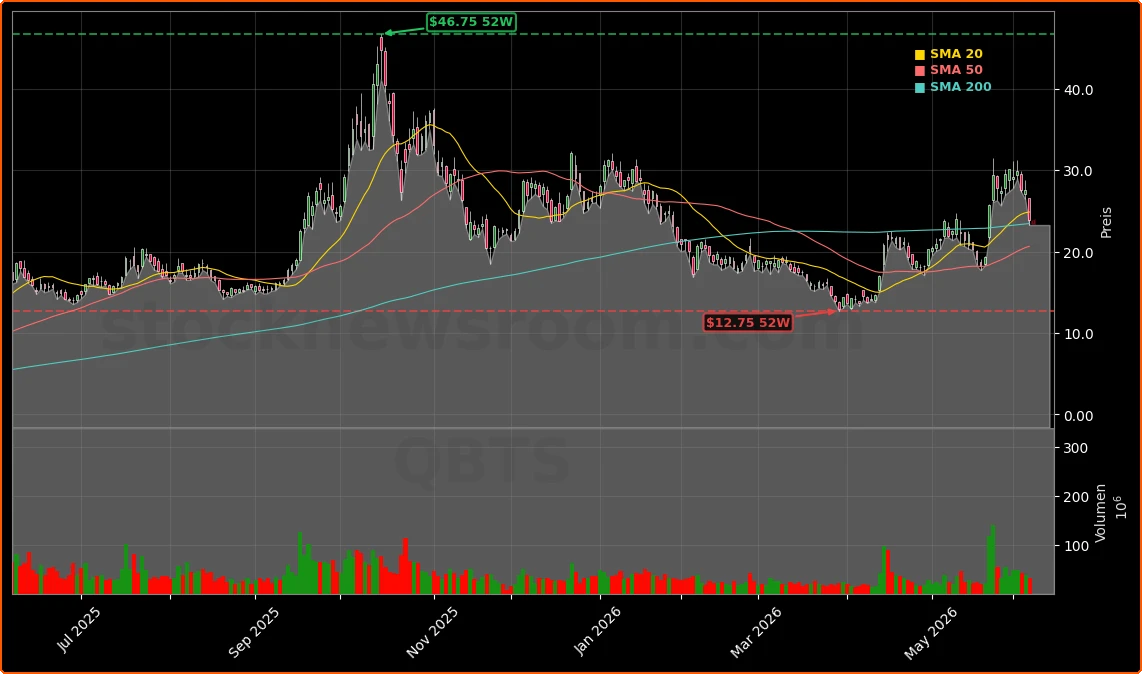
The D-Wave Quantum Plunge wasn’t driven by internal news. No earnings miss, no regulatory setback, and no analyst downgrades hit D-Wave Quantum Inc. on June 5. Instead, the sell-off emerged from a broader risk-off wave that swept across U.S. tech equities after Broadcom (AVGO) reported weaker-than-expected AI chip growth guidance Wednesday night — forecasting only a threefold increase in Q3 AI chip sales, not the four- to fivefold surge analysts had modeled. That caution rippled across the NASDAQ, dragging down semiconductor peers, crypto-linked names, and quantum computing stocks alike. By 11:45 a.m. ET, QBTS was down 11%, and by the close, it settled at $23.85 — a 13.71% intraday loss and the largest daily decline since Q1 2026.
How Does QBTS Compare to Rivals IonQ and Rigetti?
While D-Wave Quantum Inc. fell 13.71%, IonQ (IONQ) dropped 6.82% and Rigetti (RGTI) slid 11.46% — confirming this was an industry-wide compression, not a QBTS-specific event. All three quantum players share exposure to U.S. government contracts and long-term AI infrastructure bets, but diverge sharply on architecture: D-Wave focuses on quantum annealing for optimization, while IonQ and Rigetti pursue gate-model systems for broader computation. That technical distinction hasn’t insulated QBTS from sentiment swings — a reminder that for now, quantum stocks trade as a thematic basket, not differentiated assets. As RBC Capital Markets noted in its May 2026 sector note, ‘Liquidity in quantum equities remains thin, amplifying beta to NASDAQ and S&P 500 tech rotation.’
Is the D-Wave Quantum Plunge a Buying Opportunity?
Not necessarily — and investors need clarity on the runway. S&P Global Market Intelligence analysts project D-Wave Quantum Inc. won’t reach profitability until 2030, the outer edge of consensus forecasts. More critically, the company is expected to burn over $500 million in cash before achieving positive free cash flow. That capital intensity stands in contrast to IonQ, which reported $42 million in federal contract awards in Q1 2026, and Rigetti, which secured a $120 million U.S. Air Force contract in April. Citigroup maintains a ‘Neutral’ rating on QBTS with a $28 price target — unchanged despite the plunge — citing ‘strong federal pipeline but unproven commercial scalability.’ That gap between near-term sentiment and long-term execution risk defines the D-Wave Quantum Plunge’s true nature: a liquidity-driven dip, not a valuation reset.
What’s Next for D-Wave Quantum Inc.?
Attention now shifts to the U.S. government’s $100 million quantum infrastructure award — a funding deal announced May 21 that sent QBTS up 24% in a single session. That award remains pending final approval, and its timing could determine whether the D-Wave Quantum Plunge proves transitory or marks a deeper re-rating. Separately, D-Wave Quantum Inc. is advancing its Advantage2 system, with early access granted to Los Alamos National Lab and NASA this quarter. While commercial revenue remains minimal, these partnerships signal institutional validation. Goldman Sachs analysts recently highlighted QBTS as ‘the only quantum stock with near-term hardware deployment milestones tied to federal AI strategy’ — a distinction that may limit downside if broader tech stabilizes.
Liquidity in quantum equities remains thin, amplifying beta to NASDAQ and S&P 500 tech rotation.— RBC Capital Markets, May 2026 Sector Note
Related Coverage: A proposed $100 million federal award could reshape D-Wave Quantum’s trajectory — D-Wave Quantum Funding Deal Sends QBTS Up 24% on Award. Meanwhile, investors weighing quantum exposure should compare QBTS’s annealing approach against IonQ’s trapped-ion roadmap — IonQ vs. D-Wave: Architecture, Contracts, and Commercial Pathways. For context on how quantum stocks behave during NASDAQ corrections, see our analysis of the April 2026 tech selloff — How Quantum Stocks Fared in the April Tech Rout.