
Can D-Wave Quantum’s record bookings outweigh a brutal revenue drop and sharp stock pullback in the eyes of Wall Street?

How did D-Wave Quantum Earnings impact the stock?
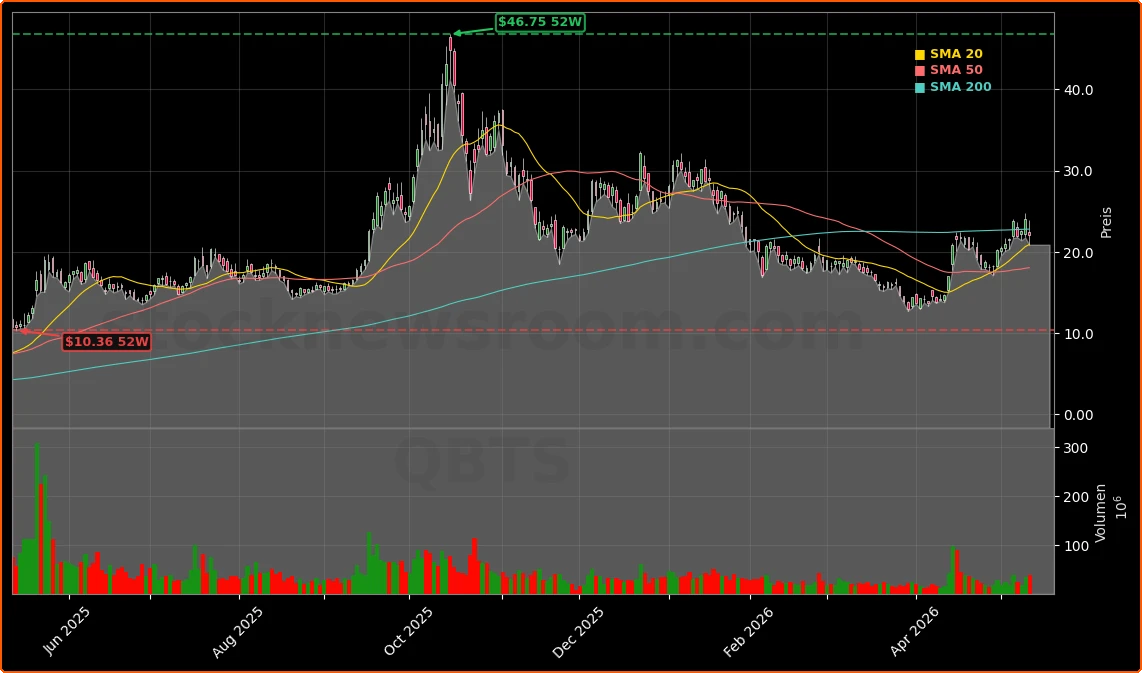
Shares of D-Wave Quantum Inc. closed at $22.02, down about 8.4% from the previous close of $24.65, reflecting investor disappointment with the latest numbers despite strong underlying demand indicators. The pullback comes after a massive rally from late 2024, when QBTS became one of the most speculative winners in the quantum computing trade on the NYSE. Even after the slide, the stock remains dramatically above its levels from October 2024, reminding investors how volatile quantum-exposed names can be compared with more established technology leaders like NVIDIA, Apple or Tesla.
Wall Street had been primed for volatility heading into the report, with quantum computing peers already showing a pattern of rapid revenue growth but widening losses. The latest D-Wave Quantum Earnings did little to change that narrative. For risk-tolerant portfolios, the move may look like a routine reset after a parabolic run, while more conservative investors may see it as confirmation that quantum exposure should stay in the “speculative satellite” portion of a diversified allocation rather than the core.
What is behind the revenue drop at D-Wave Quantum?
For the March quarter, D-Wave posted revenue of roughly $2.9 million, an 81% year-over-year decline driven primarily by an unusually large quantum system sale that closed in early 2025 and made for a tough comparison. Adjusted loss came in at $0.05 per share, versus a $0.02 loss a year earlier, but still better than the consensus forecast of a $0.08 loss. On a net basis, the company reported a loss of about $18.4 million, widening from $5.4 million in the prior-year period.
The shortfall against Wall Street’s revenue estimate of around $4.2 million highlights how uneven hardware-centric quantum revenues can be from quarter to quarter. Management emphasized that, excluding the prior-year system sale, underlying revenue still showed roughly 20% growth, suggesting that usage-based and services revenue lines are trending in the right direction. Yet for institutional investors who benchmark quantum names against profitable, cash-generating tech in the S&P 500 and NASDAQ, the combination of shrinking revenue and higher operating expenses keeps QBTS firmly in the “story stock” category.
Are bookings signaling a stronger long-term trajectory for D-Wave Quantum?
If the revenue line disappointed, bookings were the clear bright spot of these D-Wave Quantum Earnings. Closed bookings soared to $33.4 million, a jump of nearly 2,000% year over year from just $1.6 million. Two marquee deals dominated the quarter: a $20 million annealing quantum computer sale to Florida Atlantic University and a two-year, $10 million quantum computing-as-a-service agreement with a Fortune 100 customer. These contracts support the thesis that real-world commercial adoption is starting to move beyond pilot projects and into more meaningful commitments.
Remaining performance obligations – essentially contracted revenue not yet recognized – rose to $42.4 million, up from $6.4 million a year ago, with more than half expected to convert into revenue over the next 12 months. For U.S. investors comparing D-Wave’s trajectory with rivals like IonQ or Rigetti, the surge in backlog and bookings is critical. It suggests that, while quarterly sales remain bumpy, the pipeline of enterprise and academic demand is deepening, potentially providing more predictable revenue visibility in the coming years as quantum moves from lab experiments toward production workloads.
How do costs, Quantum Circuits, and competition reshape the risk profile?
The bullish bookings story comes with a cost. Operating expenses climbed to about $56.5 million, up 125% from $25.2 million in the year-ago quarter. Management attributed the increase to higher headcount, expanded research and development, stepped-up marketing, and roughly $9.1 million in non-recurring costs tied to the acquisition of Quantum Circuits. The deal, valued at around $550 million, brings in superconducting gate-model technology that is expected to accelerate D-Wave’s roadmap toward large-scale, error-corrected systems.
That roadmap targets roughly 175 physical qubits by 2028, 1,000 physical qubits and 10 logical qubits by 2030, and eventually 100 logical qubits by 2032 – a level considered an important milestone for initial quantum utility. This positions D-Wave in a hybrid lane: it remains one of the very few companies simultaneously pushing both annealing and gate-model architectures, putting it into more direct competition with larger players like IBM and potentially future industrial spin-offs. For investors used to the scale and balance sheets of mega-cap tech, the contrast is stark: D-Wave is burning cash aggressively to secure a first-mover advantage in a market that may not fully materialize for several years.
What do D-Wave Quantum Earnings mean for Wall Street valuations?
Analyst sentiment on QBTS remains broadly constructive despite the mixed quarter. A wide cohort of Wall Street firms, including houses such as Morgan Stanley and Goldman Sachs, have contributed to a “Moderate Buy” consensus rating, paired with an average 12-month price target around the mid-$30s. That implies substantial upside from the current $22 area, but the spread between target and price also reflects how sensitive the stock is to shifts in risk appetite and quarterly news flow.
For U.S. investors comparing quantum exposure with more mature AI plays anchored by companies like NVIDIA or software giants integrated into the S&P 500, the risk-reward calculus is very different. The latest D-Wave Quantum Earnings underscore that QBTS is less a near-term earnings story and more a long-horizon venture-style bet, where milestones such as bookings growth, backlog expansion, and progress on the dual-rail qubit roadmap arguably matter more than any single quarter’s revenue print.
Our record-setting $10 million quantum computing as a service agreement with a Fortune 100 company reinforced growing demand for our annealing systems.— Alan Baratz, CEO of D-Wave Quantum Inc.
In summary, these D-Wave Quantum Earnings highlight a classic early-stage tech trade-off: weak reported revenue and rising losses today against rapidly improving commercial traction and an ambitious technology roadmap. For aggressive investors comfortable with volatility, QBTS offers leveraged exposure to the quantum computing theme, while more cautious portfolios may prefer to watch from the sidelines until revenue and margins show a clearer path toward scale. The next quarters – including D-Wave’s upcoming investor events and execution on its growing backlog – will be crucial in determining whether the company can convert record bookings into sustainable, profitable growth.