
Will booming AI infrastructure orders and the Splunk deal justify Cisco’s sharp post-earnings surge, or set up the next reversal?

How is Cisco trading into the Cisco Earnings release?
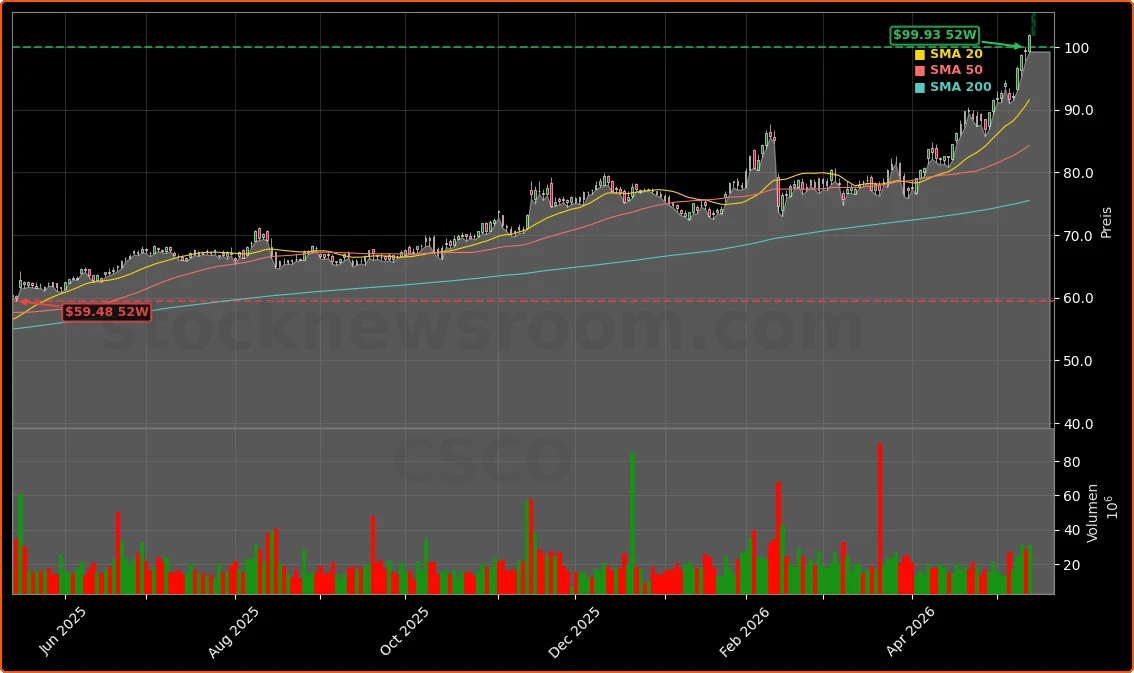
Cisco Systems, Inc. (CSCO) closed at $101.87 on Wednesday, up 2.60% from the prior close of $99.65, before jumping a further 8.07% to $110.09 in after‑hours action ahead of the fiscal Q3 print at 4:05 PM ET. The stock is trading near a 25‑year high after a roughly 30% year‑to‑date surge, underlining how tightly the market has bid up AI‑related infrastructure names across the S&P 500 and NASDAQ.
Wall Street expects fiscal Q3 revenue of about $15.56 billion, up from $14.1 billion a year earlier, and non‑GAAP EPS of roughly $1.04 versus $0.94 in the prior‑year quarter. Cisco had already nudged its full‑year guidance higher back in February, so simply matching the Street’s forecast may not be enough to sustain the latest leg of the rally in Cisco Earnings momentum.
The stock’s recent strength mirrors the broader enthusiasm for AI hardware and networking beneficiaries, a cohort that includes hyperscaler‑exposed names like NVIDIA and optical and switching specialists. Jim Cramer highlighted Cisco on CNBC’s “Mad Money,” noting the stock is “galloping like 1999” but still trades at roughly 23x forward earnings, a multiple he does not view as excessive relative to its AI optionality.
What are investors watching most in Cisco Earnings?
The key swing factor for Cisco Earnings this quarter is the trajectory of AI‑driven orders, particularly from hyperscale cloud providers. In the prior quarter, Cisco booked $2.1 billion in hyperscaler AI infrastructure orders, up from $1.3 billion in the preceding period and well above the roughly $600 million it recorded in Q3 of fiscal 2025. Management has guided to more than $5 billion of hyperscale AI orders in fiscal 2026, with over $3 billion expected to convert into recognized revenue.
That ramp has already supported networking revenue growth of more than 20% year over year, and analysts on Wall Street are looking for evidence that the curve remains steep. Bloomberg Intelligence’s Woo Jin‑ho has argued that resilient enterprise demand combined with accelerating AI data‑center spending should allow Cisco to beat and potentially raise full‑year guidance again, keeping the AI infrastructure thesis intact.
Beyond AI, investors are focused on how quickly Cisco can expand higher‑margin software and recurring revenue through its acquisition of Splunk. The deal is seen as central to improving the company’s long‑term growth profile and margin mix by deepening its presence in security, observability and data analytics – areas where peers like Apple and Tesla have also been investing heavily in their own ecosystems, albeit with different strategic angles.
Will margins and security cloud the Cisco Earnings story?
Margins represent the second major pillar of the Cisco Earnings narrative this quarter. Management previously guided non‑GAAP gross margin down to a range of 65.5% to 66.5%, from 67.5% in Q2, largely due to elevated memory and component costs tied to AI systems. CFO Mark Patterson has said that price increases and refreshed terms with channel partners should gradually offset those pressures, but that the benefit takes time to filter through the income statement.
Wall Street will be watching closely to see whether the margin drag bottoms out sooner than feared. A better‑than‑expected gross margin print or a constructive outlook for the second half of fiscal 2026 could reinforce the view that Cisco can translate AI orders into profitable growth, not just top‑line expansion.
At the same time, there are soft spots that could complicate the Cisco Earnings reaction. Last quarter, security revenue fell about 4% as Cisco pushed more aggressively into cloud‑delivered offerings, and services revenue slipped 1%. CEO Chuck Robbins has said he expects the organic security portfolio to approach double‑digit growth by the fiscal fourth quarter. Early signs of that reacceleration would help offset concerns that legacy hardware or on‑premise security products could be losing steam.
How do analyst views frame the risk–reward?
Analyst sentiment on Cisco Systems, Inc. remains broadly constructive but not euphoric. The stock carries a consensus rating between “Moderate Buy” and “Strong Buy,” with an average price target around $94.70 that it has already surpassed in recent trading. Several firms, including Citigroup and Goldman Sachs, have previously highlighted Cisco’s underappreciated leverage to AI networking and the potential for Splunk to lift recurring software revenue over time, even as they caution that expectations have risen sharply.
Some strategists also frame Cisco as a more reasonably valued way to gain AI exposure compared with high‑multiple chip leaders like NVIDIA. Others argue that faster‑growing pure‑play AI names still offer greater upside, but with meaningfully higher volatility. Jim Cramer, for example, described Cisco as doing “very, very well” under Robbins but warned that the sharp run‑up means investors should be prepared for a pullback if the print or guidance falls short.
Cisco’s stock has been a monster move, but at about 23 times forward earnings, it isn’t all that expensive if the AI data center story keeps playing out.— Jim Cramer, Mad Money
For US investors, the Cisco Earnings release is therefore not just about one stock. The company is a bellwether for enterprise networking demand, cloud and AI capex, and the pace at which traditional hardware vendors can pivot toward software and recurring revenue models. A strong showing could reinforce the bullish narrative around AI infrastructure spending, while any disappointment might temper enthusiasm across the sector.