

Can Visa’s new Flexible Credential keep buy-now-pay-later disruptors on its rails instead of losing volume to alternative payment apps?

How does this Visa Product Launch change the card?
The new Visa Product Launch centers on Visa Flexible Credential, a capability that allows several payment options to sit behind a single card or digital credential. Instead of holding different cards for debit, credit, or installments, a Zilch cardholder can use one familiar credential and select at checkout which payment option to apply. The experience still rides on existing infrastructure, including in-store tap-to-pay and standard online card checkout flows, which lowers friction for both consumers and merchants.
For issuers, Visa Flexible Credential is designed to be a front-end layer on top of Visa’s global acceptance network, which already reaches more than 150 million merchant locations worldwide. That means banks and fintechs can offer new configurations of pay-now, pay-later and revolving credit without having to educate merchants or integrate alternative tender types. In the UK pilot with Zilch and Thredd, Visa is effectively positioning itself as the connective tissue between a modern BNPL-style user experience and the legacy card rails that still dominate global commerce.
Strategically, that matters because many of the fastest-growing fintechs pitch consumers on flexibility and transparency. If the card networks can replicate that flexibility inside the card paradigm, they reduce the incentive for shoppers to migrate to closed-loop wallets or standalone BNPL apps that bypass the network altogether.
What’s driving demand for more flexible payments?
Visa’s own research in the UK shows that about 87% of respondents say flexible payment options support their financial or lifestyle goals. That aligns with broader trends visible on Wall Street: BNPL volumes are rising, digital wallets from players like Apple and NVIDIA-powered mobile devices are normalizing tokenized credentials, and consumers are increasingly comfortable mixing credit, debit and installment products.
The Visa Product Launch with Zilch taps directly into this behavior. Zilch already offers a hybrid experience that allows users to split payments over time or pay in full while earning rewards. Embedding Visa Flexible Credential behind the existing Zilch card makes it easier for users to decide, transaction by transaction, whether to preserve cash flow, avoid interest, or optimize rewards. Importantly, the consumer does not need to learn a new checkout flow; the choice happens in-app or in the background while merchants continue to process a standard Visa transaction.
From a risk and regulatory perspective, tying flexible options to a card credential can also give issuers better visibility into spend and repayment patterns versus fragmented BNPL apps. That could ultimately support improved underwriting models and more stable loss performance—key concerns for U.S. investors watching the BNPL sector’s credit cycles.
How does Visa Flexible Credential compare to rivals?
For American portfolios, the question is how this Visa Product Launch shifts the competitive balance versus traditional peers and newer disruptors. Mastercard has been rolling out similar multi-credential and tokenization initiatives, and large wallets from Apple and other tech majors let users choose among cards at the point of sale. What distinguishes Visa Flexible Credential is that the choice can sit within a single issuer card, dynamically mapping a transaction to different underlying balances.
For now, the deployment is limited to Zilch in the UK, but the underlying architecture appears portable to banks, neobanks and co-brand partners across regions. If scaled, this could fortify Visa Inc.’s pricing power by embedding its rails even more deeply into new payment constructs that might otherwise have grown outside the network. That is particularly relevant as regulators in Europe and, to a lesser extent, the U.S. scrutinize card fees and push for more competition.
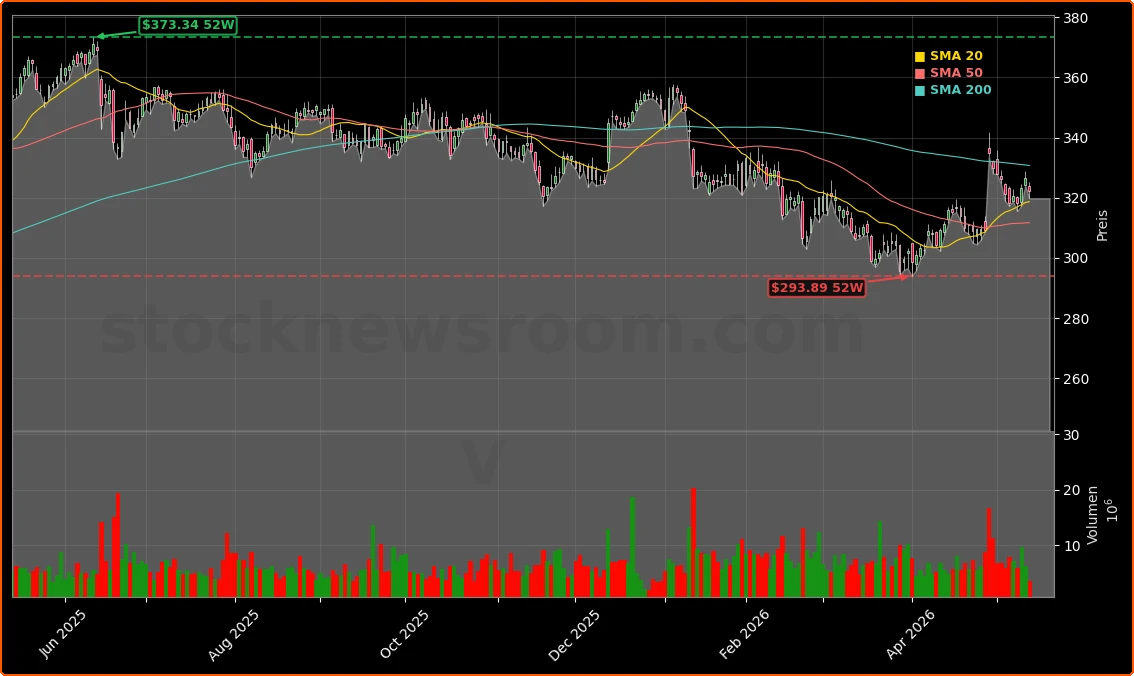
On the equity side, Visa shares traded at $322.06 on Wednesday, down about 1.33% from the prior close of $326.66. The stock remains well off its 52-week highs, leaving some room before sentiment fully prices in newer growth vectors like network tokenization, value-added services and flexible credentials. Long-term, Visa’s track record since its 2008 IPO—where it raised about $28 billion and has since delivered well over 1,000% total return—continues to support the view that the company can compound through multiple payment cycles.
What are analysts on Wall Street watching?
Major banks such as Goldman Sachs, Citigroup and Morgan Stanley have generally kept positive stances on Visa in recent quarters, emphasizing the company’s durable margins and global scale versus smaller fintech names. While this specific UK Visa Product Launch has not yet triggered fresh target changes, analysts have highlighted that product innovation is crucial for sustaining high-teen EPS growth as core cross-border volumes normalize post-pandemic.
Goldman Sachs has repeatedly cited Visa’s ability to layer value-added services and new capabilities onto its existing network as a key part of its premium valuation relative to the broader S&P 500. Citigroup has focused on the resilience of card spending through mixed macro data, and Morgan Stanley has pointed to secular drivers including cash displacement and e-commerce penetration. For all three, incremental innovations like Visa Flexible Credential reinforce the thesis that Visa can remain the default plumbing of digital payments rather than ceding ground to standalone BNPL and account-to-account schemes.
Related Coverage
Investors looking for a deeper read on how Visa’s fundamentals are evolving beyond individual product launches may want to review the company’s latest earnings commentary. Our recent analysis, “Visa Earnings Record: Profit Surge Shocks Cautious Wall Street”, breaks down how record profits and an expanded buyback program are shaping sentiment and valuations heading into the next fiscal year. Together with the current Visa Product Launch around Flexible Credential, the earnings backdrop highlights how both financial performance and product innovation are working in tandem for the network.
Visa Flexible Credential gives issuers a simple way to offer that choice through one familiar card, while keeping the ease, security and global acceptance people already trust Visa for.— Mathieu Altwegg, Head of Product and Solutions, Visa Europe
Overall, this Visa Product Launch underscores that Visa Inc. is not standing still as payment habits fragment across credit, debit, installments and wallets. For investors, the Flexible Credential rollout with Zilch and Thredd is an early but important proof point that the company can pull new payment experiences back onto its rails. The next phase will be whether Visa can scale this model to major issuers and other regions, turning product innovation into sustained revenue growth and reinforcing its role at the center of global commerce.