
Are Mastercard’s latest earnings strong enough to offset fresh worries about a sudden slowdown in lucrative cross-border spending?

Why did Mastercard stock drop on strong results?
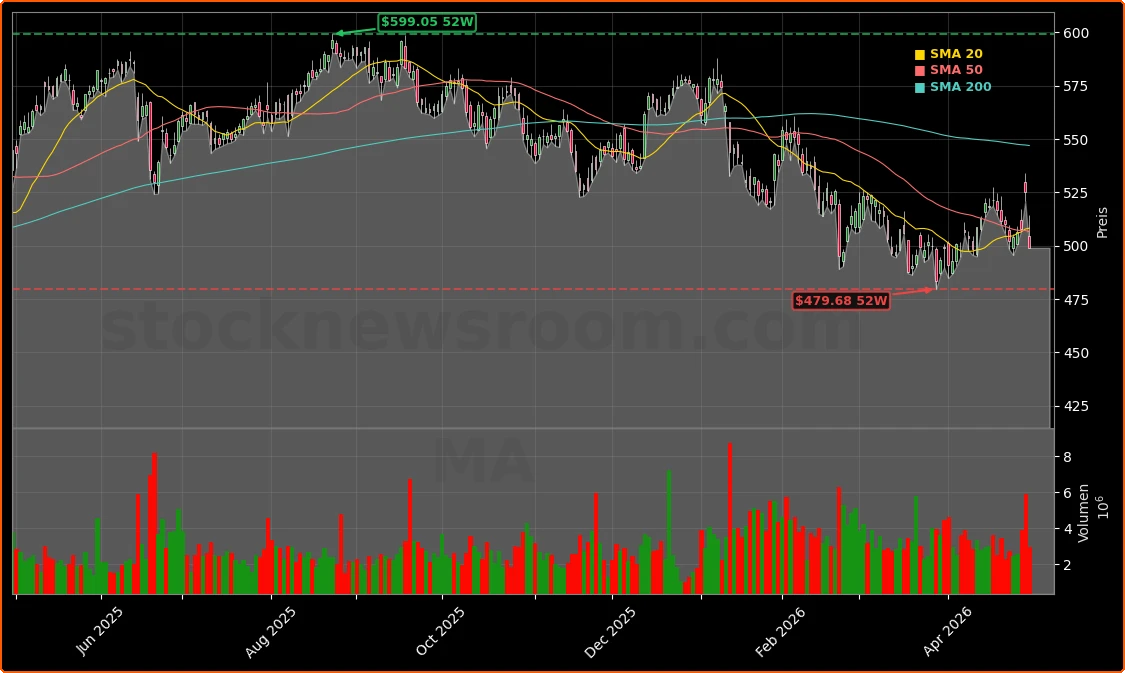
On Thursday, Mastercard Incorporated shares fell about 5% to roughly $499 in New York afternoon trading, retreating from a prior close of $529.60. That move comes even after a run-up in recent sessions driven by optimism around sector peers such as Visa and NVIDIA, which had helped lift sentiment toward payment and tech leaders across the S&P 500 and NASDAQ.
Investors had been primed for good news after a sector-wide rally that followed stronger-than-expected numbers from Visa, so expectations for Mastercard Earnings were already elevated. When the company merely beat forecasts rather than smashing them, while simultaneously signaling softer momentum in cross-border travel volumes heading into the second quarter, traders used the news as a reason to lock in profits.
From a valuation perspective, MA had been trading near the upper end of its historical earnings multiple range, with buybacks providing an additional floor under the stock. The combination of a high bar, geopolitical uncertainty and a modest sequential slowdown in a key growth metric was enough to trigger a repricing, even though the headline figures look robust.
How strong were Mastercard’s Q1 2026 numbers?
For the quarter ended March 31, 2026, Mastercard Incorporated reported net income of $3.88 billion, up from $3.28 billion a year earlier. GAAP earnings per share rose to $4.35 from $3.59. Adjusted EPS came in at $4.60, comfortably ahead of Wall Street consensus around $4.40–$4.41, giving Mastercard Earnings a clear beat on the bottom line.
Net revenue grew about 16% year over year to roughly $8.4 billion, surpassing projections near $8.25–$8.26 billion. The company’s core payment network business delivered a 7% increase in gross dollar volume to about $2.7 trillion, a 13% jump in cross-border volume and a 9% rise in switched transactions. Value-added services and solutions — including cybersecurity, digital authentication, analytics and customer engagement tools — surged about 22%, or 18% on a currency-neutral basis.
Operating expenses rose roughly 13%, in part due to restructuring charges, but operating leverage remained solid given the double-digit revenue growth. Mastercard ended the quarter with about $7.9 billion in cash and cash equivalents, providing firepower for continued investment and shareholder returns.
What’s worrying investors about cross-border trends?
The pressure point in the latest Mastercard Earnings update is not the Q1 snapshot but the trajectory into Q2 and beyond. Management highlighted that overall cross-border volume growth, while still a healthy 13% year over year in the quarter, showed a sequential slowdown starting in March, largely tied to the conflict involving Iran and the broader Middle East region.
The company estimates that the affected geographies — including Gulf Cooperation Council countries and Israel — account for roughly 6% of overall cross-border volume. Executives anticipate that most of the earnings impact will appear in the second quarter, assuming the conflict runs its course during that period. Without this drag, management indicated that Q2 net revenue growth would likely have been closer to Q1 levels.
Beyond the direct regional hit, Mastercard is also contending with a softer spending backdrop among lower-income consumers, particularly in discretionary categories. While affluent cardholders and business travelers continue to support growth, the mix shift adds another layer of uncertainty for investors trying to forecast normalized travel and cross-border demand into the second half of 2026.
How does Mastercard compare with Visa and tech peers?
The latest report keeps Mastercard firmly in the camp of high-quality compounders within the global payments ecosystem, alongside Visa and digital commerce beneficiaries like Apple and Tesla. Visa’s own strong results earlier this week had raised the bar across the sector, and Mastercard’s performance largely validated the bullish thesis that card-based and digital transactions remain resilient despite macro headwinds.
Still, market positioning matters. Coming into the report, several Wall Street firms, including large banks such as Goldman Sachs and Morgan Stanley, had positive stances on MA, citing durable high-teens EPS growth and powerful cash returns. With sentiment stretched and the stock near recent highs, even modestly cautious commentary on cross-border trends was enough to trigger profit taking, in contrast with some AI beneficiaries like NVIDIA where momentum expectations dominate.
For diversified U.S. portfolios, Mastercard and Visa remain core plays on the secular shift from cash to electronic payments, while mega-caps like Apple offer complementary exposure to wallet and device-based payments. The near-term divergence in share price action following these Mastercard Earnings reflects time-horizon differences rather than a fundamental break in the story.
What is Mastercard’s strategy for stablecoins and AI payments?
While short-term headlines focus on geopolitics, the strategic message from management is about building the next generation of payment rails. CEO Michael Miebach emphasized that Mastercard is evolving “beyond the swipe,” investing heavily in value-added services, AI-driven “agentic commerce” and digital asset infrastructure.
The planned acquisition of BVNK is central to its stablecoin ambitions. Mastercard aims to provide an interoperability and trust layer for tokenized money and stablecoins, enabling institutions and fintechs to move value across traditional card networks and blockchain-based systems. Combined with initiatives such as Mastercard Agent Pay and partnerships with technology leaders including Google, Microsoft and OpenAI, the company is positioning itself to capture emerging B2B and consumer use cases in autonomous payments and digital identity.
Shareholder returns remain aggressive. Mastercard repurchased 7.8 million shares for about $4 billion in Q1 and bought an additional 3.3 million shares for $1.7 billion through April 27, leaving roughly $11.7 billion under its current authorization. For long-term investors, that buyback pace, layered on top of double-digit revenue and EPS growth, is a key part of the equity story.
Related Coverage
For a deeper dive into the company’s digital asset strategy, including the planned BVNK deal, see how Mastercard’s BVNK acquisition could transform stablecoins into a mainstream payments rail for Wall Street. That analysis explores how integrating stablecoin infrastructure with Mastercard’s existing network may reshape cross-border flows, institutional settlement and the competitive landscape in crypto-enabled payments.
Mastercard is diversified, future-ready, and delivering.— Michael Miebach, CEO of Mastercard Incorporated
Overall, the latest Mastercard Earnings confirm that the core franchise is humming, even as cross-border trends wobble under geopolitical pressure. For U.S. investors, MA remains a high-quality payments leader with powerful buybacks and a credible roadmap in AI and stablecoins. The next quarters will show whether easing conflict and a stabilizing consumer backdrop can turn Thursday’s pullback into another long-term buying opportunity.