
Are Wayfair earnings signaling a temporary stumble or the start of a deeper reset in the home-furnishings e-commerce trade?

How did Wayfair earnings hit the stock today?
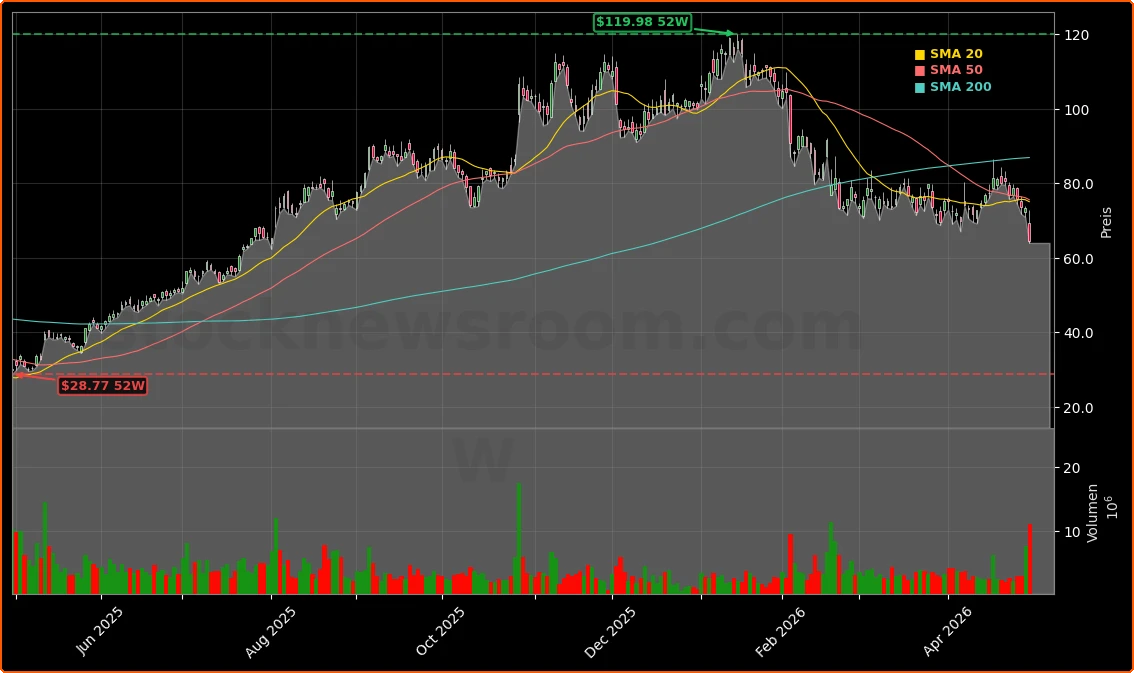
Wayfair Inc. shares dropped about 12% to $64.45 on the NYSE after investors digested the latest quarterly figures and outlook. The decline comes against a prior close of $73.27 and adds to a year‑to‑date slide of more than 30%, underscoring how fragile sentiment remains around discretionary e‑commerce names. While revenue and operating metrics generally moved in the right direction, the adjusted earnings per share shortfall versus analyst expectations was enough to spark heavy selling.
Management reported that net revenue grew 7.4% in Q1, with the U.S. business up 7.5% and international operations advancing 6%. Those numbers stand out in a home-furnishings category that management described as slightly negative in the same period. Order growth reached 3%, with new orders climbing nearly 7%, the strongest new‑order performance since 2021. The average order value increased 4%, supporting the top line even as the broader housing and furniture backdrop remained soft.
Profitability metrics showed incremental progress. Gross margin came in at 30.1% of net revenue, contribution margin reached 15% (up 70 basis points year over year), and adjusted EBITDA totaled $151 million, representing a 5.2% margin and improving 130 basis points from the prior year. Still, the $0.26 in adjusted EPS fell short of the roughly $0.30 that many on Wall Street had penciled in, turning a fundamentally decent Wayfair Earnings print into a negative stock catalyst.
What are the key drivers inside Wayfair Inc.?
Under the hood, management continues to emphasize cost discipline and operating leverage as central to the turnaround story. Selling, operations, technology, general, and administrative expenses were trimmed to $356 million, the lowest level since fiscal Q2 2019, even though the business now generates roughly $3 billion more in annual revenue than it did then. That cost base is down nearly 40% from the 2022 peak, equating to an estimated run‑rate reduction of more than $800 million.
The customer base is also stabilizing. Active customers turned positive year over year after several quarters of sequential improvement, a notable shift following pandemic‑era pull‑forwards and a subsequent hangover. Management highlighted the Wayfair Rewards loyalty program, which surpassed 1 million members at the end of 2025 and continues to expand. While the program applies downward pressure on gross margin percentage, executives argue it accelerates revenue and adjusted EBITDA growth by boosting retention and lowering acquisition costs.
Internationally, Canada reached its highest non‑COVID market share, and the U.K. assortment has been expanded to about 6 million products. Faster delivery in Canada, helped by more local warehousing and cross‑border fulfillment upgrades, has cut delivery times by nearly two days versus a year ago. Across markets, Wayfair is leaning heavily on generative AI for catalog merchandising, product attribute enrichment, and translation, enabling faster product launches and more accurate localization without a proportional increase in headcount.
How does Q2 guidance shape the Wayfair earnings outlook?
In its Q2 2026 outlook, management guided to mid‑single‑digit revenue growth, a gross margin range of 29.5% to 30.5%, and a contribution margin around 15%. Adjusted EBITDA margin is expected between 6% and 7%, suggesting sequential improvement in profitability even as the company invests in price, loyalty, and supply chain to gain share. Leadership reiterated a willingness to let gross margins sit slightly below 30% when necessary to speed up top‑line growth and widen the company’s share advantage over brick‑and‑mortar rivals.
On the balance‑sheet front, Wayfair ended the quarter with $1.1 billion in cash and equivalents and total liquidity of $1.5 billion, including an undrawn revolver. Free cash flow remained negative at about $106 million, though this marked a $33 million improvement versus the same quarter a year earlier, partly reflecting seasonal working‑capital patterns. The company reduced gross leverage to 3.8x, roughly three turns lower than a year ago, and retired more than $300 million of convertible debt, removing potential dilution of over 4 million shares.
Management continues to view the current environment as a cyclical down cycle in home goods. The strategy is to “lean in” by undercutting weaker competitors, expanding physical retail, and enhancing technology so that when the housing and furniture markets normalize—potentially by late 2026—Wayfair emerges as a scale winner. Longer term, leadership is targeting 20%‑plus organic growth, driven by omnichannel expansion, B2B optimization, and further AI deployment.
How do Wayfair earnings compare for investors?
The latest Wayfair Earnings report comes in a mixed landscape for consumer and e‑commerce stocks. While mega‑cap tech names such as Apple and NVIDIA have recently set the tone for the NASDAQ and S&P 500 with strong AI‑driven results, more cyclical, housing‑exposed businesses like Wayfair face a tougher macro backdrop. Unlike platform giants or EV players like Tesla, Wayfair remains firmly tied to discretionary household budgets and housing turnover, both of which are still normalizing after the post‑pandemic surge.
Hedge funds and fundamental managers remain divided. Bares Capital, for example, has treated Wayfair as a long‑term holding since 2019, aggressively adding and trimming its stake through multiple cycles. Filings from late 2025 showed that it had cut its position to roughly 672,000 shares, down a little over 8% from the prior quarter, reflecting a more cautious stance even as management’s narrative becomes more optimistic. On Wall Street, some firms such as Morgan Stanley and Goldman Sachs have periodically highlighted the upside of a more efficient cost structure and potential operating leverage, while others, including Citigroup and RBC Capital Markets, have focused on persistent execution risk and the volatility of consumer demand. These differing analyst views help explain why the stock can swing sharply on even modest profit surprises or misses.
In the meantime, Wayfair is expanding physical retail with new stores in Atlanta and planned openings in Columbus and Denver. Early indications show those locations skewing toward new‑to‑file customers, turning brick‑and‑mortar into a profitable acquisition channel rather than a drag on margins. Combined with initiatives like the luxury‑oriented Perigold brand, AI‑driven catalog improvements, and a growing rewards ecosystem, the company is trying to build a moat that does not rely solely on online ad spending—an important shift for long‑term margin sustainability.
Related coverage on Wayfair Inc.
For a deeper look at how the market has reacted to earlier results, readers can review Wayfair’s prior quarter, when profit surged but the stock still crashed 13%. That piece dissects why strong revenue and EBITDA in a previous period were not enough to satisfy Wall Street and offers useful context for understanding today’s volatile reaction.
Our share spread to the market, I think it’s basically a double-digit share spread.— Niraj Shah, CEO of Wayfair Inc.
Overall, the current Wayfair Earnings snapshot shows a company gaining share, cutting structural costs, and slowly repairing its balance sheet, yet still battling skepticism about the durability of its margins. For U.S. investors, the stock now trades at a steeper discount after today’s drop, but also carries execution and macro risk tied to the housing and home‑furnishings cycle. The next few quarters of Wayfair earnings will be critical in proving that revenue growth, loyalty investments, and AI‑driven efficiencies can translate into consistently stronger free cash flow for long‑term shareholders.