
Can Altria Earnings and a 6.5% stock surge really be sustained as smokers vanish and smoke-free products take center stage?

How are Altria Earnings shaping market sentiment?
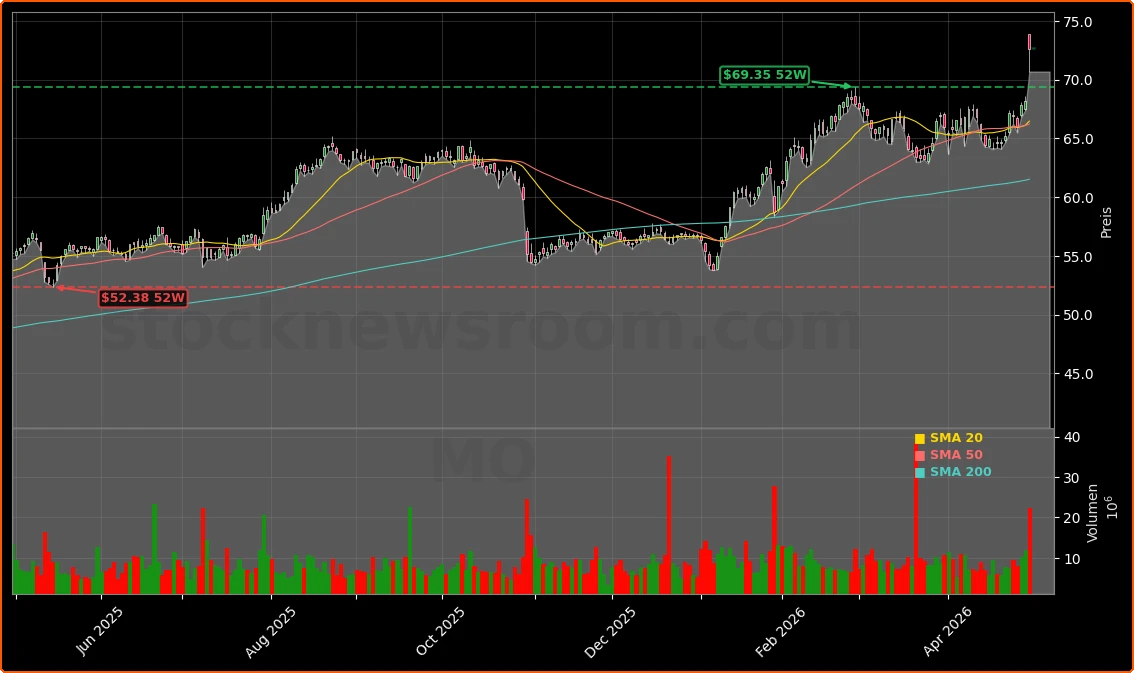
Altria Group, Inc. (MO) climbed more than 6% today, ending the NYSE session at $72.64 and ticking slightly higher to $72.65 in after-hours trading. The move extends a roughly 10% share price gain over the past 12 months and leaves the company’s market capitalization near EUR 95 billion. For income-focused investors, the stock’s appeal continues to center on its robust cash generation and dividend policy rather than rapid revenue expansion.
Recent Altria Earnings have shown that profit growth is still possible despite declining cigarette consumption. Adjusted diluted EPS for full-year 2025 rose 4.4% to $5.42, and management has guided for 2026 adjusted EPS of $5.56 to $5.72, implying growth of 2.5% to 5.5%. In the most recent reported quarter, adjusted diluted EPS increased by 7.3%, supported by disciplined cost control and continued pricing power in core smokeable products. For portfolio managers benchmarking against the S&P 500, MO has not been a price-return leader, but its earnings consistency and income profile have provided a different kind of defensive ballast.
What stands out inside Altria Earnings quality?
The latest Altria Earnings breakdown highlights resilient profitability in traditional cigarettes. The smokeable products segment increased adjusted operating company income (OCI) by 6.3%, while the adjusted OCI margin expanded to 65.1%. Domestic cigarette shipment volume declined about 4% after inventory adjustments, better than an estimated 5% industry drop, suggesting modest share gains even in a shrinking category.
Marlboro’s position in the premium segment remains a key earnings driver. The brand’s premium segment share edged up to 59.5%, though its total retail share slipped as more consumers traded down to discount offerings. Altria’s Basic brand capitalized on this trend, gaining 2.4 percentage points of share within the discount segment year over year. Management has emphasized data-driven promotions rather than broad-based discounting, a strategy that helps protect margins and underscores the quality of Altria Earnings relative to peers facing similar consumer trade-down dynamics.
How important are smoke-free products for Altria Group?
While combustibles still generate the bulk of profits, the company’s strategic narrative now revolves around smoke-free nicotine. The oral tobacco products segment produced more than $400 million in adjusted OCI, with a still-robust margin of 67.4%, even as higher marketing spend and mix shifts pressured margins modestly. Total oral tobacco volumes declined about 3.1% on a reported basis and closer to 8.5% when adjusting for inventory movements.
Within that segment, Altria’s on! and on! PLUS nicotine pouches are increasingly central to the long-term thesis. Shipment volumes for the on! portfolio climbed nearly 18% to more than 46 million cans, while on! PLUS achieved shelf presence in roughly 100,000 stores, covering about 85% of nicotine pouch category volume. The pouches accounted for 7.8% of the oral tobacco category in recent data, slightly lower year over year but improving sequentially, as the overall pouch market expanded and now represents more than 58% of total oral tobacco. Significantly, on! PLUS has been described as the first product authorized under the FDA’s pilot program for certain pouch PMTA reviews, a regulatory milestone that could create a competitive moat versus illicit or unapproved rivals.
How do dividends and buybacks support Altria Earnings value?
From a cash-return perspective, Altria remains one of Wall Street’s most prominent income plays. The company recently paid a quarterly dividend of $1.06 per share, corresponding to a yield above 6% at recent prices. Over the last year, the dividend was raised by approximately 3.9%, and management targets a payout ratio in the 75% to 80% range of adjusted EPS. Combined with modest share repurchases — about 4.5 million shares for $280 million in the latest period and a total buyback budget of roughly $1 billion for 2025 — this policy underscores the emphasis on shareholder distributions over aggressive expansion.
Debt discipline has been another supporting factor for Altria Earnings stability. The company retired just over $1 billion of maturing debt, maintaining a debt-to-EBITDA ratio near 1.9x, comfortably within management’s target range. Equity earnings from its stake in AB InBev added around $160 million, up 9.6% year over year, providing incremental diversification away from nicotine. For dividend investors comparing MO to consumer-staple peers like Apple in big-tech income portfolios, or to Dividend Kings such as Coca-Cola and Genuine Parts, Altria stands out for its yield but carries unique regulatory and ESG risks.
How do competitors and analysts view Altria Earnings?
On Wall Street, analysts generally recognize the trade-off between Altria’s high yield and modest growth outlook. Firms such as Goldman Sachs and Morgan Stanley have highlighted the durability of the dividend but remain cautious on long-term volume erosion in cigarettes and intensifying competition in smoke-free products from rival tobacco groups. By contrast, some income-oriented research desks at Citi and RBC Capital emphasize valuation, noting that a forward P/E ratio around 12 appears reasonable given a 60-year history of consecutive dividend increases and steady EPS growth in the low- to mid-single digits.
In the broader market context, Altria’s price performance has lagged high-growth names like NVIDIA and Tesla over the past decade, but its total return picture improves when reinvested dividends are considered. For risk-tolerant income investors, Altria Earnings offer a combination of slow but steady profit growth and substantial cash payout, in exchange for accepting structural declines in cigarette volumes and ongoing regulatory uncertainty in e-vapor and nicotine pouches.
Related Coverage
Investors looking to dig deeper into the sustainability of Altria’s payout can review the detailed dividend analysis in Altria Dividend Strategy Warning as Cash Flow Faces Test. That piece explores how competition from Philip Morris in U.S. smoke-free products and regulatory headwinds could challenge Altria’s ability to keep funding its near-7% yield over the long term, and what that might mean for income-focused portfolios.
Altria Earnings continue to show that the company can grow per-share profits and raise its dividend even in a shrinking cigarette market. For U.S. investors seeking high current income, MO remains a compelling but controversial holding that trades long-term price upside for cash flow today. The next set of results will be crucial in proving that the smoke-free pivot and disciplined capital allocation can keep supporting this income story on Wall Street.