
If IonQ Earnings smashed expectations, why did the stock suddenly plunge nearly 13% anyway?

What Do IonQ Earnings Reveal About Real Demand?
IonQ, Inc. reported Q1 2026 revenue of $64.7 million — a 30% beat versus the midpoint of prior guidance — driven by commercial cloud access, government hardware contracts, and algorithm co-development services. Roughly 60% of revenue came from commercial clients, 35% from international sources, and the company shipped its first 256-qubit system to the University of Cambridge. Key federal wins included a $39 million Space Development Agency HALO contract and inclusion in the Missile Defense Agency’s SHIELD IDIQ program. Unlike peers such as Rigetti (RGTI) and D-Wave (QBTS), IonQ’s $470 million backlog represents contracted, auditable future revenue — not press-release milestones. CEO Niccolo de Masi called it ‘the biggest quarter in our company’s history,’ underscoring four consecutive quarters of record results.
How Does IonQ Compare to Quantum Peers on Wall Street?
While Rigetti reported GAAP net income of $33 million in its latest filing, that figure was inflated by a $54 million non-cash swing in derivative warrant liabilities — not operational profitability. D-Wave (QBTS) trades with a 10.02% gain this week but lacks IonQ’s cloud-native integration across Amazon AWS, Microsoft Azure, and Google Cloud. IonQ, Inc. remains the only pure-play quantum firm embedded natively in all three major cloud platforms — a strategic advantage that underpins its 755% YoY revenue growth. Meanwhile, Quantinuum’s recent $1.68 billion IPO — opening at $68 — reset valuation expectations across the quantum cohort, pressuring peers to prove scalability beyond government grants. Notably, IonQ’s $26.65 billion market cap sits against $270 million in top-line guidance, yielding a price-to-sales ratio in the high double digits — far above the S&P 500’s median of 2.3x.
Why Did IonQ, Inc. Drop Despite Strong IonQ Earnings?
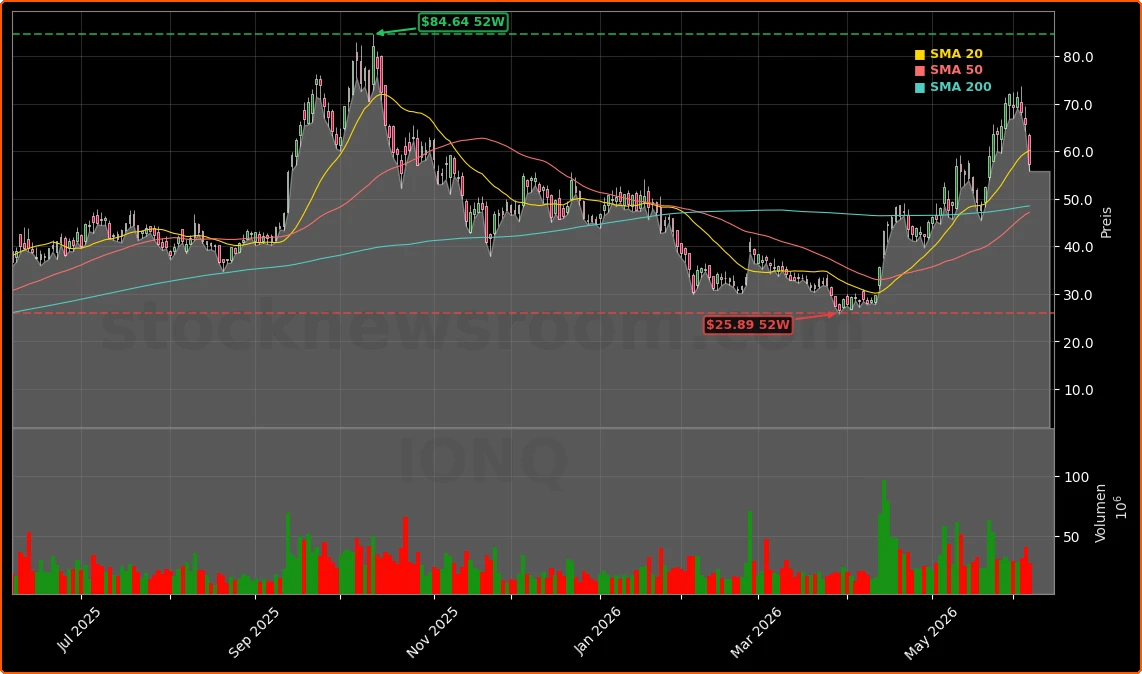
IonQ, Inc. fell 12.87% to $57.21 on Friday — not on earnings disappointment, but amid a broad ‘risk-off’ tech selloff triggered by Broadcom’s (AVGO) AI chip growth warning and weakness in NVIDIA, Micron (MU), and Bitcoin. The move occurred outside regular trading hours and reflected sector-wide rotation, not company-specific news. At $57.21, IonQ remains 31.5% above its 50-day simple moving average ($46.66), signaling continued underlying strength despite volatility. Technical indicators like MACD remain positive — suggesting selling pressure is easing. Still, the stock carries structural risk: analysts at S&P Global Market Intelligence forecast no profitability before 2030 and project $900 million in cumulative cash burn over the next several years — nearly half its current $493.5 million cash position.
What’s Next for IonQ, Inc. and Its Acquisition Strategy?
IonQ, Inc. is advancing a vertical integration play with its pending acquisition of SkyWater Technology — a U.S.-based semiconductor foundry — to secure control over trapped-ion quantum chip fabrication. This move directly addresses a core vulnerability in the quantum value chain: reliance on third-party manufacturing. The deal complements IonQ’s existing $4.99 billion shareholders’ equity base and aligns with U.S. industrial policy priorities under the CHIPS and Science Act. Meanwhile, $2.013 billion in newly announced quantum grants — including $1 billion to IBM for a superconducting foundry — reinforce federal commitment but also intensify competitive pressure. For investors, the next catalyst is clear: Q2 2026 guidance of $65–$68 million. A beat above $68 million would reaffirm accelerating demand; a miss would test the durability of the current valuation premium.
Related Coverage
We’re raising our revenue expectations for the full year to $270 million at the high end, based upon the strong and growing demand for our leading quantum computers.— Niccolo de Masi, CEO of IonQ, Inc.
For deeper analysis on federal exposure, see IonQ Government Contracts -6.1% as Growth Hype Meets Reality, which examines how defense-sector dependency could limit upside if budget priorities shift. Also review IonQ Government Contracts -6.1% as Growth Hype Meets Reality for updated risk assessments on contract execution timelines and revenue recognition patterns. These pieces contextualize why IonQ Earnings matter beyond headline growth — they reflect real-world adoption, not theoretical potential.