
Can Ethereum shake off funding fears and security shocks, or is the market quietly pricing in a tougher road ahead?

What drove Ethereum’s -3.6% weekly slide?
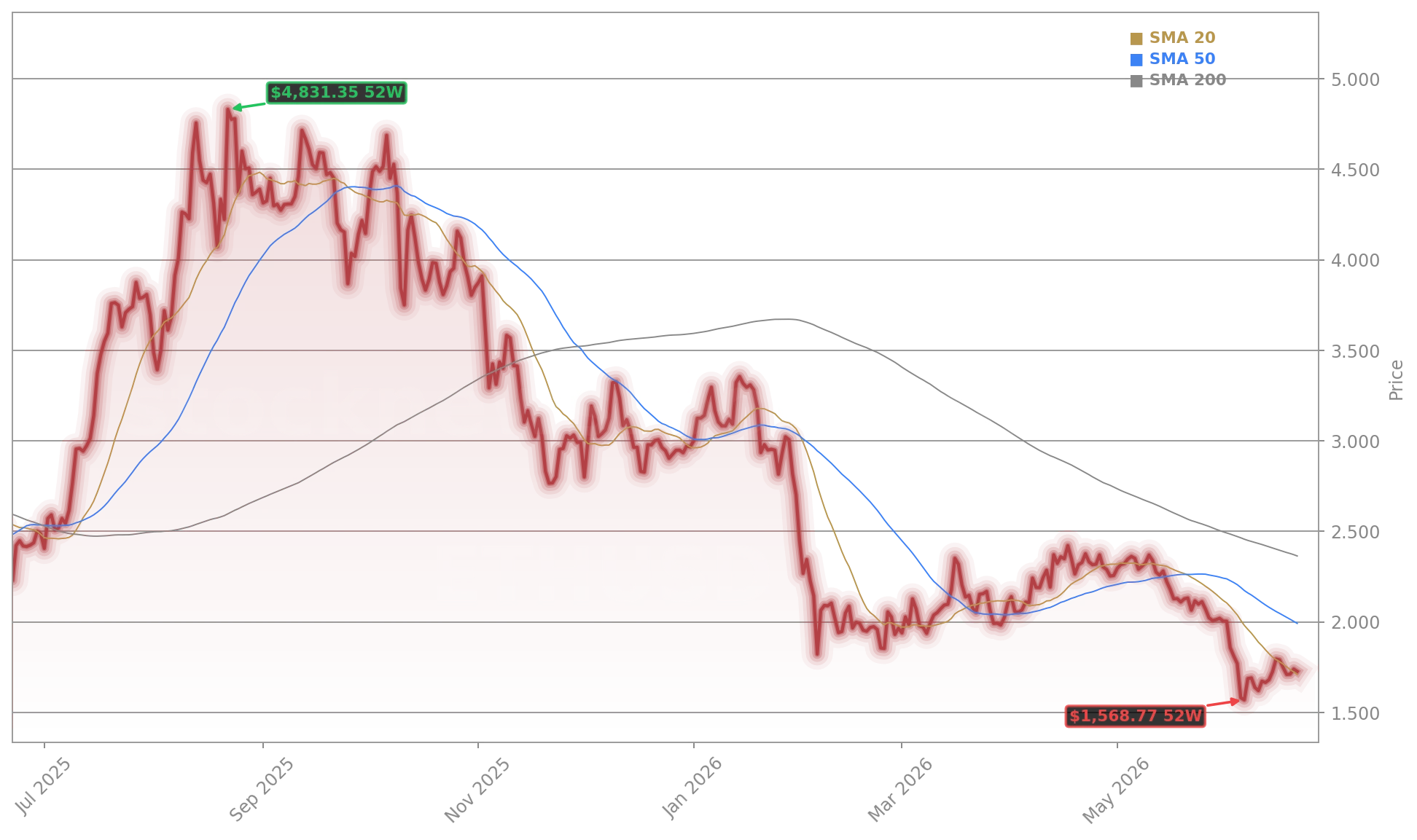
This week, Ethereum (ETH/USD) posted a -3.6% weekly performance — Monday’s open at $1790.40 to Friday’s close at $1726.10 — with a weekly high of $1807.28 and a weekly low of $1670.10. The move was not driven by a single outlier day (none exceeded ±3%), but by a steady, multi-day decline — accelerating after the Federal Reserve’s June 17 decision to lift the 2026 dot-plot median to 3.8% and strip easing language. Spot Ethereum ETFs shed capital on three consecutive days, contributing to a $257 million outflow for the week. That macro pressure compounded pre-existing structural headwinds: rising concerns over core development funding, high mainnet gas fees, and shifting retail capital toward faster, lower-cost alternatives like Solana. The price action reflected not panic, but a quiet recalibration — investors repricing ETH’s near-term catalysts against a backdrop of tightening liquidity and intensifying competition.
Ethereum Weekly Recap: What were the top themes?
Three dominant themes defined this Ethereum Weekly Recap: funding fragility, ETF evolution, and security maturation. First, former Ethereum Foundation core developer Trent VanEpps warned of a ‘slow-burning funding crisis’ over the next 3–9 months, citing the April expiration of the $30 million/year Client Incentive Program and shrinking Foundation expenditures. His assessment was echoed — though tempered — by Zcash co-creator and StarkWare co-founder Eli Ben-Sasson, who stressed merit-based governance over political alignment. Second, Morgan Stanley intensified competitive pressure on the ETH ETF landscape, filing amended registration statements for its proposed Ethereum Trust with a 0.14% annual fee — undercutting Grayscale’s 0.15% and BlackRock’s 0.25% — and explicitly targeting staking-adjusted yield as the new institutional benchmark. Third, the Ethereum Foundation publicly launched ‘clear signing’ standards on June 21, 2026, aiming to replace unreadable hexadecimal wallet prompts with human-readable transaction summaries — a foundational step to reduce phishing and wallet-drainer attacks, especially for mainstream users.
Why did the $7.5M Jaredfromsubway.eth exploit matter?
The $7.5 million drain of the infamous Ethereum MEV bot Jaredfromsubway.eth was more than a security incident — it was a symbolic inflection point. Blockaid confirmed the attacker exploited the bot’s own automated approval logic, deploying fake tokens and liquidity pools to trick it into granting persistent ERC-20 allowances — then sweeping WETH, USDC, and USDT. The irony was stark: a bot responsible for ~70% of Ethereum’s $60 million/year sandwich attack losses became its own victim. This event underscored the systemic risk of industrialized, machine-speed trading — and validated the urgency behind the Ethereum Foundation’s clear signing initiative. It also highlighted the network’s evolving threat model: not just contract bugs, but adversarial manipulation of behavioral logic. For investors, it reinforced that Ethereum’s security evolution is now as much about user interface design and incentive alignment as it is about cryptographic primitives.
What catalysts could reverse the trend next week?
Next week brings three tightly clustered catalysts. First, the U.S. Securities and Exchange Commission’s proposed rescission of climate disclosure rules — while not crypto-specific — could ease compliance burdens for publicly traded crypto firms like NVIDIA-linked infrastructure providers and Bitcoin miners, potentially improving capital allocation efficiency. Second, the Digital Asset Market Clarity Act remains on track for potential July passage — a potential regulatory tailwind for Ethereum’s DeFi and tokenization leadership. Third, the Ethereum Foundation’s June 21 target date for ‘significant progress’ in clear signing adoption looms — if major wallets like MetaMask or Ledger announce integration timelines, it could catalyze renewed confidence in Ethereum’s user-layer maturity. Also watch: any shift in ETH ETF flows following Morgan Stanley’s filing, and whether the $1,060 technical support level — identified by analyst Ali Martinez as a multi-year retest zone — holds amid continued macro uncertainty.
Related Coverage: For deeper context on how Fed policy is reshaping crypto risk-on dynamics, read Ethereum Market Analysis: ETH Faces Fed Warning Now. To understand how Bitcoin’s resilience at key support levels may influence broader crypto sentiment — including ETH’s path — see Bitcoin Market Analysis: Fed Warning as BTC Holds Key Support.
Anyone who thinks that by writing fiction Vitalik isn’t choosing the most effective way he can think of to further the growth and adoption of Ethereum is missing the point.— Joseph Lubin, Consensys CEO and Ethereum co-founder
This Ethereum Weekly Recap confirms that Ethereum’s price is no longer moving in lockstep with its infrastructure progress — but that divergence is temporary. The -3.6% weekly slide reflects near-term macro and structural headwinds, not a rejection of Ethereum’s long-term utility. With clear signing rolling out, staking-optimized ETFs advancing, and quantum-resistant upgrades progressing, the foundation for recovery is being laid — not eroded. Investors should treat this week’s weakness not as a warning, but as a tactical entry point ahead of the Glamsterdam upgrade and Clarity Act catalysts. This Ethereum Weekly Recap ends not with doubt, but with conviction: Ethereum’s next leg up begins where the fundamentals are strongest — and they’re strengthening now.