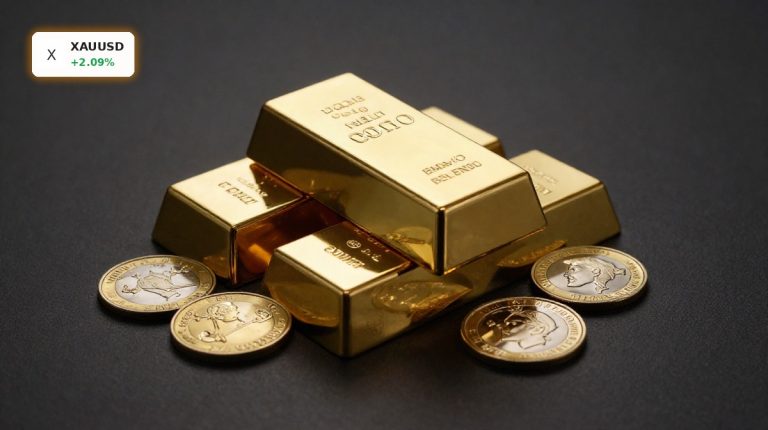

Will the sudden cooling of US consumer prices propel gold to new record highs, or will stubborn Treasury yields cap its upside?

How did the latest US consumer price data impact the market?
Global financial markets experienced a significant shift following the release of the US inflation report for June. The consumer price index fell to 3.5% on an annual basis, down from the previous reading of 4.2%. This deceleration came in below the consensus estimate of 3.8%. On a month-over-month basis, consumer prices declined by 0.4%, marking the sharpest monthly drop recorded since 2020. Additionally, core inflation, which excludes volatile food and energy costs, cooled to 2.6% compared to the prior 2.9% reading.
These cooler-than-expected figures have altered expectations regarding the Federal Reserve’s path forward. Prior to the release, market participants were pricing in a higher probability of further interest rate hikes due to geopolitical tensions in the Middle East, which had pushed Brent crude oil prices up by eleven percent to around $79.60 per barrel. The sudden cooling of inflationary pressures has provided relief to the bond market, even as the 10-Year US Treasury yield recently climbed slightly by 0.06% to 4.62%.
Why does Gold Inflation dictate the movement of precious metals?
For international investors, tracking Gold Inflation dynamics is essential when evaluating portfolio allocation. When consumer price growth slows, the pressure on the Federal Reserve to maintain restrictive interest rates begins to ease. Lower interest rates reduce the opportunity cost of holding non-yielding physical assets like Gold, which recently traded at $4046.88 per ounce, down a marginal 0.17% from its previous close of $4054.20. Despite this minor intraday slip, the metal has shown resilience, rebounding from a recent technical correction that saw prices temporarily dip to $3,993.83 before large institutional buyers stepped in to support the market.
Conversely, other precious metals like silver continue to face headwinds. While physical silver is supported by industrial demand from artificial intelligence data centers and the solar industry, it remains highly sensitive to real yields. High Treasury yields and a strong US Dollar index generally weigh on the sector. However, the cooling of consumer prices provides a supportive macro backdrop, offsetting some of the bearish sentiment driven by high interest rates.
Should investors choose physical metals or mining equities?
The debate between holding physical bullion and investing in mining companies has intensified. Many Wall Street investors historically turned to vehicles like the VanEck Gold Miners ETF (GDX) to gain leveraged exposure to rising commodity prices. However, historical performance data highlights a significant drag caused by operational risks and fee structures. Over the ten-year period ending in July 2026, the GDX returned 183.15%, while the cheaper iShares MSCI Global Gold Miners ETF (RING) returned 198.64%.
Strikingly, the physical metal tracking fund, SPDR Gold Shares (GLD), outperformed the GDX over the same decade with a return of 196.51%—without the associated corporate volatility. Mining operations face rising capital expenditures, labor costs, and unpredictable annual dividend distributions, which complicates tax planning for retail portfolios. For investors seeking a direct hedge against long-term currency devaluation, physical replication funds or direct bullion holdings have frequently delivered superior risk-adjusted returns compared to equity-based alternatives.
What are financial institutions forecasting for the sector?
Wall Street analysts remain divided on the near-term trajectory of precious metals as macroeconomic indicators fluctuate. Major investment banks are closely monitoring central bank purchases and retail sentiment. In the silver space, which often moves in tandem with the broader precious metals complex, JPMorgan Chase analysts project a recovery toward $80 per ounce by the end of 2026, pointing to a persistent supply deficit. Conversely, Bloomberg Intelligence analyst Mike McGlone has cautioned that the correction from previous record highs may not be entirely over, suggesting that elevated bond yields could continue to limit aggressive upside in the near term.