Can central bank buying stop the Gold Plunge, or is a stronger dollar about to push XAU even lower?

Why Did XAU Break Below $4,000?
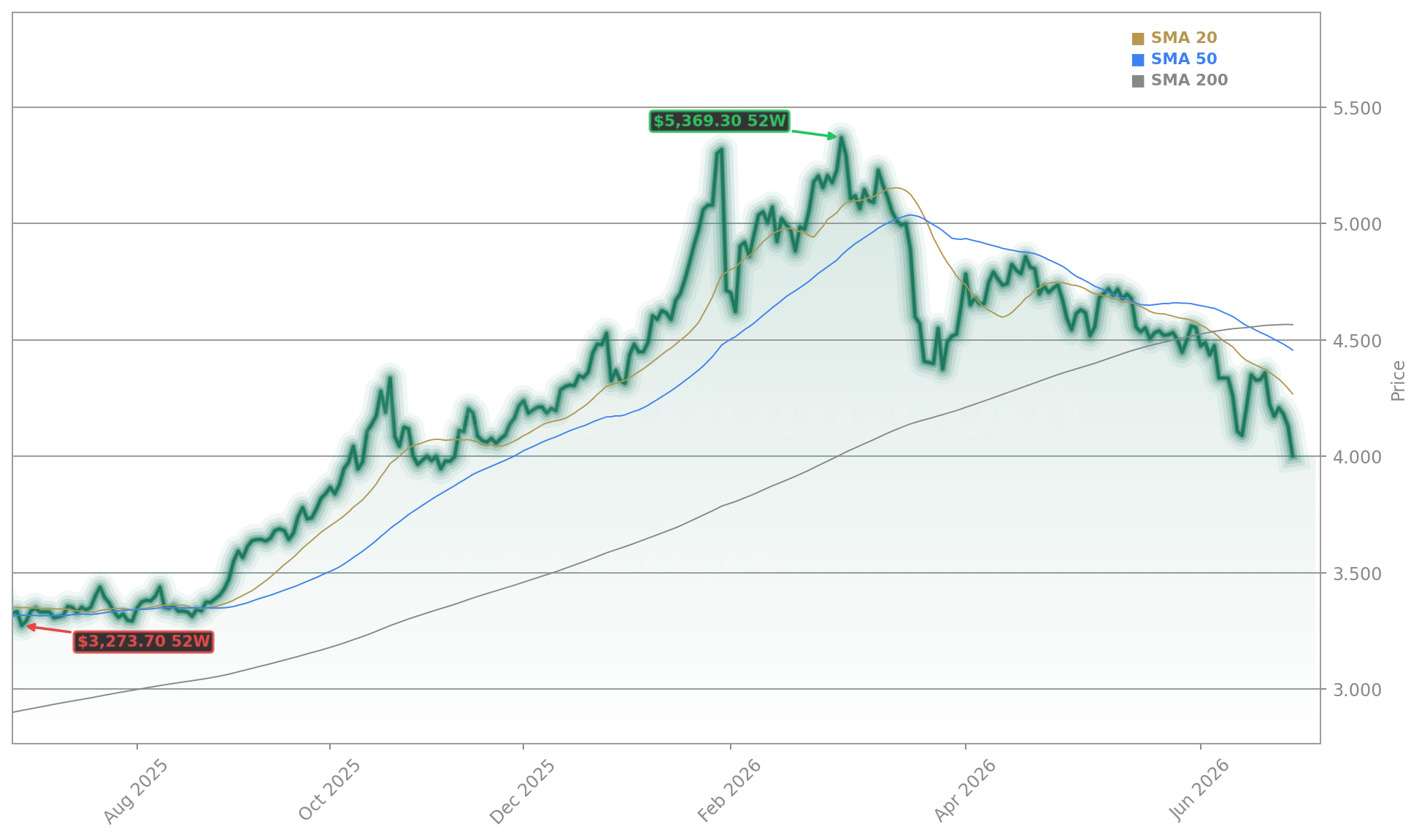
The Gold Plunge accelerated Wednesday as the U.S. dollar index climbed to its highest level since May 2025, pressuring dollar-denominated commodities. Gold (GC=F) fell to $4,059.30 by 7:58 a.m. ET — its weakest opening since June 11 — and later breached $3,976. The catalyst: hawkish commentary from new Federal Reserve Chair Kevin Warsh, who emphasized ‘price stability as non-negotiable’ during his first public address. Traders now price in two 25-basis-point hikes by March 2027, up from one just two weeks ago. Higher yields and a stronger greenback have converged to drain gold’s appeal — especially as inflation concerns ease following the U.S.-Iran Hormuz agreement and falling oil prices (WTI down 3.0% to $71.02).
How Are Gold Miners Reacting?
Gold producers are feeling acute pressure. Barrick Gold (GOLD) fell 2.1% intraday, while Newmont (NEM) dropped 1.8% — both underperforming the S&P 500 by over 300 basis points this quarter. The VanEck Gold Miners ETF lost 1.74% to $114.52 AUD, extending its Q2 2026 decline to nearly 10%. Operational headwinds compound the macro pain: multiple producers reported seismic-related production halts, and rising input costs are squeezing margins. Franco-Nevada (FNV) and Royal Gold (RGLD) — royalty-focused peers — declined 1.3% and 1.6%, respectively, reflecting broad-based de-risking across the sector.
What Do Analysts Say About the Gold Plunge?
Major banks have slashed price targets. Goldman Sachs cut its year-end gold forecast by $500 to $4,900 — still bullish long-term but signaling near-term caution. Deutsche Bank reduced its outlook by up to 22%, citing ‘waning institutional demand and heightened sensitivity to Fed policy shifts.’ Meanwhile, RBC Capital Markets downgraded the sector to ‘Underperform,’ warning that ‘gold’s technical structure remains broken below $4,100, with no near-term reversal catalyst beyond PCE data.’ Notably, Citigroup maintains a ‘Neutral’ rating on Barrick Gold but lowered its 12-month price target to $48 from $54, citing ‘weaker near-term sentiment and elevated dollar risk.’
Are Central Banks Still Buying?
Yes — and that’s the one structural floor beneath the Gold Plunge. According to the World Gold Council’s June 16 survey — the largest participation in its history — central banks plan record gold purchases in 2026, with over 65% of respondents citing ‘de-dollarization’ and ‘reserve diversification’ as top drivers. This demand has already absorbed nearly 30% of annual mine supply, helping limit downside despite ETF outflows totaling $4.2 billion in Q2. Still, the pace of official buying hasn’t offset the $8.7 billion in speculative long-position liquidations seen since May — a key reason gold’s 52-week high of $5,600 remains 28% out of reach.
What’s Next for Gold Investors?
Gold’s break below $4,000 reflects a decisive shift in macro positioning — the debasement trade is unwinding, and yield-sensitive investors are rotating out of non-interest-bearing assets.— Ewa Manthey, Commodity Strategist at ING Bank
Short-term focus shifts to Thursday’s U.S. PCE inflation report — the Fed’s preferred gauge — and Friday’s Q1 GDP revision. A hotter-than-expected print could push gold toward $3,800, per Deutsche Bank’s risk scenario. Conversely, a dovish surprise may trigger a technical bounce: the RSI for GC=F sits at 32.6, well into oversold territory. Silver (SI=F), down 19.4% month-to-date and trading at $59.32, is amplifying gold’s pain — with its industrial demand profile making it more sensitive to growth fears. For U.S. investors, the Gold Plunge isn’t just a commodity story; it’s a stress test for portfolio hedges amid a tighter Fed regime and concentrated equity leadership in NVIDIA and Apple.