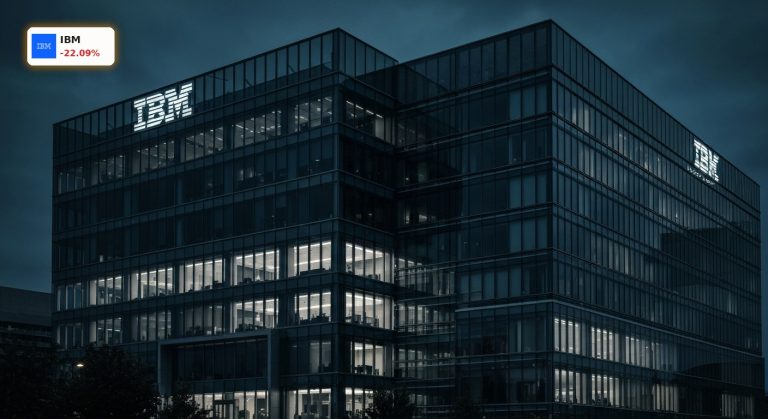

Will IBM’s massive 22% stock crash prove to be a temporary execution slip, or is the tech giant losing its grip on enterprise spending?

Why Did the Preliminary IBM Earnings Miss Wall Street Estimates?
The primary driver behind the disappointing preliminary IBM Earnings was a sudden and unexpected shift in enterprise spending. The company reported preliminary second-quarter revenue of $17.2 billion, representing a modest 1% increase year-over-year but falling well short of the $17.86 billion consensus estimate. On the profitability front, adjusted operating non-GAAP earnings came in at $2.93 per share, missing the $3.01 to $3.02 per share target anticipated by Wall Street analysts. Meanwhile, GAAP diluted earnings per share fell 2% to $2.27, and the company’s GAAP gross profit margin contracted by 100 basis points to 57.7%.
According to a letter to investors issued by Chief Executive Officer Arvind Krishna, the shortfall was heavily concentrated in the infrastructure division, which saw revenue slide by 7% during the quarter. This performance was significantly worse than the low-single-digit decline the company had originally projected. Krishna explained that in the final weeks of June, enterprise clients abruptly redirected their capital expenditure budgets away from software and mainframe systems toward supply-constrained hardware components, including servers, storage, and memory, to secure inventory ahead of anticipated price increases.
How Did International Business Machines Respond to the Execution Shortfall?
The sudden reallocation of corporate budgets caught the tech giant off guard. In his address to shareholders, Krishna admitted that the company failed to adapt quickly enough to these changing market conditions. The distraction of rapidly evolving, industry-wide cybersecurity concerns further complicated the sales cycle, causing numerous large-scale enterprise deals to slip past their expected closing timelines. “This quarter we faltered,” Krishna wrote, emphasizing that these delayed transactions accounted for the vast majority of the revenue miss rather than a permanent destruction of demand.
Despite the overall setback, the preliminary report highlighted several resilient segments within the broader portfolio of International Business Machines Corporation. Software revenue grew by 5%, bolstered by an 11% sequential acceleration in Red Hat. Additionally, recent acquisitions like HashiCorp and Confluent delivered solid performances, while the company’s Distributed Infrastructure business achieved its best historical performance with a 37% surge. The company also maintained its aggressive forward-looking roadmap, noting that its $10 billion quantum computing push remains on track to deliver the first large-scale, fault-tolerant quantum computer by 2029.
How Are Wall Street Analysts Reacting to the News?
The abrupt earnings warning prompted immediate reactions from major financial institutions. HSBC downgraded the stock from Hold to Reduce and slashed its price target to $191 from $231. Conversely, Morgan Stanley analyst Erik Woodring maintained an Equal-Weight rating on the stock and actually raised the price target to $293 from $267, indicating that some analysts view the long-term structural transformation as intact despite the near-term execution issues. The broader market felt the impact immediately, as the IBM miss sparked a wider sell-off across prominent software peers like Microsoft and SAP.
Related Coverage
These conditions require our teams to execute perfectly, and this quarter we faltered. We did not adapt and move quickly enough, and numerous large deals failed to close on the timelines we expected.— Arvind Krishna
To better understand the company’s broader operational trajectory, consider reading about the recent IBM Product Launch +2.2%: z17 and LinuxONE 5 Soar, which details how the company’s mainframe momentum was initially expected to drive long-term AI infrastructure growth. For a broader look at how shifting consumer patterns are impacting other major market sectors, explore the analysis of PepsiCo Earnings: Domestic Snacking Slump Tests Wall Street Patience, which highlights how macroeconomic headwinds are testing corporate resilience across the U.S. economy.