Is the Netflix Merger story finally shifting from failed mega-bids to a smaller deal Wall Street could actually support?

Why Did Netflix Miss Roku?
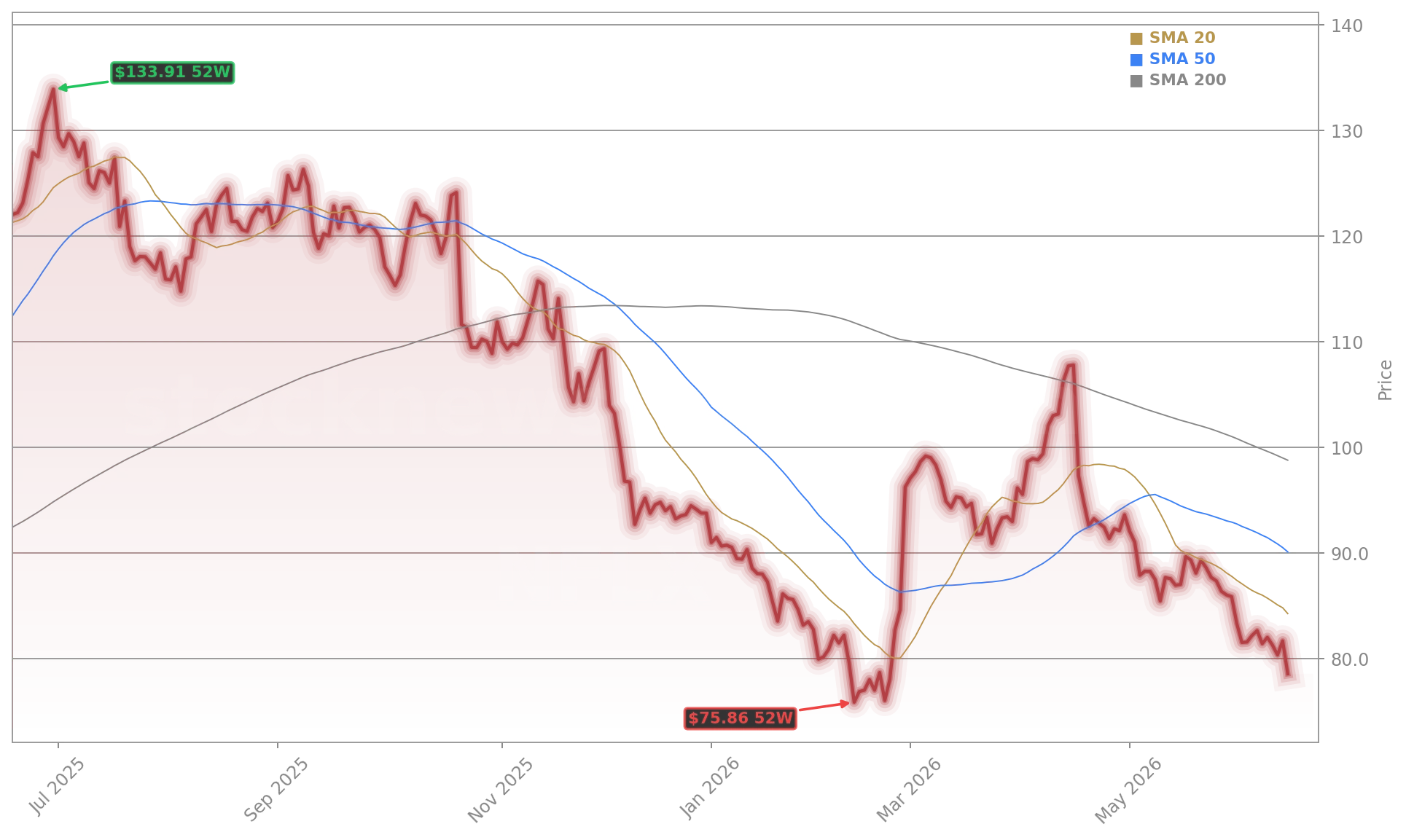
Netflix lost its bid for Roku to Fox Corporation’s $22 billion cash-and-stock offer, according to Semafor and Investor’s Business Daily. Fox’s $160-per-share valuation reportedly outpaced Netflix’s proposal, which never advanced to formal negotiations. Roku’s board prioritized maximum shareholder value — a stance that exposed Netflix’s disciplined but ultimately non-competitive pricing. The failed bid comes just months after Netflix also stepped back from the Warner Bros. Discovery auction, where Paramount Skydance ultimately prevailed. Co-CEO Ted Sarandos previously acknowledged the effort helped Netflix “build our M&A muscle,” but Wall Street is now questioning whether the company’s capital allocation strategy aligns with its growth mandate — especially as its stock trades 20% below its 200-day moving average.
What’s Driving the Netflix Merger Buzz?
The Netflix Merger narrative has pivoted sharply toward Lionsgate Studios — the $4.2 billion producer behind “The Hunger Games,” “John Wick,” and “Saw.” While Netflix has not confirmed formal talks, multiple sources, including Semafor and Investor’s Business Daily, identify it as one of several serious suitors. Lionsgate’s enterprise value is estimated at roughly $9 billion (25x EBITDA), a fraction of Netflix’s $344 billion market cap — making it a strategically logical, financially digestible target. For Netflix, acquiring Lionsgate would instantly bolster its owned IP library, accelerate ad-tier content differentiation, and reduce licensing dependencies — a critical need as it targets $3 billion in advertising revenue by end-2026.
How Is Wall Street Reacting?
Investors are pricing in both execution risk and valuation uncertainty. Netflix shares plunged nearly 4% intraday on June 16, closing at $78.55 — just above its key $75 support zone. The technical picture remains bearish: the stock trades below all major moving averages, with MACD momentum weakening and a death cross confirmed in December 2025. Yet after-hours action saw a 3.95% rebound to $81.66, suggesting short-term positioning may be shifting. Citigroup maintains a ‘Neutral’ rating with a $85 price target, citing “strong free cash flow generation and ad-tier scalability,” while RBC Capital Markets upgraded to ‘Outperform’ last week, noting “Lionsgate would be a high-conviction, low-dilution bolt-on that strengthens Netflix’s moat against Apple, Meta, and Disney.” Meanwhile, Morgan Stanley warns that “any Netflix Merger must deliver double-digit EBITDA accretion within 18 months — or risk further multiple compression.”
What’s Next for Netflix’s Growth Trajectory?
With Q1 2026 revenue at $12.3 billion (+16% YoY) and Q2 estimates pointing to $12.58 billion, Netflix’s core streaming business remains operationally sound — growing subscribers via anti-account-sharing enforcement, live sports, and WWE partnerships. Margins are expanding, free cash flow is robust, and the ad-tier is scaling faster than expected. But growth alone no longer satisfies investors. The market now demands strategic clarity — and the Netflix Merger push signals Netflix’s intent to move beyond licensing into vertical integration. That ambition could reshape competitive dynamics across the NASDAQ, where Netflix remains a top-10 weight in key tech ETFs like the First Trust DJ Internet Index Fund (FDN). With earnings due July 16, all eyes are on guidance for content spend, Lionsgate synergy assumptions, and the timeline for the next strategic move.
Lionsgate would be a high-conviction, low-dilution bolt-on that strengthens Netflix’s moat against Apple, Meta, and Disney.— RBC Capital Markets
Related Coverage: Netflix’s podcast partnership is already fueling a $1.8 billion advertising revenue boom ahead of Q2 — read how Netflix Podcast Partnership Fuels $1.8B Ad Revenue Boom. Meanwhile, Alphabet’s parallel $85 billion AI infrastructure investment underscores how streaming and AI infrastructure are converging — see Alphabet AI Financing: $85B Bet on Next-Gen AI Capacity.