Are the latest Nike Earnings a temporary stumble or the start of a longer slowdown that could even threaten its dividend story?

How weak are the latest Nike Earnings?
Nike, Inc. reported fiscal third-quarter 2026 revenue of $11.3 billion, essentially flat year over year on a reported basis and down 3% in constant currency. Wholesale revenue rose 5% to $6.5 billion, but Nike Direct sales, once the growth engine, fell 4% to $4.5 billion. The shift back toward wholesale is helping clear inventory, yet it also pressures brand control and long-term pricing power.
Gross margin came in at 40.2%, underscoring ongoing discounting and mix headwinds across North America, EMEA and Greater China. Diluted EPS landed at $0.35, underscoring that profitability is not keeping pace with the company’s dividend ambitions. CEO Elliott Hill emphasized tighter execution and “business quality” initiatives, but the Q3 Nike Earnings snapshot still looks more like stabilization than a true turnaround.
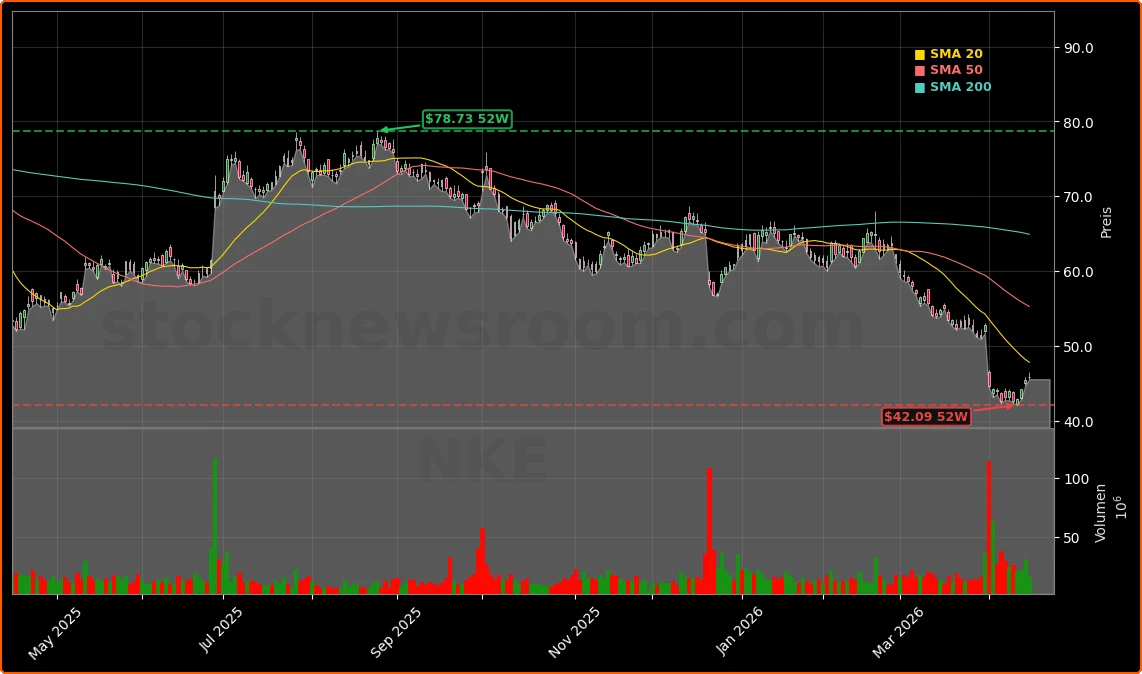
The market reaction has been muted rather than euphoric. At $45.85, the stock is only modestly above its prior close and remains far below the all‑time high near $166 set in late 2021, leaving Nike significantly underwater versus many S&P 500 consumer names that have already reclaimed or surpassed their pre‑inflation peaks.
Are analyst downgrades now driving the story?
Sell-side sentiment has cooled meaningfully. On April 13, HSBC analyst Erwan Rambourg cut his rating on Nike, Inc. from Buy to Hold and slashed the price target to $48 from $90, citing limited visibility and persistent challenges in Converse, China, EMEA and the broader sportswear category. The new target implies only marginal upside from current levels, framing the risk/reward as balanced at best in the near term.
JPMorgan Chase & Co. has likewise reiterated a neutral stance on the stock, aligning with a growing cluster of Hold ratings across Wall Street. With consensus targets drifting lower and Nike now trading closer to its 52‑week lows than its highs, portfolio managers focused on the S&P 500 consumer discretionary cohort may find more attractive growth-adjusted return prospects in high-momentum names like NVIDIA or Tesla rather than in a still-decelerating apparel giant.
Technical traders remain split, with recent TradingView commentaries highlighting both potential short setups on fading rallies and contrarian long ideas off support zones. Until the next Nike Earnings release shows a clearer inflection in demand and margins, the stock is likely to remain a battleground name rather than a consensus overweight.
Is Nike’s dividend becoming a liability?
For dividend investors, the most striking data point is Nike’s payout ratio. With an annual dividend of $1.64 per share — $0.41 paid quarterly — the trailing payout ratio has climbed to roughly 106%, meaning the company is distributing more cash than it is currently generating in earnings. For a mature blue-chip, a healthy range is typically considered 30% to 60%, allowing room to reinvest while rewarding shareholders.
Management still opted to raise the quarterly dividend by 1 cent in late 2025, marking the 24th consecutive annual increase. One more hike in 2027 would qualify Nike, Inc. as a dividend aristocrat, a status that carries marketing value in income-focused ETFs and dividend growth strategies. But the uncomfortable reality is that the latest Nike Earnings do not fully support the existing payout, let alone further increases, without either stronger profit growth or a willingness to fund dividends via balance sheet flexibility.
Critics argue that sustaining a payout ratio above 100% while revenues are flat and margins under pressure is not viable. Some institutional income funds could be forced to reassess their exposure if management signals even a temporary pause in dividend growth, a move that would also undercut the aristocrat narrative.
Do insider buys outweigh legal and governance risks?
Insider activity has recently turned decisively bullish. In mid-April, President and CEO Elliott Hill purchased roughly 23,660 Class B shares at about $42.27, lifting his direct stake above 265,000 shares. Around the same time, director Timothy D. Cook — better known to investors as the CEO of Apple — acquired 25,000 shares at $42.43, a more than $1 million vote of confidence. Director John W. Rogers Jr. also added 4,000 shares at $43.34 earlier in April.
These open-market buys follow the March 31 Nike Earnings release and were made under the company’s standard post-earnings trading window policies. For many Wall Street investors, such clustered insider purchases near 52-week lows are a key bullish signal that management sees the current price as undervaluing long-term brand strength and global scale.
Balancing this, an investor-rights law firm has launched an investigation into whether certain officers and directors may have breached fiduciary duties to shareholders, raising questions around governance and strategic missteps. While no specific allegations have been proven, the probe adds another layer of uncertainty for risk-averse investors already concerned about execution problems in China and repeated turnover in the innovation leadership team.
Related Coverage
Concerns about execution and product pipeline strength were explored in more detail in a recent analysis, “Nike Innovation -3.4% Plunge Raises Turnaround Warning”, which examined whether leadership churn in innovation can be addressed fast enough to defend margins and justify the stock’s valuation. For a broader look at consumer brand earnings momentum, readers can also examine how another global powerhouse is navigating pricing and cost pressures in “PepsiCo Earnings +2.9% Surge as Margin Power Returns”, where PepsiCo’s margin recovery offers an instructive contrast to Nike’s current reset.
In summary, the latest Nike Earnings highlight a company caught between brand power and financial strain: flat sales, a 40.2% gross margin and EPS of $0.35 leave little cushion for a dividend now yielding about 3.8% with a payout ratio above 100%. For investors, the mix of insider buying, looming dividend-aristocrat status and still‑solid blue-chip positioning must be weighed against analyst downgrades, governance questions and regional weakness, especially in China. The next few quarters of Nike Earnings will be critical in proving whether today’s sub‑$50 share price is a value opportunity or a value trap.