Can a solid Norwegian Cruise Line earnings beat outweigh a gloomy outlook that suddenly puts the post-pandemic recovery story in doubt?

How did Norwegian Cruise Line Earnings stack up?
Norwegian Cruise Line Holdings Ltd. (NCLH) reported Q1 2026 total revenue of about $2.3 billion, up roughly 10% year over year, driven by increased capacity days as the fleet continues to normalize post-pandemic. GAAP net income swung to a profit of about $105 million, or $0.23 per share, versus a loss of $40 million a year earlier. Adjusted EPS also came in at $0.23, more than doubling year on year and topping consensus expectations near $0.14.
Adjusted EBITDA climbed 18% to $533 million, beating internal guidance of around $515 million and underscoring improving operating leverage. Gross margin per capacity day rose about 4% on a reported basis, while net yield slipped a modest 0.3% as reported (about 1% in constant currency), a smaller decline than management had guided. On the cost side, gross cruise costs per capacity day fell from roughly $297 to $287, and adjusted net cruise cost excluding fuel per capacity day edged lower, helped by new cost-saving initiatives.
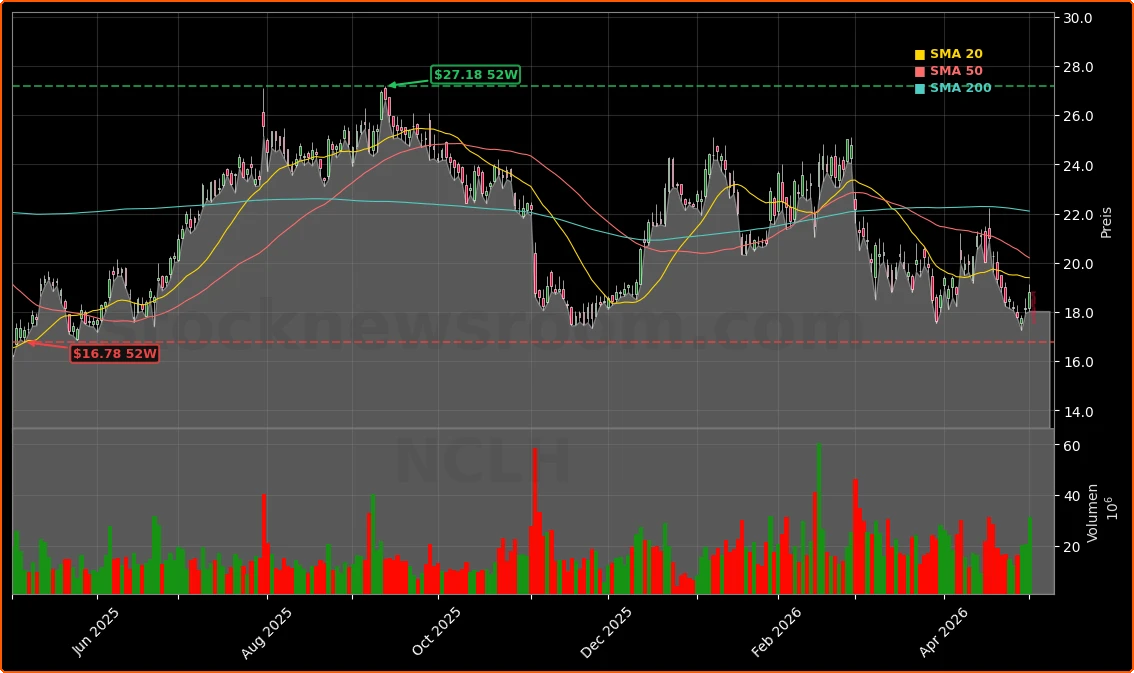
Yet despite the operational progress highlighted in the latest Norwegian Cruise Line Earnings release, the market reaction has been negative. NCLH closed Friday at $18.81, up 3.47% and outperforming the S&P 500, but in pre-market trading Monday the stock was down about 6.6% near $17.57 as investors focused on a weaker outlook rather than the Q1 beat.
Why did guidance overshadow the profit beat?
Management cut its full-year 2026 guidance, signaling that this could be the first annual earnings decline since the pandemic recovery began. The company now expects full-year adjusted EPS between $1.45 and $1.79, down from its prior view and below many bullish projections embedded in recent price targets. Full-year adjusted EBITDA is now seen in a range of roughly $2.48 billion to $2.64 billion, while adjusted operational EBITDA margin is expected at about 32.9% to 34.3%.
The downgrade reflects several headwinds. Disruptions linked to conflict in the Middle East are driving higher fuel expenses and causing some guests to rethink itineraries, especially for Europe-bound cruises. Management also acknowledged entering 2026 behind its targeted booking curve, making it harder to fill ships at optimal pricing in a more uncertain macro and geopolitical backdrop.
Net yield is now expected to decline approximately 3% to 5% for the full year on a constant-currency basis, even as adjusted net cruise cost excluding fuel per capacity day is forecast to be roughly flat versus 2025. The Q2 2026 outlook calls for net yield to fall about 3.6% and costs ex-fuel to rise around 1% on a constant-currency basis, pointing to margin pressure in the near term despite cost actions.
What strategic moves is Norwegian Cruise Line making?
To offset those pressures, Norwegian Cruise Line Holdings Ltd. is pushing a series of structural changes. The company announced about $125 million in expected annualized SG&A run-rate savings, driven by workforce optimization and organizational streamlining. Management argues these are long-term fixes, not one-off cuts, intended to make the business leaner and more accountable.
The fleet is still expanding selectively. Norwegian recently took delivery of the Norwegian Luna, a new ship featuring an enhanced lineup of venues and entertainment, including an in-house Elton John-themed production. The company is also refreshing its board, appointing five new independent directors effective March 31, 2026, in a move meant to sharpen governance and shareholder focus as it continues to work down the heavy debt load accumulated during the COVID shutdown.
From a valuation perspective, some research platforms see NCLH as materially undervalued around the high-teens share price, with estimated fair value well above current levels. Large institutions remain exposed: Vanguard Group, for example, held more than 52 million shares at the end of Q4 2025, representing roughly 11.6% ownership.
How does Norwegian compare to other cruise stocks?
For U.S. investors, the key question is how this guidance reset positions Norwegian Cruise Line Earnings relative to peers like Carnival and Royal Caribbean. Norwegian tends to skew more toward premium and upscale brands, much like how Apple focuses on higher-end hardware versus value competitors, and that positioning has historically supported stronger pricing power. However, it also means the company is more exposed when affluent travelers pull back on discretionary international trips.
Recent commentary from institutional investors suggests that long-term potential remains, supported by robust demand for premium offerings and solid liquidity, but the path may be bumpier than initially hoped. Some funds note ongoing operational inefficiencies and a structurally higher cost base, while also highlighting the opportunity if management can execute on cost cuts and deleveraging. On Wall Street, consensus remains generally constructive, with several major banks still rating the stock a “Buy” or “Moderate Buy” even after trimming price targets earlier in the year, though individual houses such as Citigroup and Morgan Stanley have emphasized execution and debt reduction as critical drivers for upside.
Related coverage: What about Norwegian Cruise Line debt?
Investors worried about leverage can find a deeper dive in the analysis “Norwegian Cruise Line Debt +11.5% Surge: Risk or Revival?“. That article explores whether the stock’s sharp rebound is enough to balance the still-elevated debt burden and rising fuel costs that now frame the latest Norwegian Cruise Line Earnings update. Together, the earnings reset and the debt discussion give a fuller picture of the risk‑reward profile facing U.S. portfolios.
We delivered strong first quarter results, and more importantly we have already begun taking decisive actions to strengthen execution and accountability across the company.— John W. Chidsey, Chairperson and CEO of Norwegian Cruise Line Holdings Ltd.
In sum, the newest Norwegian Cruise Line Earnings report shows a company that is executing well in the short term but recalibrating expectations for 2026 amid geopolitical and demand challenges. For investors, the combination of a profit beat, lower guidance and a pullback in the share price could create an attractive entry point, provided they are comfortable with leverage and macro risk. The next quarters will be crucial in proving that cost savings, new capacity and governance changes can support sustainable earnings growth and justify a re-rating higher for NCLH.