Can GameStop’s $56 billion eBay Acquisition bid really rewrite the e‑commerce playbook or will investors kill the deal first?

How did markets react to eBay Inc. today?
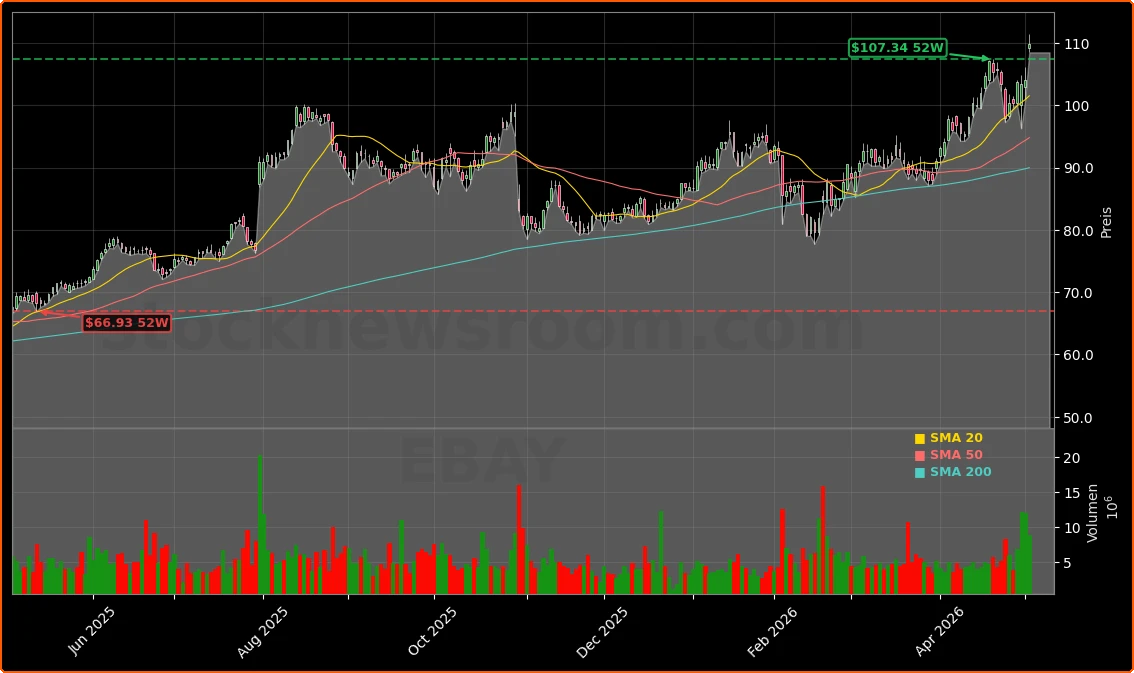
The takeover headlines lit up U.S. pre‑market trading, pushing eBay Inc. sharply higher before the opening bell. EBAY gained roughly 8–10% in early indications and is recently trading at about $109.77, up 5.50% on the day, after an earlier spike that briefly touched the mid‑$110s. That move puts the stock at a fresh 52‑week high zone but still meaningfully below the proposed $125 offer level, underscoring skepticism that the full price will materialize or that the transaction will close on current terms.
GameStop shares, which had initially jumped on the news in Sunday night trading, have been more volatile as investors digest the size of the proposed deal and the dilution risk. The market is now trying to handicap three things at once: the probability that the eBay Acquisition happens, the likelihood of a higher competing bid, and how much value GameStop’s cost‑cutting and integration plan could realistically unlock if the deal does close.
What exactly is GameStop offering for eBay Inc.?
GameStop’s proposal values eBay at $125 per share, split 50/50 between cash and GameStop common stock. Based on eBay’s current share count, that equates to roughly $55.5 billion in equity value, or about a 20% premium to Friday’s close and a 46% premium to the unaffected price on February 4, 2026, when GameStop began building its stake. The company has quietly amassed an economic interest of about 5% in eBay via shares and derivatives.
To fund the cash portion, GameStop is pointing to approximately $9.4 billion in cash and liquid investments on its balance sheet as of January 31, 2026, plus a “highly confident” financing letter from TD Securities for up to $20 billion in acquisition debt. The remainder would have to be covered with newly issued GameStop stock and potentially additional equity or hybrid capital from outside investors such as sovereign wealth funds. That heavy reliance on new shares is the main reason analysts flag significant dilution risk for existing GameStop investors, even if the eBay Acquisition ultimately creates a larger, more diversified commerce platform.
How does the eBay Acquisition fit into the strategy?
GameStop CEO Ryan Cohen frames the bid as a once‑in‑a‑generation chance to build a credible rival to Amazon and other mega‑cap e‑commerce names like Apple’s marketplace ecosystem and, indirectly, the merchant platforms surrounding NVIDIA‑powered AI infrastructure. Cohen argues that eBay has the “second‑largest commerce franchise” globally but is under‑monetized, especially in high‑margin segments like collectibles, gaming hardware, fashion resale, and auto parts.
The strategic blueprint leans on three pillars. First, GameStop claims it can deliver about $2 billion in annualized cost savings within 12 months of closing, primarily by cutting roughly $1.2 billion from eBay’s sales and marketing budget, $300 million from product development, and $500 million from general and administrative overhead. On GameStop’s projections, those cuts alone would lift eBay’s diluted GAAP EPS from $4.26 to $7.79 in the first year after completion.
Second, GameStop’s approximately 1,600 U.S. stores would be repurposed as a physical backbone for eBay — handling authentication, intake, and fulfillment for categories such as sneakers, trading cards, refurbished electronics, and retro‑gaming. Plans also include live‑commerce broadcasts from stores, a model already being tested by players ranging from Tesla’s showroom‑style marketing to livestream pilots on major platforms.
Third, Cohen, who would become CEO of the combined company and takes no base salary or cash bonus, wants to push deeper into AI‑driven shopping experiences, personalization, and trust systems, mirroring how Apple and other tech giants have used software ecosystems to deepen user engagement and monetization.
Can GameStop really close this deal?
The biggest question on Wall Street is not whether the eBay Acquisition would be transformative, but whether it is feasible. eBay currently carries a market capitalization of roughly $46 billion, nearly four times GameStop’s roughly $12 billion equity value. Leveraging a smaller meme‑stock to buy a larger, profitable NASDAQ mainstay is structurally unusual and puts intense scrutiny on financing, governance, and regulatory risk.
eBay has already confirmed that its board received an unsolicited, non‑binding proposal and is working with advisors to evaluate the offer, with a particular focus on the credibility of the stock consideration and the ability to deliver a binding, fully financed bid. The company has urged shareholders to take no action for now as it continues to execute on its own growth plan, which emphasizes high‑value verticals and AI‑driven product improvements.
On the sell‑side, early commentary skews cautious. Several Wall Street banks highlight that any credible offer would likely require substantial equity issuance from GameStop and careful balance sheet management at the combined entity. While specific ratings such as “Buy” or “Underperform” from houses like Goldman Sachs, Morgan Stanley, Citigroup, or RBC Capital have not yet shifted on the back of today’s headlines, analysts broadly flag meaningful execution risk, from integrating culture and technology stacks to hitting the aggressive $2 billion cost‑reduction target without damaging eBay’s core franchise.
What does this mean for eBay shareholders now?
For EBAY holders, the immediate implication is simple: a live takeover angle is now embedded in the stock. With the share price trading at a notable discount to the $125 headline figure, the market is implicitly assigning a probability that the deal will not close as proposed, or at all. A rival bid from a strategic or private‑equity buyer could change that calculus, but nothing concrete has emerged so far.
Fundamentally, eBay remains a profitable, cash‑generating marketplace that has been refocusing on recommerce and enthusiast categories, including through previous moves like acquiring Depop and other specialty platforms. Long‑term investors now have to weigh standalone upside — driven by margin expansion, buybacks, and niche growth — against the optionality that a revised or competing eBay Acquisition could surface a higher control premium.
Related Coverage
Investors looking to understand how M&A has already shaped the company’s strategy may want to revisit eBay’s push into recommerce and youth marketplaces. An earlier breakdown of those moves can be found in “eBay Depop Acquisition: Double-Digit Revenue Boom and Rally Opportunity”, which explores how the Depop deal boosted growth and strengthened eBay’s positioning in second‑hand fashion.
Overall, the proposed eBay Acquisition by GameStop puts eBay Inc. at the center of one of 2026’s boldest corporate gambles, with near‑term upside anchored by a takeover premium and long‑term outcomes dependent on execution. For U.S. and global investors, EBAY has abruptly shifted from a steady NASDAQ marketplace play into a live event‑driven story. The next phase will hinge on how eBay’s board responds, whether financing firms fully backstop the bid, and if other suitors emerge — developments that could keep the stock squarely in Wall Street’s spotlight.