
Is the Coinbase Stablecoin Compromise the regulatory turning point that finally lets COIN rally without a constant Washington overhang?

How is Coinbase reacting to the Coinbase Stablecoin Compromise?
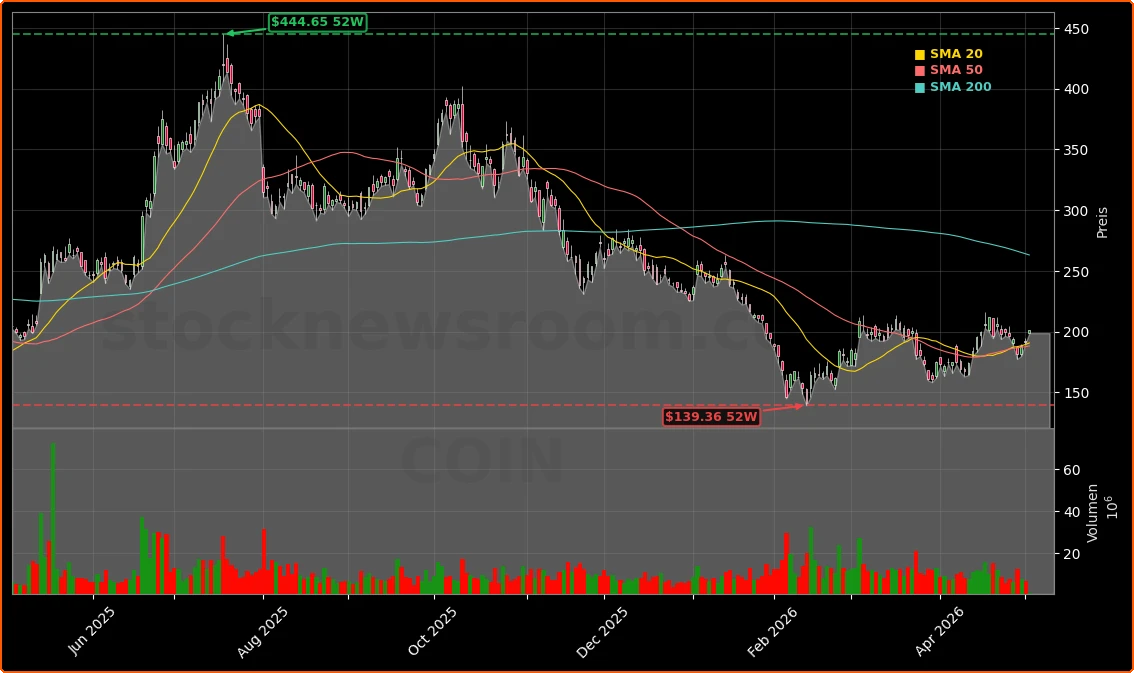
On Monday, Coinbase Global, Inc. traded higher to $201.38, a gain of about 5.3%, as Wall Street digested the Coinbase Stablecoin Compromise that reshapes expectations for U.S. crypto regulation. The move comes as Bitcoin has surged roughly 5% in recent days and briefly crossed $80,000, with improving risk appetite across the NASDAQ and S&P 500 helping crypto‑linked names.
Senators Thom Tillis (R‑N.C.) and Angela Alsobrooks (D‑Md.) released updated language for the Digital Asset Market Clarity Act that addresses one of the most contentious issues for centralized platforms: whether stablecoin issuers and exchanges can pay yield simply for holding token balances. The compromise would prohibit interest‑like payments solely for parking stablecoins, but it preserves room for rewards tied to actual usage and transactions on crypto networks.
Faryar Shirzad, Coinbase’s chief policy officer, welcomed the outcome, arguing that banks secured tighter limits on “yield‑like” rewards, but crypto platforms retained the ability for users to earn incentives based on real activity. That distinction matters for Coinbase’s growing stablecoin and payments ecosystem, including infrastructure such as the x402 protocol that underpins internet‑native payments and is being migrated into the Linux Foundation with partners like Fiserv.
What exactly changed for stablecoin rewards?
The Coinbase Stablecoin Compromise centers on how stablecoin rewards are defined and restricted. Under the revised bill text, issuers and platforms would be barred from paying “any form of interest or yield” simply for holding a stablecoin balance, including programs that are economically equivalent to interest‑bearing bank deposits. The language explicitly extends to loyalty‑style schemes if they merely mimic deposit interest.
However, the bill carves out an important exception: incentives based on “bona fide activities or bona fide transactions.” In practice, that opens the door for Coinbase and peers to redesign their products around a “buy and use” model rather than pure “buy and hold” yield. Rewards could be tied to on‑chain payments, trading, or network participation instead of passive balances, preserving a path for consumer incentives without directly undercutting bank deposits.
This framework reduces a flashpoint with traditional banks, which had lobbied hard against stablecoin rewards on the grounds that they threaten core deposit funding. For investors, the Coinbase Stablecoin Compromise signals that Washington is looking for coexistence between digital asset platforms and the banking system rather than an outright crackdown on stablecoins.
How does this affect Coinbase’s business and valuations?
For Coinbase, the compromise helps de‑risk a strategically important revenue lane. Stablecoins support trading liquidity, payments, cross‑border transfers, and emerging credit products such as Coinbase’s new stablecoin‑based credit fund highlighted in recent coverage. That fund, coupled with higher Bitcoin prices and rising spot Bitcoin ETF inflows, strengthens the thesis that Coinbase can monetize both trading and on‑chain financial services.
At $201.38, COIN remains sensitive to Bitcoin’s path; the stock has historically traded as a leveraged play on crypto sentiment. But the Coinbase Stablecoin Compromise adds a regulatory pillar that could support a higher multiple if investors gain confidence that U.S. lawmakers are converging on a workable market‑structure regime. The Clarity Act still needs markup in the Senate Banking Committee, alignment with the Agriculture Committee’s version, and precious floor time before the Memorial Day recess, yet industry voices now expect the bill to move forward rather than stall.
Wall Street analysts at large banks such as Goldman Sachs and Morgan Stanley have previously highlighted regulatory visibility as a key swing factor for COIN’s valuation. While no major target changes were published on Monday, the improved tone from Washington and robust Bitcoin ETF inflows may put upward pressure on price targets if the rally holds into Coinbase’s May 7 earnings release after the U.S. close.
What are competitors and correlated plays doing?
The policy breakthrough has lifted the broader crypto equity complex. Crypto‑exposed names such as Strategy, Riot Platforms, Hut 8, and Block all traded higher as Bitcoin reclaimed the upper $70,000s. Hut 8, for example, just refinanced a $200 million Bitcoin‑backed credit facility, moving from a more expensive arrangement with Coinbase’s lending arm to a cheaper structure with FalconX that cuts interest rates and frees up roughly 3,300 BTC as unencumbered collateral. That underscores how miners are using the current window of stronger prices and improved credit conditions to shore up balance sheets.
Traditional finance is also inching deeper into digital assets. Morgan Stanley has been expanding both its Bitcoin ETP offerings and direct BTC holdings, while pursuing an OCC digital trust charter to provide custody and spot trading. These institutional moves complement the regulatory progress behind the Coinbase Stablecoin Compromise and help explain why flows into spot Bitcoin ETFs accelerated to several billion dollars over recent months.
Beyond pure crypto names, large‑cap tech and AI beneficiaries such as NVIDIA, Apple and Tesla remain the dominant drivers of the NASDAQ, but the renewed life in Bitcoin and stablecoins is giving investors another high‑beta satellite theme to rotate into alongside the AI trade.
Coinbase Stablecoin Compromise: what’s next for the Clarity Act?
The key question now is whether Congress can move quickly enough. Senator Bernie Moreno has warned that the Clarity Act likely needs to pass by May or risk being pushed aside by election‑year politics. The Banking Committee still must hold a markup, reconcile its version with the Agriculture Committee’s language, and then secure floor time in both chambers. Even so, industry leaders, including Coinbase CEO Brian Armstrong, are publicly urging lawmakers to “mark it up” and finalize the bill.
If the Coinbase Stablecoin Compromise holds through the markup process, Coinbase could enter 2027 with a much clearer U.S. regulatory perimeter for stablecoins, token classification, DeFi, and tokenization. That would lower legal risk premia embedded in COIN and potentially support broader adoption of Coinbase’s infrastructure offerings, from stablecoin rails to payment protocols like x402.
Related Coverage: For a deeper dive into how Coinbase is expanding on‑chain credit, readers can explore detailed analysis of the Coinbase Stablecoin Credit Fund and its +3.3% surge on the CUSHY launch, which examines whether this marks a turning point for private credit on public blockchains. Crypto traders watching network alternatives can also review our latest Solana price update on whether the crucial $85 support will hold or break, an important backdrop for assessing layer‑1 competition to Ethereum and the ecosystems that exchanges like Coinbase serve.
The Coinbase Stablecoin Compromise has turned a major policy headache into a potential catalyst, helping COIN rebound as Bitcoin and institutional flows strengthen the crypto backdrop. For U.S. investors seeking exposure to both trading and the infrastructure side of digital assets, Coinbase now sits at the intersection of Washington rule‑making and Wall Street adoption, with upcoming Q1 earnings and the fate of the Clarity Act set to determine whether this momentum can continue.