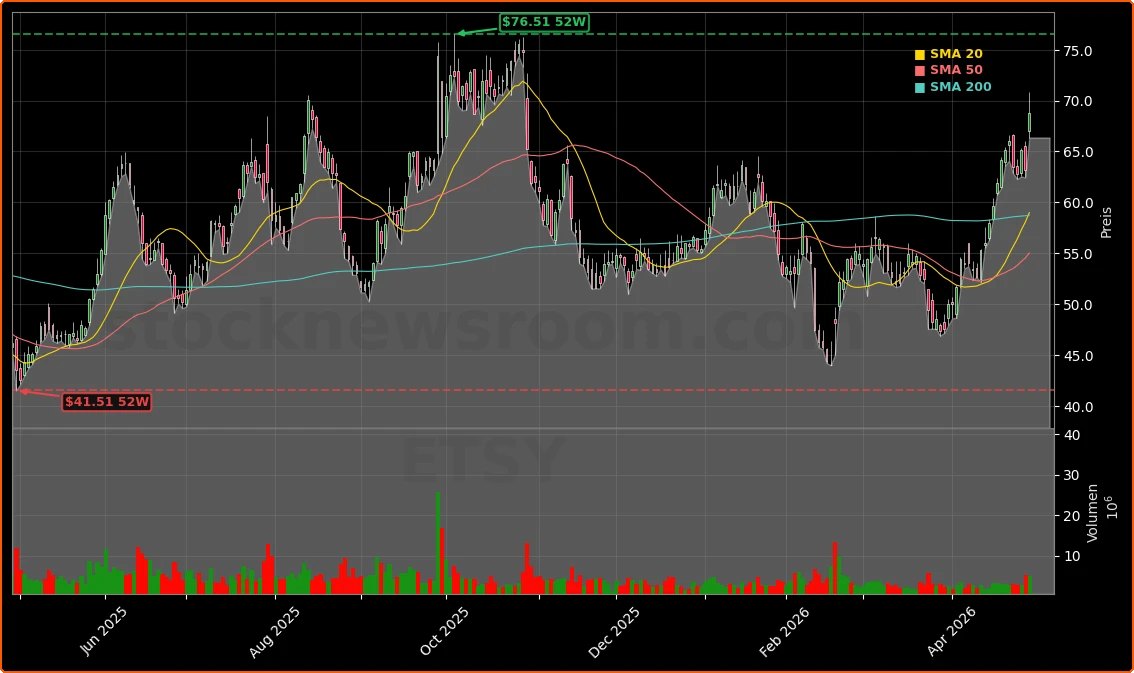
Can the latest Etsy Earnings surprise and an 8.9% stock surge finally reset the narrative around this embattled marketplace?

Why did Etsy, Inc. jump after the report?
Etsy, Inc. delivered a Q1 performance that exceeded cautious expectations. Revenue reached about $631 million, ahead of analyst estimates near $621 million, supported by a 5.5% year‑over‑year increase in marketplace GMS to roughly $2.5 billion. Diluted earnings per share from continuing operations came in at $0.89, far above Wall Street forecasts closer to $0.62, as the company combined modest top‑line growth with tight cost control and operating leverage.
On the bottom line, net income from continuing operations swung to roughly $105 million from a loss a year earlier, when results were weighed down by a large non‑cash impairment. Adjusted EBITDA was approximately $185 million, for an impressive 29.3% margin, underlining that Etsy still operates a highly profitable asset‑light marketplace despite uneven demand in discretionary categories like home and décor.
Momentum in the mobile app was a key driver. App GMS grew more than 11% year over year and reached about 47% of total GMS, with management emphasizing that app users generate around 40% higher lifetime value than web‑only shoppers. That mix shift supports higher engagement and more efficient marketing, a dynamic closely watched by investors who compare Etsy’s app strategy with platforms like Apple’s App Store ecosystem or NVIDIA‑powered AI personalization engines across e‑commerce.
How do current Etsy Earnings change the growth narrative?
The latest Etsy Earnings also marked the first sequential increase in active buyers in two years, a critical inflection for a company that had struggled to re‑accelerate engagement after the pandemic boom. The trailing 12‑month active buyer base reached about 86.6 million, while GMS per active buyer rose to $122, growing year over year for the first time since 2022 and improving sequentially for the fourth straight quarter.
Average order value (AOV) increased as well, aided by foreign exchange tailwinds, the expiration of a de minimis tariff exemption and marketplace product tweaks that nudge shoppers toward higher‑priced or bundled items. Management cautioned that these pricing benefits will likely moderate later in the year, but the combination of rising AOV and improving frequency points to healthier underlying behavior on the platform.
On the seller side, Etsy reported that active sellers grew roughly 3.3% to 5.6 million, the first year‑over‑year increase since it introduced a seller setup fee. New and reactivated buyers totaled nearly 11.9 million, up close to 5% year over year, suggesting that marketing and AI‑driven discovery are beginning to pay off. While AI‑generated traffic still represents only a low single‑digit percentage of total visits, leadership expects personalization and conversational agents to play a growing role in buyer matching and seller support over time, echoing broader trends seen at mega‑caps like Meta and commerce peers such as Tesla’s direct‑to‑consumer digital sales approach.
What guidance did Etsy, Inc. give for the next quarters?
Etsy’s outlook helped reinforce the positive reaction to the latest Etsy Earnings. For the second quarter, management projected marketplace GMS between $2.48 billion and $2.53 billion, implying 3%–5% year‑over‑year growth. The company expects the take rate to hover near the current 25.7% level and guided to an adjusted EBITDA margin of 27%–29%, effectively signaling that it can sustain high‑20s profitability even while investing in product, AI and marketing.
For full‑year 2026, leadership anticipates low single‑digit percentage GMS growth, with positive year‑over‑year GMS in each quarter. Executives acknowledged that foreign exchange tailwinds and tariff‑related pricing boosts will fade as the year progresses, making comparisons more challenging, and warned that the growth path “won’t be linear” amid macroeconomic uncertainty and pressure on consumer budgets.
Still, Etsy ended the quarter with about $1.6 billion in cash, cash equivalents and investments, and expects a further $1.2 billion cash inflow from the pending sale of its Depop fashion resale platform to eBay, which is targeted to close by the end of Q3 2026. That war chest supports ongoing share repurchases—about $145 million in stock was bought back in the quarter, with $828 million remaining under board authorization—and provides flexibility for selective investment without reliance on new equity or debt issuance.
How is Wall Street reacting to Etsy Earnings?
On Wall Street, sentiment around Etsy remains mixed but is shifting as the latest Etsy Earnings reset expectations. UBS recently raised its price target to $72 from $53 while maintaining a Neutral rating, citing the balance‑sheet boost from the Depop transaction and the potential for capital returns. At the same time, MarketBeat data show a consensus Hold rating across covering analysts, with an average price target around the low‑$60s, below the present share price near $69, reflecting skepticism about how far the recovery can run.
Some institutional investors have reduced exposure—Zürcher Kantonalbank, for example, cut its stake significantly in the fourth quarter—while insider selling by former CEO and current chair Josh Silverman has also drawn attention. However, institutional ownership remains extremely high, near 100%, keeping Etsy squarely in the professional investor universe and sensitive to shifts in growth expectations or margin guidance.
Compared with other e‑commerce and marketplace names on the NASDAQ and S&P 500, Etsy is still far below its pandemic‑era peak, down roughly 79% from all‑time highs, but the stock has climbed more than 30% over the past year as the turnaround thesis gains traction. For U.S. investors weighing high‑growth tech exposures like Apple or AI beneficiaries such as NVIDIA, Etsy now represents a more cash‑rich, margin‑resilient mid‑cap option with a focused niche rather than a broad retail platform.
We saw encouraging signals during the first quarter that our growth priorities are taking hold, and I have even more conviction in our focus and confidence in our ability to translate recent momentum into durable growth.— Kruti Patel Goyal, CEO of Etsy, Inc.
In sum, the latest Etsy Earnings show a company that is leaner, more disciplined and increasingly confident in its ability to grow buyers, spending and profitability from a reset base. For long‑term investors, the key questions now are whether management can maintain momentum in mobile app engagement and AI‑driven personalization, and how quickly macro headwinds ease. The next couple of quarters will determine whether Etsy’s renewed growth trajectory becomes a lasting feature of the story or just another brief uptick on a still‑volatile chart.