Can a double-digit revenue jump and a 7% stock surge turn T-Mobile US into Wall Street’s next cash-flow favorite?

How did T-Mobile US Earnings stack up?
T-Mobile US, Inc. (TMUS) delivered adjusted earnings per share between $2.27 and $2.70 for Q1 2026 in various presentations, comfortably ahead of Wall Street expectations around $2.02–$2.06. Revenue reached about $23.11 billion, modestly topping consensus estimates near $23 billion and rising roughly 11% year over year. Service revenue climbed to $18.8 billion, also up about 11%, underlining the company’s shift toward higher-value accounts rather than just raw subscriber counts.
Postpaid performance remained the key profit engine. T-Mobile added 217,000 postpaid net accounts in the quarter, about 6% more than a year earlier and ahead of estimates near 193,000. Postpaid service revenue rose around 15% to $15.6 billion, while postpaid average revenue per account (ARPA) increased roughly 3.9% to $151.93, supported by pricing actions and customer-mix upgrades. Core adjusted EBITDA advanced around 12% to $9.2 billion, and operating cash flow improved to about $7.2 billion, with adjusted free cash flow of $4.6 billion, both up around 5%.
Despite the beat, headline net income fell about 15% to $2.5 billion and diluted EPS slipped roughly 12%, mainly due to merger-related items and accelerated depreciation tied to the UScellular transaction. Management framed these charges as largely non-recurring and emphasized that underlying account economics and cash generation continue to strengthen.
What changed in the 2026 outlook?
On the back of the strong T-Mobile US Earnings start to the year, the company nudged its full‑year 2026 guidance higher. Management now expects 950,000 to 1.05 million postpaid net account additions, compared with the prior range of 900,000 to 1 million. The outlook for core adjusted EBITDA and adjusted free cash flow was also raised, although only slightly, signaling confidence in margin resilience despite a still-competitive landscape dominated by AT&T and Verizon.
Strategically, the company is leaning into its 5G network lead, ongoing cost‑reduction targets of roughly $2.7 billion through 2027, and fiber joint ventures that are meant to expand its broadband footprint by more than 1 million homes. Management reiterated medium-term goals that include robust free cash flow growth and continued shareholder returns via dividends and buybacks. The shareholder return program for 2026 has been lifted to about $18.2 billion, highlighting T-Mobile’s transition from a pure growth story to a cash-return and capital‑efficiency narrative more in line with mature S&P 500 peers like Apple.
How are analysts reacting to T-Mobile US Earnings?
The latest T-Mobile US Earnings release prompted a flurry of moves from major Wall Street banks. JPMorgan analyst Sebastiano Petti cut his price target to $275 from $300 but kept an Overweight rating, describing the recent pullback as a “compelling entry point” given a roughly 9% free‑cash‑flow yield on 2027 estimates. His valuation framework centers on a 2027 EV/EBITDA multiple of about 7.0 and an implied free‑cash‑flow multiple of roughly 14 times.
Oppenheimer’s Timothy Horan turned more bullish, upgrading the stock to Outperform from Perform with a $260 target. His thesis is that T-Mobile can increasingly use artificial intelligence for personalized pricing, churn reduction and operating‑expense cuts, allowing the carrier to narrow its estimated 20% pricing discount versus rivals without proportional cost inflation. Horan also highlighted management’s decision to stop reporting certain volume metrics, interpreting it as a signal that the focus is shifting to ARPA and margin quality rather than headline subscriber adds.
By contrast, Bank of America trimmed its price target to $220 from $270 and maintains a Neutral stance. Its analysts caution that cable and wireless competitors may reignite price wars, and argue that T-Mobile’s premium valuation versus legacy telecoms already reflects much of its operational edge. The spread between BofA’s cautious view and the more upbeat targets from JPMorgan and Oppenheimer encapsulates the current bull‑bear debate around growth durability and competitive intensity.
What does the stock move mean for investors?
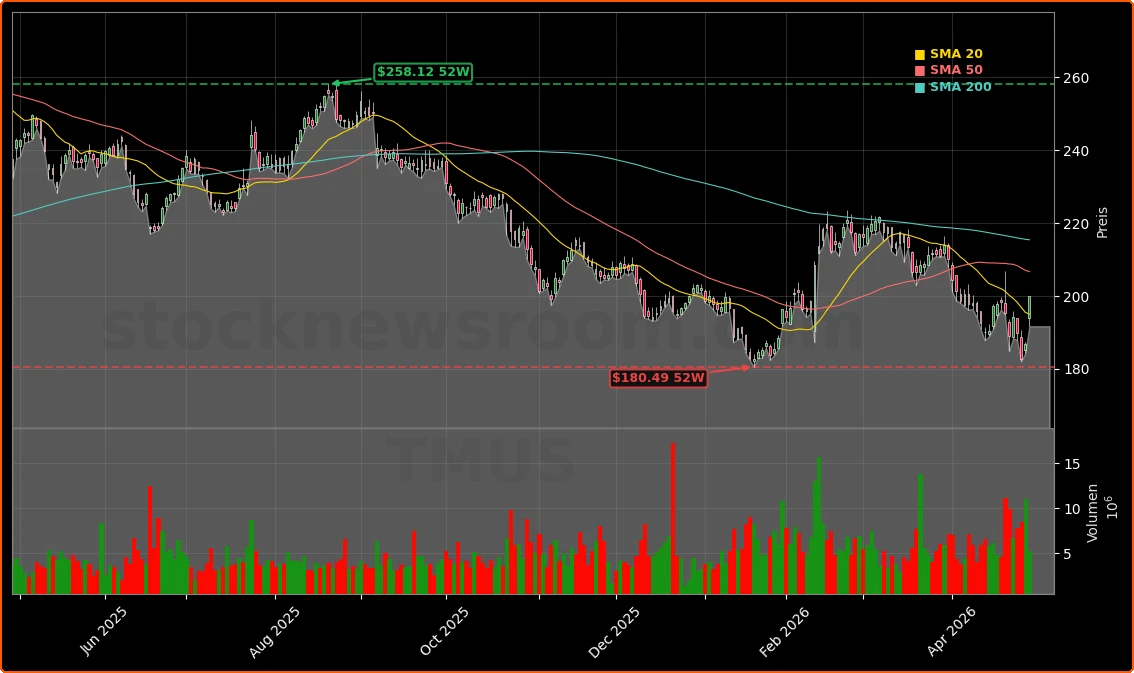
On Wednesday, TMUS shares were recently quoted around $199.80, up about 7.01% from the prior close of $190.45 in U.S. intraday trading. Even after the move, the stock remains well below its 52‑week high near $258, leaving room before any retest of prior peaks. With a market capitalization around $200 billion, T-Mobile now trades at roughly 17x forward earnings and about 10x EV/EBITDA, a premium multiple that reflects its stronger growth profile relative to traditional telecom names as well as its prominence in the NASDAQ and broader U.S. equity benchmarks.
For portfolio managers, the question is whether T-Mobile sits closer to other growth‑tilted mega‑caps like NVIDIA and Tesla in terms of risk‑reward, or whether it is gradually morphing into a more defensive cash‑compounder. The elevated free cash flow yield, enhanced buyback program and rising dividends argue for the latter, while management’s bets on AI‑driven pricing, network innovation and fiber expansion keep an element of growth optionality alive. The potential long‑term restructuring of ownership with Deutsche Telekom, which holds just over half of the shares and is exploring a deeper combination under a new holding structure, could add another strategic catalyst, though discussions remain at an early stage and would likely require political support in Europe.
Q1 marked a strong start to the year as we continue to execute against our ambitious 2026 and 2027 targets, representing yet another proof point of our winning formula and unique differentiation.— Srini Gopalan, CEO of T-Mobile US
Overall, the latest T-Mobile US Earnings underline a company executing well on both growth and capital‑return fronts. For U.S. investors, the stock offers a blend of above‑average cash generation, continued 5G and broadband expansion, and emerging AI upside, set against the backdrop of a mature and sometimes cut‑throat wireless market. The next quarters will show whether T-Mobile can maintain ARPA growth, hit its upgraded guidance and turn today’s analyst debate into a sustained rerating on Wall Street.